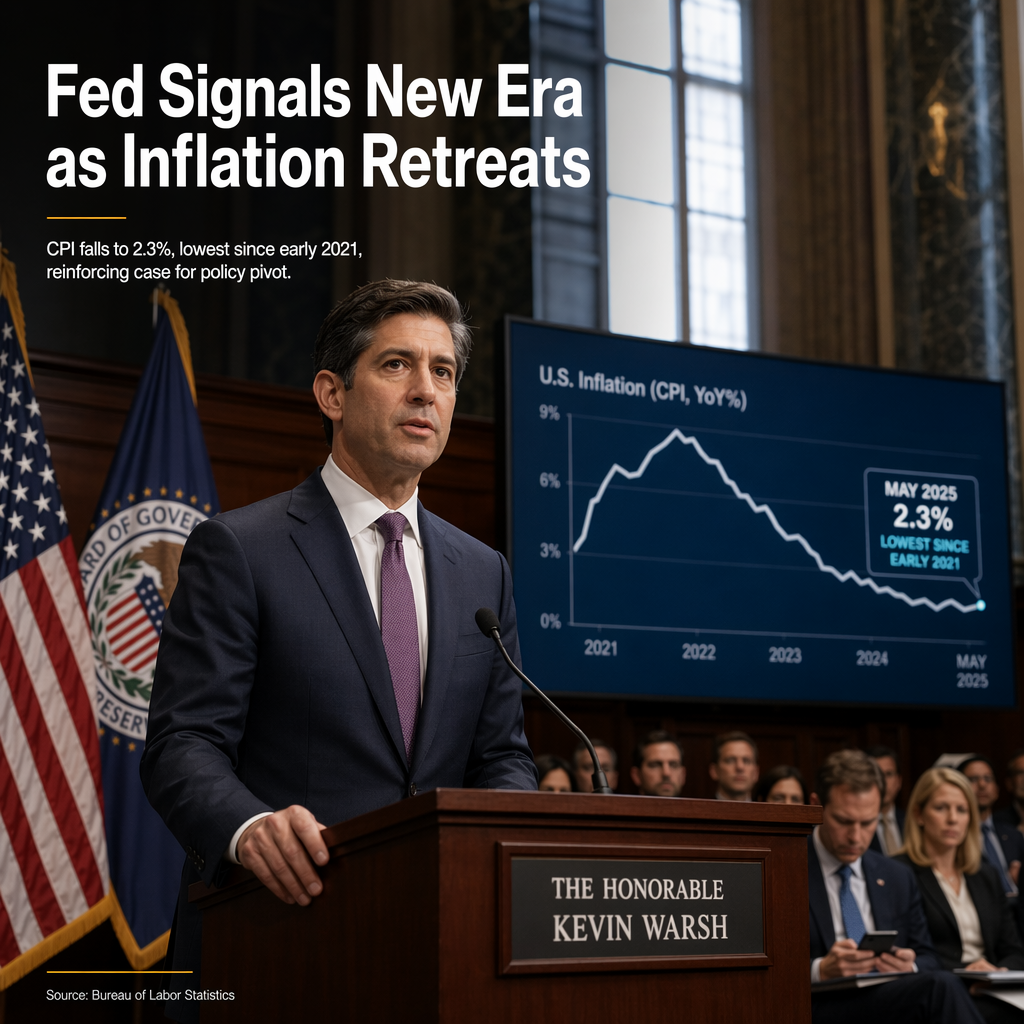
Federal Reserve Chairman Kevin Warsh delivered his first Congressional monetary report, coinciding with a notable decline in the consumer price index (CPI), which fell for the first time in six years, effectively removing the prospect of a near-term Fed rate hike from market expectations [1]. Warsh emphasized that while it is premature to declare 'mission accomplished,' he is committed to defeating inflation and restoring price stability, referencing the 63 months of inflation above target as an 'unfair burden' and a 'tax on the American people and businesses.' He indicated that the Fed is prepared to consider a 'regime change' in policy and has established several high-level task forces to report on potential reforms later in the year [1].
The CPI's topline number for all items was lower in May than in April, and in June it fell by 0.4%. The topline also dropped by 1.1% in June, with services prices remaining flat and new and used car prices declining. The 12-month change in core inflation, excluding food and energy, was reported at 2.6%, with monthly numbers trending downward. Energy and gasoline prices were significant drivers of the index's decline, while goods prices, excluding food and energy, have been nearly flat for a year, suggesting that anticipated tariff-driven inflation did not materialize in a sustained way [1].
Market reaction was swift, with futures markets removing at least one Fed rate hike from the table following the benign CPI report. While there remains some expectation of a rate hike later in the autumn, the likelihood appears diminished. Warsh conveyed optimism about the broader economy, highlighting robust business investment and suggesting that strong economic growth can coexist with low inflation. He reiterated that achieving credible progress toward the 2% inflation target would naturally lead to lower and more stable interest rates [1].
CONCLUSION
Federal Reserve Chairman Kevin Warsh's testimony and the unexpected drop in CPI have shifted market expectations, with a near-term rate hike now seen as unlikely. Warsh's commitment to policy reform and inflation control, alongside positive economic signals, has reassured markets and suggests a more stable monetary outlook ahead.