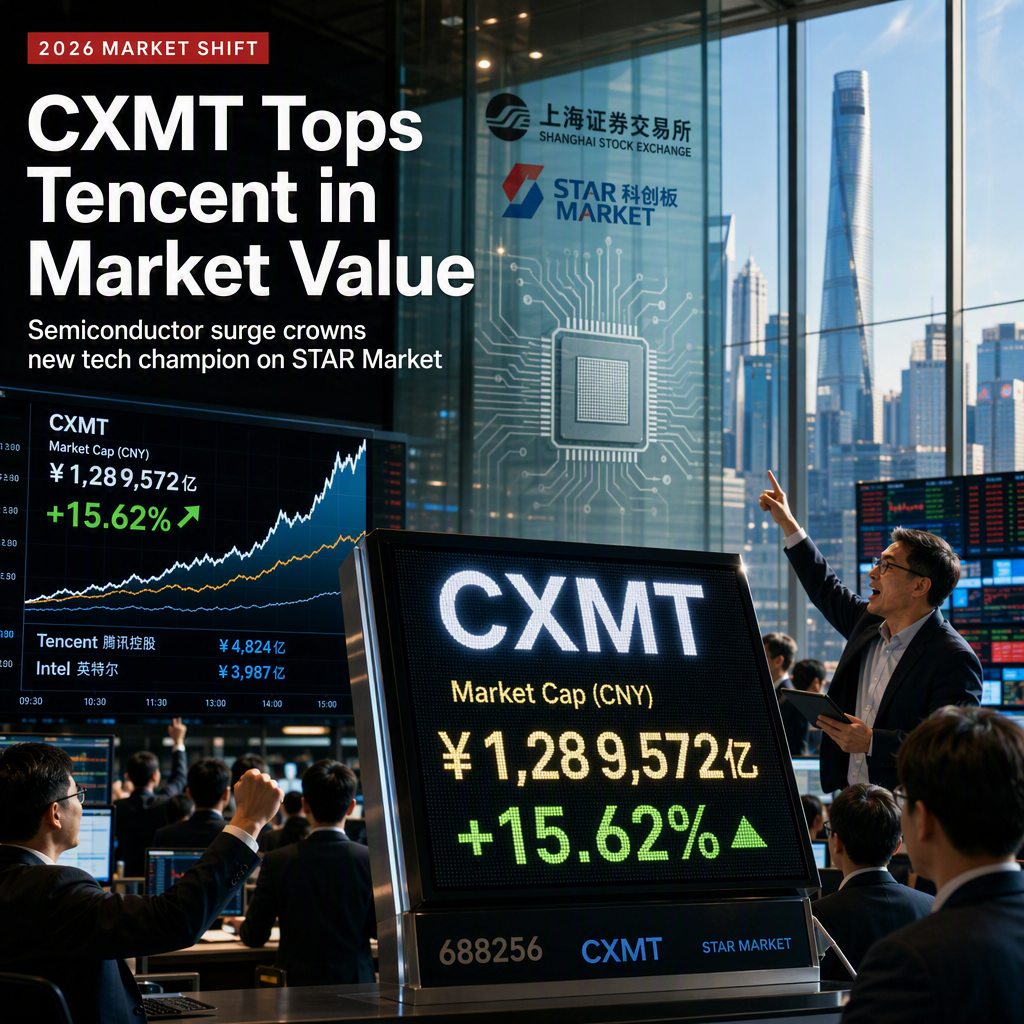
Chinese memory chipmaker CXMT has overtaken Tencent Holdings in market capitalization, becoming the most valuable company listed on the mainland or in Hong Kong as of Thursday, August 13, 2026 [1]. CXMT went public in July, and its IPO saw shares surge by 465% on debut, surpassing even Intel's market cap and elevating the STAR Market—China's equivalent of Nasdaq—to new prominence [1]. This dramatic rise is attributed to a global 'memory crunch,' with major PC manufacturers such as HP, Asus, and Acer beginning to use CXMT chips to address ongoing memory shortages [1].
Investor sentiment toward large gaming and advertising groups like Tencent has been negatively impacted by concerns over AI capital expenditures, prompting a shift in market focus toward semiconductor and technology manufacturing sectors [1]. CXMT's valuation surge is seen as a significant milestone for China's chip industry, with strong trading activity reflecting robust market sentiment toward domestic technology manufacturers [1]. Technical analysis indicates that CXMT's stock price has established new support levels above its IPO price, with resistance near its post-listing high, and institutional buying from China's 'national team' has further supported the momentum [1].
The listing has also fueled local government investments in technology, particularly in cities like Hefei, and has triggered policy interest across Asia [1]. Market participants are advised to closely monitor CXMT's financial results and expansion plans, as continued supply constraints and government backing could drive further gains [1]. The STAR Market's performance is expected to be influenced by CXMT's trading volume and price movements, with broader implications for equity trends in China [1].
CONCLUSION
CXMT's rapid ascent to the top of China's market capitalization rankings highlights a significant shift in investor focus toward domestic semiconductor manufacturing amid global memory shortages. The company's performance is expected to have a lasting impact on the STAR Market and broader Chinese equities, with continued government support and supply constraints likely to drive further market activity.