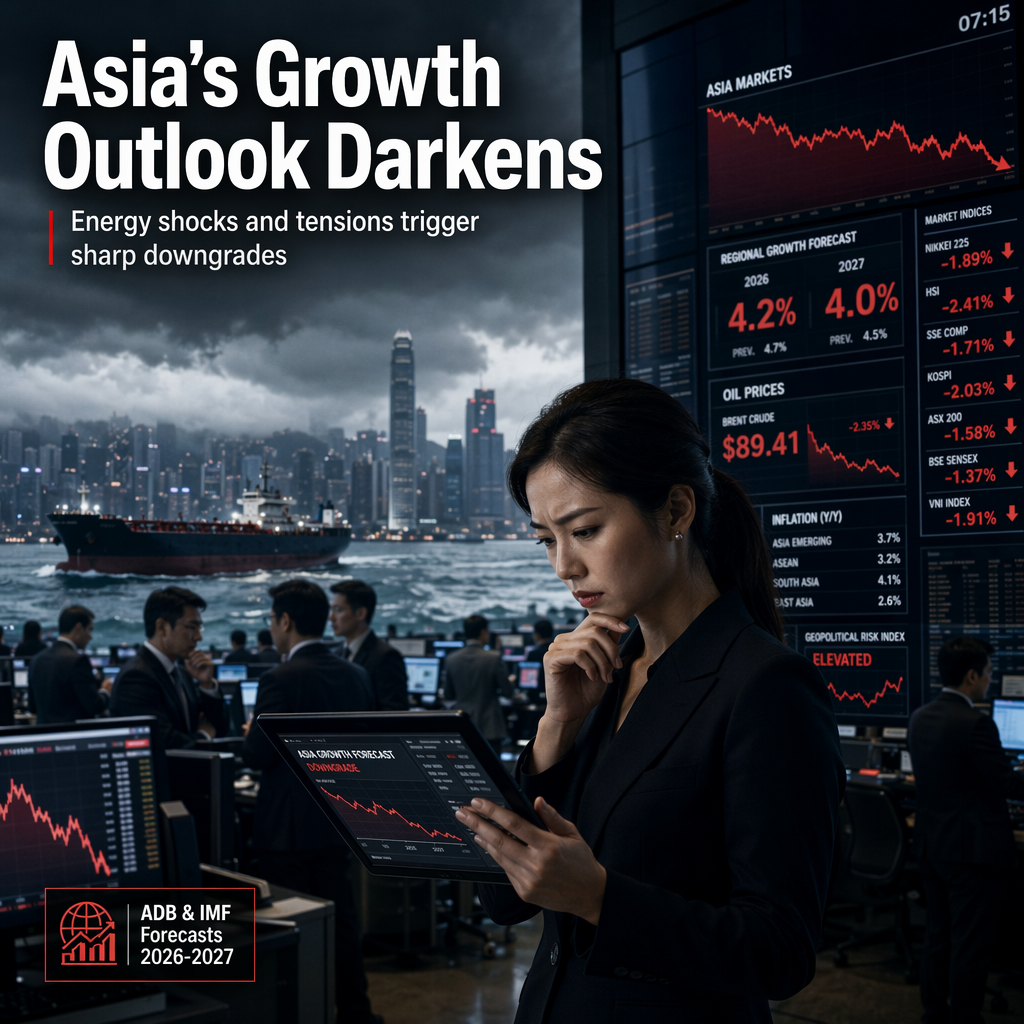
The Asian Development Bank (ADB) has revised its 2026 growth forecast for developing Asia and the Pacific downward to 4.9%, compared to its earlier projection of 5.1% in April, citing the prolonged impact of the Middle East conflict on energy markets and supply chains. The ADB maintained its 2027 forecast at 5.1% but warned that elevated energy prices and persistent supply chain challenges are slowing growth across the region, with the Philippines particularly affected by higher fuel costs, rising inflation, and restrained consumer and business activity. The ADB noted that while some economies show resilience, downside risks remain high due to potential further escalation in the Middle East and commodity market volatility. The bank emphasized the need for policy support and prudent macroeconomic management to sustain recovery momentum, and suggested that the Philippine central bank may consider further interest rate hikes to contain inflation. The energy shock is also causing Southeast Asians to reduce spending, slowing economic recovery. However, the ADB expects regional growth to recover to 5.1% in 2027, assuming stabilization in energy markets and improved geopolitical conditions [1].
In a related development, the International Monetary Fund (IMF) has sharply downgraded its economic outlook for Cambodia, forecasting growth to slow to 3%, a significant reduction from previous projections. Inflation in Cambodia is expected to double to 5.6%, driven by rising energy prices, ongoing Thai border conflict, and the impact of the cyber scam industry. The IMF highlighted that the textile and garment sector is particularly vulnerable to these headwinds, and warned that without decisive policy action, these factors will continue to suppress growth and fuel inflationary pressures. The IMF report also points to disruptions in tourism, manufacturing, and services, suggesting that businesses and households in Cambodia should prepare for tighter conditions and increased costs in the coming months [2].
Both the ADB and IMF reports underscore the significant challenges facing Asian economies due to external shocks, particularly energy price volatility and regional geopolitical tensions. While the ADB maintains a cautiously optimistic outlook for 2027, both institutions stress the importance of policy intervention to mitigate downside risks and support economic recovery [1][2].
CONCLUSION
The latest forecasts from the ADB and IMF highlight the substantial impact of energy shocks and regional tensions on Asian economies, with notable downgrades for both developing Asia and Cambodia. Policymakers are urged to take decisive action to address inflation and support growth, as the region faces elevated risks and uncertain recovery prospects.