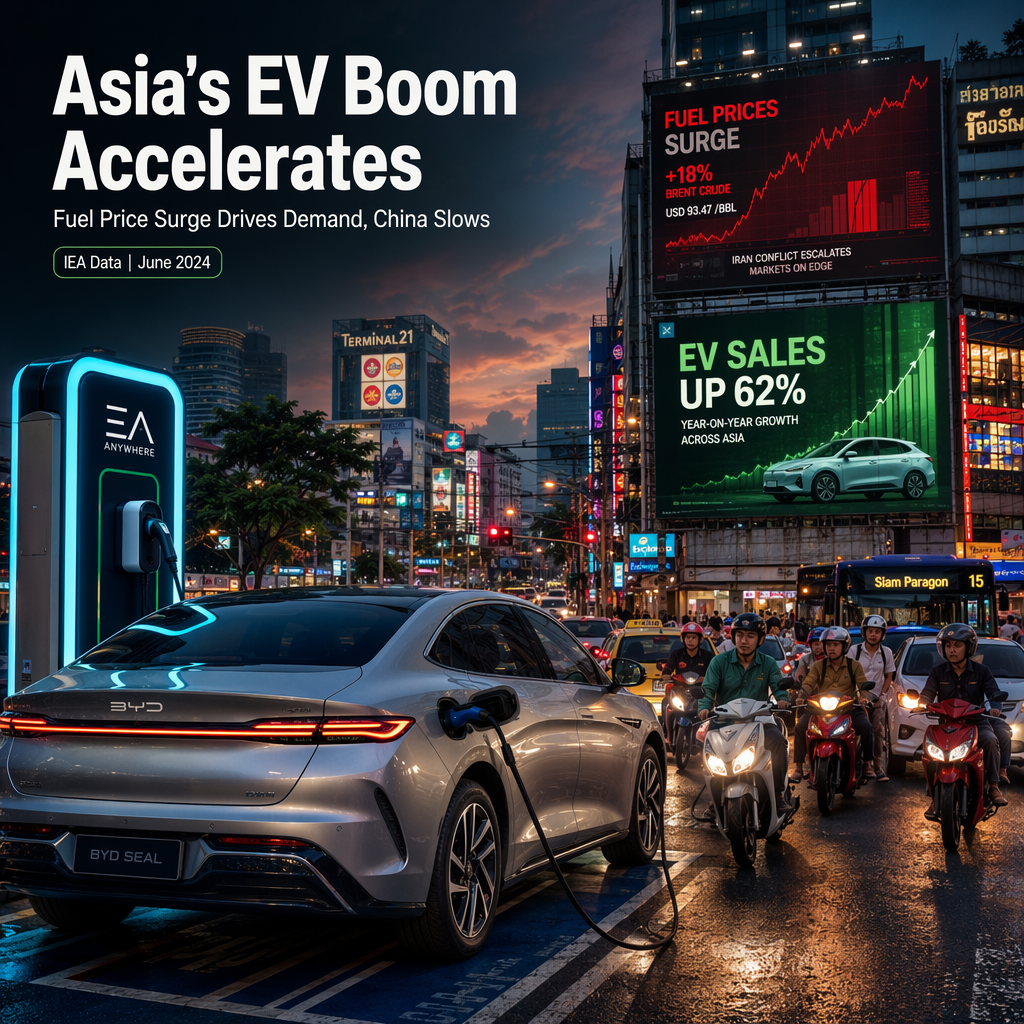
Electric vehicle (EV) sales across most of Asia have experienced a significant boost following the U.S.-Iran war, which led to higher fuel prices, according to the International Energy Agency (IEA) [1]. Southeast Asia saw a 62% year-on-year increase in EV sales between March and June, with Thailand, Vietnam, and Indonesia leading the surge [1]. Additionally, EV sales have doubled in Australia, India, South Korea, and Vietnam since the onset of the conflict [1]. Market analysis attributes this rapid growth to elevated fuel prices resulting from geopolitical tensions, which have accelerated the shift toward electric vehicles in the region [1].
Despite robust growth in most Asian markets, China—the world's largest EV market—has experienced a notable slowdown. The contraction in Chinese EV sales is directly linked to Beijing's decision to roll back subsidies, with IEA data showing a decline in sales during the second quarter compared to previous periods [1]. Technical indicators reveal that Chinese EV sales have dropped below key support levels seen in previous years, signaling strong resistance in the market [1]. In contrast, Southeast Asian markets are displaying upward momentum, with sales growth and price levels breaking above recent highs [1].
Analysts emphasize that the sustainability of EV demand in Asia will depend on continued government incentives and stable fuel prices [1]. Trading advice suggests closely monitoring the impact of ongoing geopolitical tensions on oil prices, as further increases could trigger another wave of EV adoption across the region [1]. Overall, market sentiment remains bullish for EVs in Asia outside China, while traders are cautious about the Chinese market until there is greater policy clarity regarding incentives and subsidies [1].
CONCLUSION
The U.S.-Iran war has driven a surge in electric vehicle sales across Asia, especially in Southeast Asia, as higher fuel prices encourage consumers to switch to EVs. However, China's market has slowed due to the removal of government subsidies, dampening overall regional growth. Market sentiment is positive for Asian EV markets outside China, but future demand will depend on government policies and fuel price stability.