
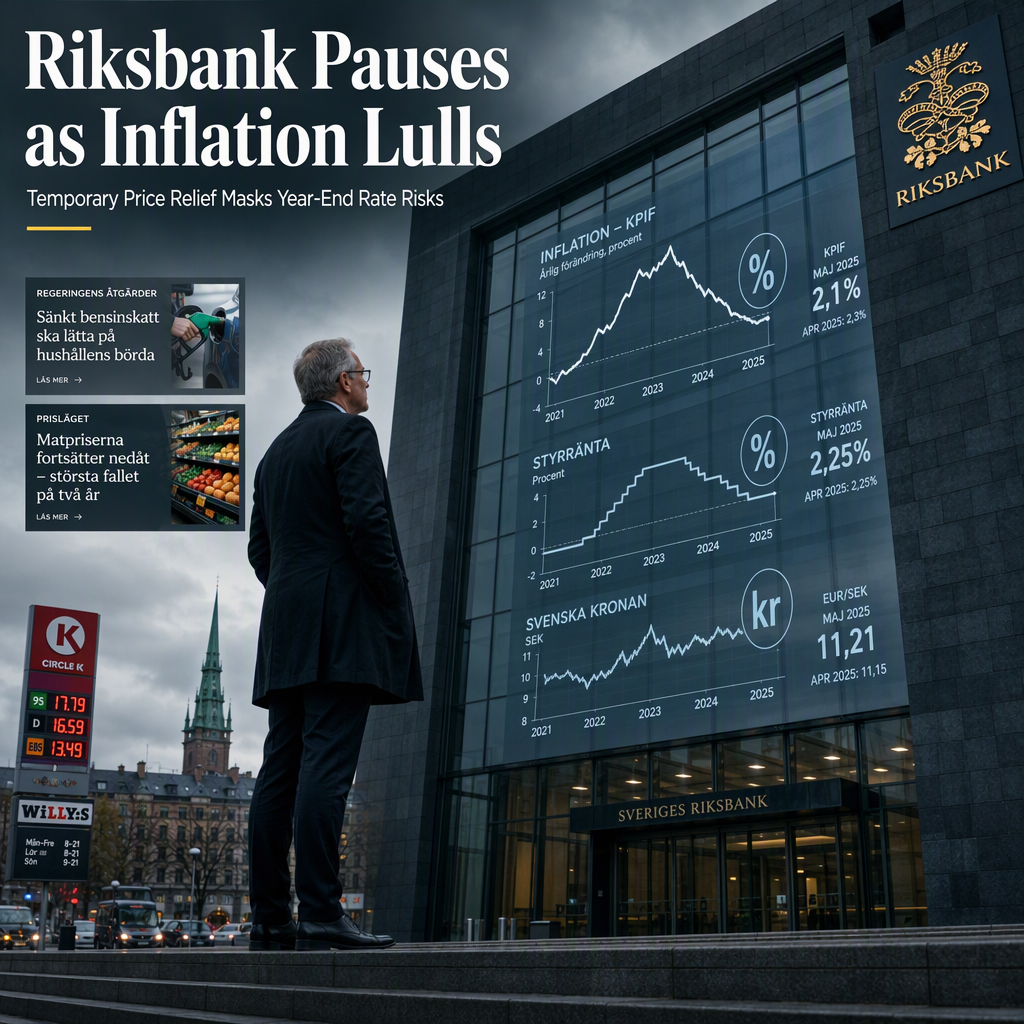
Commerzbank analysts Michael Pfister and Norman Liebke report that the Swedish Riksbank has kept its key interest rate unchanged at 1.75%, with no hawkish statements issued following its latest meeting [1]. The Swedish government has implemented several temporary measures since the start of the conflict in Ukraine, including a reduction in value-added tax on food from 12% to 6% in April, which businesses have largely passed on to consumers, and successive reductions in gasoline and diesel prices at gas stations—1 and 0.4 kronor per litre in May, followed by an additional 3 kronor per litre in July [1]. These interventions have led to extremely low inflation in Sweden, with the rate falling further at times since the onset of the war [1].
Despite the current low inflation, the Riksbank expects prices to begin rising again in the spring and is monitoring counterfactual inflation, which is estimated to be around 2% without the temporary measures [1]. Commerzbank analysts see good reasons for a rate increase at the end of the year to counter potential price risks [1]. However, they question the market's pricing of nearly 120 basis points of rate hikes over the next 12 months, suggesting that the krona's reaction to these expectations has been complicated and that the realism of such aggressive hikes will only become clear over time [1].
Unlike Norges Bank, which has issued hawkish statements, the Riksbank remains cautious, with its policy stance influenced by the temporary government measures that have masked underlying inflationary pressures [1]. The forward-looking view from Commerzbank is that while a year-end rate hike is likely, the scale of tightening anticipated by markets may be overstated [1].
CONCLUSION
The Riksbank is maintaining its current rate policy due to temporarily suppressed inflation, with a potential hike expected at year-end as government measures expire. Analysts caution that market expectations for aggressive tightening may be unrealistic, and the krona's response remains uncertain. Investors should monitor inflation developments and central bank signals closely.