
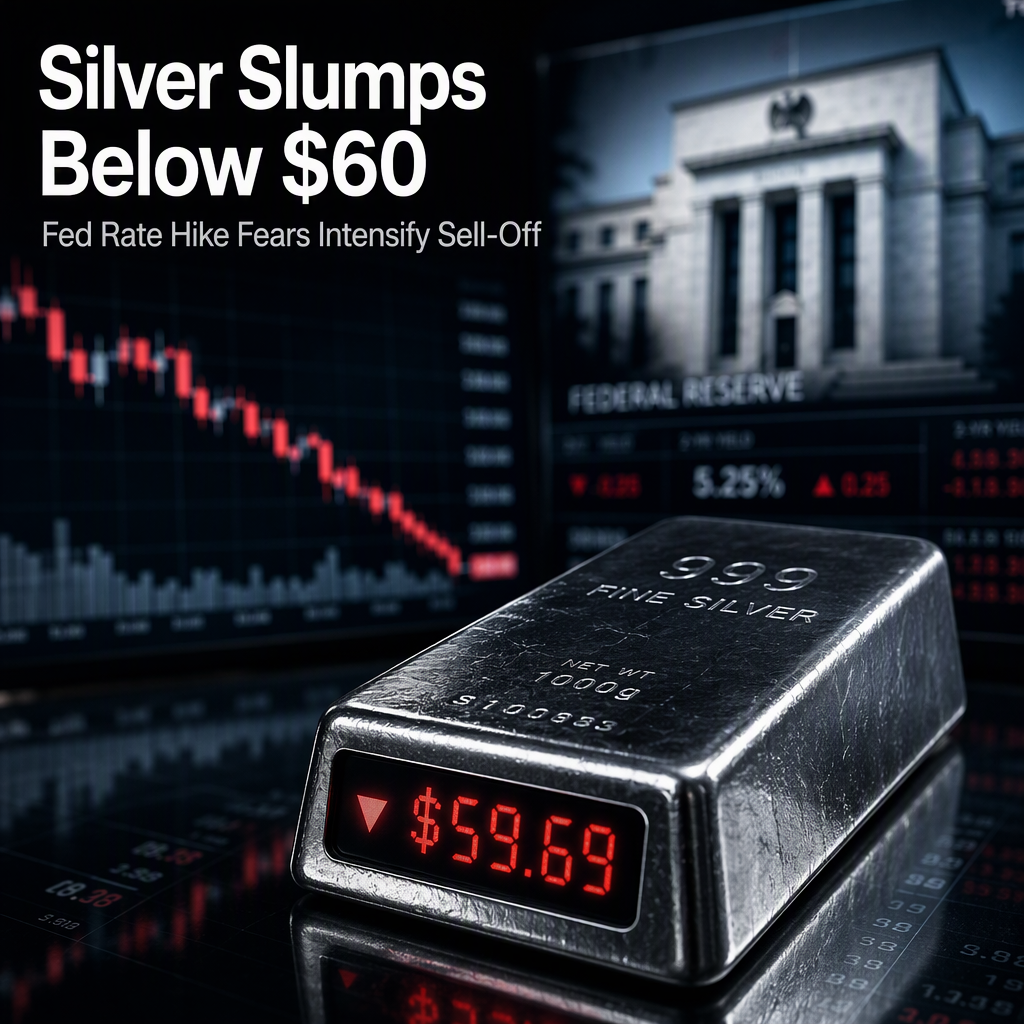
Silver (XAG/USD) extended its losses on Wednesday, falling below the $60 mark to trade at $59.69, representing a decline of over 1.67% [1]. This drop followed the release of the latest Federal Reserve Minutes, which indicated that officials expect another rate increase towards the end of the year [1]. The bearish momentum in silver is accelerating, as evidenced by the Relative Strength Index (RSI) moving toward oversold territory, and the price remains below key technical levels: the 50-, 100-, and 200-day Simple Moving Averages at $64.22, $64.28, and $72.78, respectively [1]. The market structure continues to show lower highs and lower lows, reinforcing the downward bias [1].
Technical analysis suggests that the path of least resistance for silver is further downside, with bears targeting the August 3 low of $56.57 and the year-to-date low of $54.77. If these levels are breached, silver could potentially reach $50.00 [1]. For a bullish reversal, the first resistance is at the October 2 daily and monthly peak of $62.09, followed by the confluence of the 50- and 100-day SMAs at $64.22-$64.28, and then $65.00 ahead of the $70.00 psychological level [1].
The article notes that silver prices are influenced by a variety of factors, including geopolitical instability, recession fears, US Dollar strength, investment demand, mining supply, and industrial demand, particularly from sectors such as electronics and solar energy [1]. However, the immediate market reaction is driven by expectations of higher interest rates, which tend to weigh on yieldless assets like silver [1].
No forward-looking statements or analyst opinions beyond the technical outlook and Fed expectations are provided in the article [1].
CONCLUSION
Silver's price decline below $60 is primarily attributed to expectations of further Federal Reserve rate hikes, which have intensified bearish momentum and pushed the metal toward key support levels. The technical outlook suggests continued downside risk unless resistance levels are reclaimed. Market participants should monitor Fed policy and technical thresholds for signs of reversal or further weakness.