
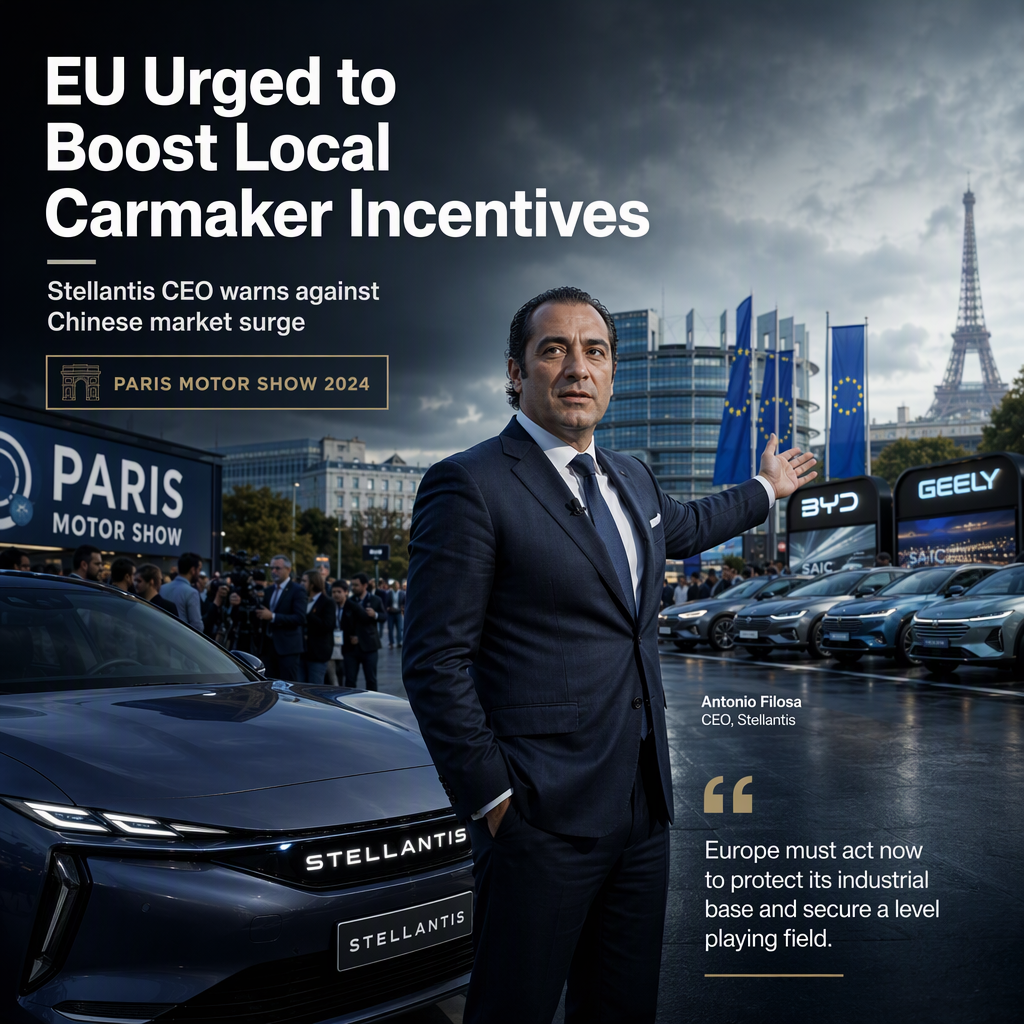
Stellantis CEO Antonio Filosa has urged European regulators to introduce stronger incentives for carmakers who manufacture vehicles within the region, citing intensifying competition from Chinese automotive companies that are rapidly increasing their market share in Europe [1]. Filosa made these remarks ahead of the Paris Motor Show, highlighting the need for a 'level playing field' and supporting proposed EU legislation that would require carmakers to meet minimum local content requirements to sell within the European market [1].
Stellantis, known for brands such as Jeep and Ram, is currently implementing a $70 billion turnaround strategy amid declining sales and has seen its shares fall nearly 60% since the beginning of the year [1]. Despite these challenges, Stellantis shares rose 2.7% in early trading on Monday following news that the EU and China reached an agreement to cut the number of hybrid cars China exports to the bloc [1]. Other European automotive stocks also reacted positively, with Renault up around 3%, and French automotive parts suppliers Valeo and Forvia rising in early trading [1].
According to market research from GlobalData, Chinese car brands have increased their global auto-sales share by nearly 70% from 2020 to 2025, while their share of European car sales rose from nearly zero in 2020 to 12% as of August this year, based on data from Germany-based Dataforce [1]. European trade commissioner Maroš Sefčovič announced that China has agreed to halve its exports of hybrid cars to the EU, a move that was previously resisted by Beijing [1].
Filosa acknowledged the strengths of Chinese automakers, stating, 'I believe that Chinese automakers, the ones that we know, can really offer many consumers in many segments, good technology, and competitive prices' [1]. The Stellantis CEO emphasized the importance of regulatory measures that incentivize and protect manufacturers who design and engineer cars in Europe [1].
CONCLUSION
The Stellantis CEO's call for EU incentives comes as Chinese carmakers rapidly expand their presence in Europe, prompting regulatory action and positive market reactions among European automotive stocks. The agreement to halve Chinese hybrid car exports to the EU has provided a short-term boost, but ongoing competition and regulatory developments remain key factors for the sector.