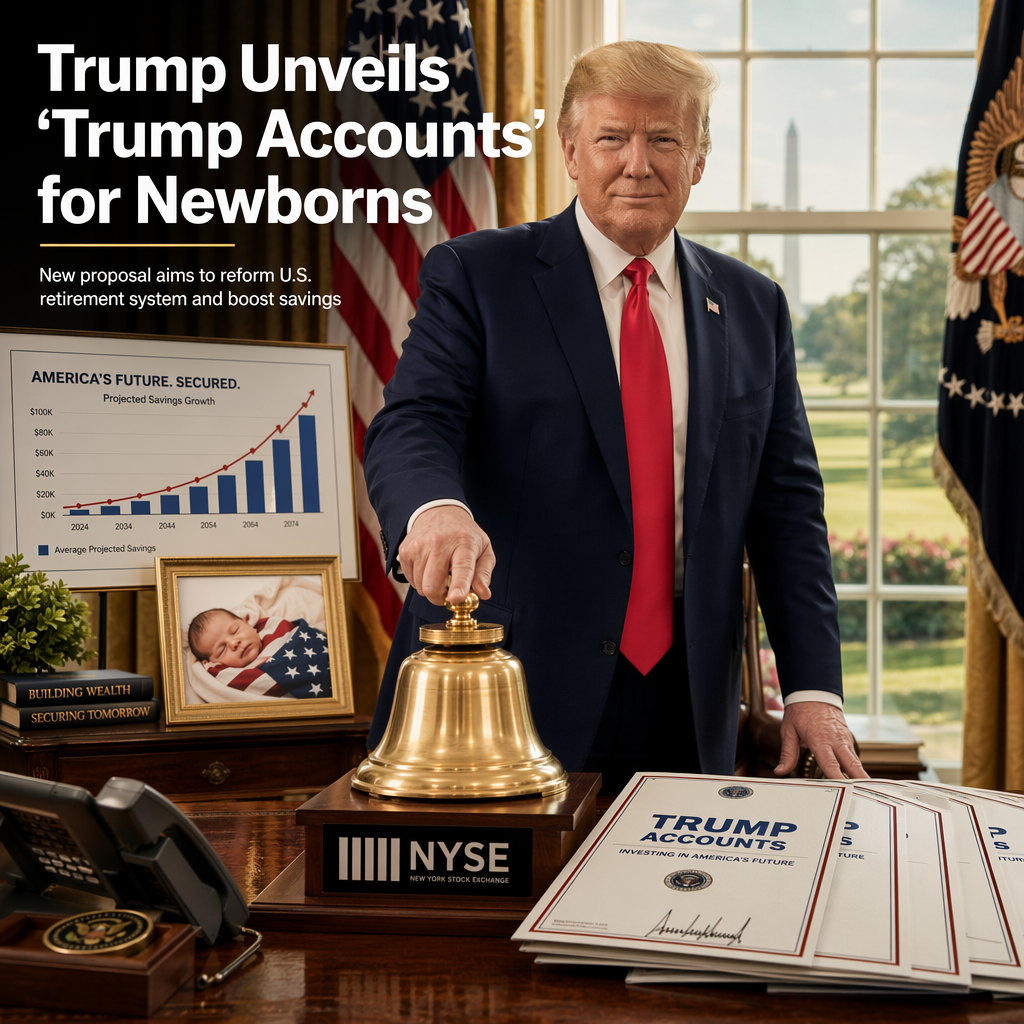
President Donald Trump has announced a new initiative to address what is described as a broken American retirement system by launching tax-deferred 'Trump Accounts' for newborns, an event marked by Trump ringing the NYSE and NASDAQ opening bells from the Oval Office [1]. Fox Business host Charles Payne has publicly supported the initiative, stating that it encourages entrepreneurial spirit and expands stock market participation among Americans [1].
The proposal comes in response to the current challenges facing the U.S. retirement landscape, where traditional pensions are nearly extinct, the average savings rate is just 2.6%, and many workers—especially freelancers and gig economy participants—lack access to employer-sponsored retirement plans like 401(k)s [1]. The article notes that too many Americans have little or no retirement savings, highlighting the urgency for reform [1].
Trump's plan draws inspiration from Australia's 'Super' system, which mandates employer contributions to portable, employee-owned retirement accounts that follow workers from job to job, resulting in one of the world's largest retirement savings pools relative to population size and a steady flow of capital into markets [1]. However, Trump has emphasized that he does not intend to copy Australia directly, but rather to adapt successful elements to create a 'sharper' American version [1].
If enacted, the initiative could represent the most significant shift in U.S. retirement policy since the introduction of Social Security in 1935 [1]. The article suggests that the American version would likely maintain Social Security as a foundation, introduce portable retirement accounts owned by workers, and require or strongly encourage automatic contributions [1].
CONCLUSION
President Trump's proposal for tax-deferred 'Trump Accounts' aims to address the shortcomings of the current U.S. retirement system by increasing investment account ownership and encouraging long-term savings. If implemented, this initiative could significantly reshape retirement policy and broaden market participation among Americans.