
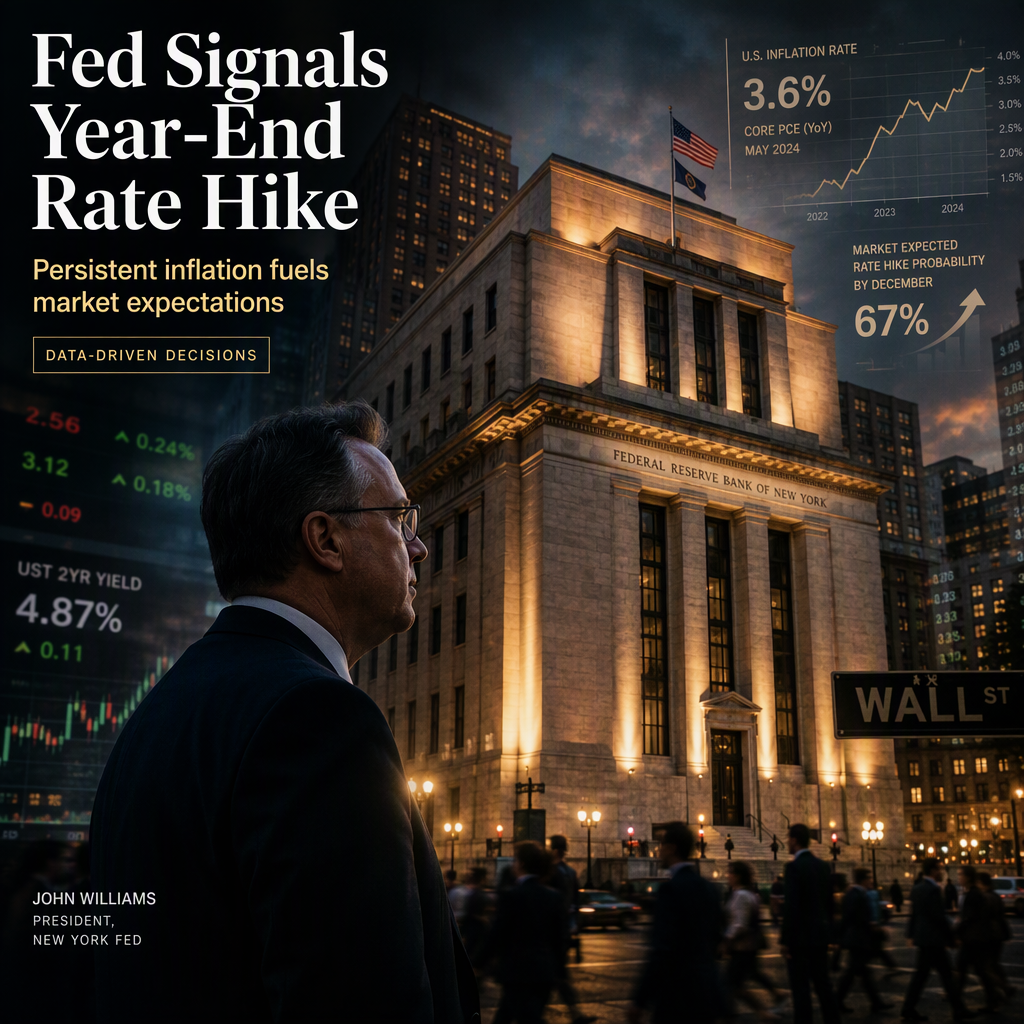
New York Federal Reserve President John Williams stated that it would be 'reasonable' to expect another interest rate hike by the end of the year, reflecting current investor sentiment that anticipates further tightening of monetary policy. Williams emphasized that the Federal Reserve will rely on incoming economic data to guide future decisions, moving away from explicit forward guidance, a stance echoed by Fed Chairman Kevin Warsh, who confirmed the central bank will not directly signal its intentions for upcoming meetings [1].
The Federal Reserve recently raised its benchmark interest rate by a quarter percentage point, setting the overnight funds rate at a target range of 3.75%-4% [1]. Following this decision, market expectations for another rate hike have increased, with the CME Group’s FedWatch tool indicating a 77.5% probability of an October rate increase, up from around 53% the previous day [1].
Recent economic data points to continued strength in the U.S. economy, while inflation remains above 3%. Boston Federal Reserve President Susan Collinson warned of an 'increased likelihood' that inflation will stay 'notably' above the Fed’s 2% target [1]. Additionally, Fed Governor Michael Barr stated that 'further policy adjustments are likely to be needed to ensure inflation comes down to target in a timely fashion' [1].
The combination of persistent inflation and strong economic data has fueled expectations for further tightening, with multiple Fed officials signaling that additional rate hikes may be necessary to achieve the central bank’s inflation goals [1].
CONCLUSION
The Federal Reserve is signaling a data-dependent approach but acknowledges that another rate hike by year-end is likely, given persistent inflation and robust economic data. Market expectations for further tightening have increased sharply, suggesting significant implications for financial markets and borrowing costs.