
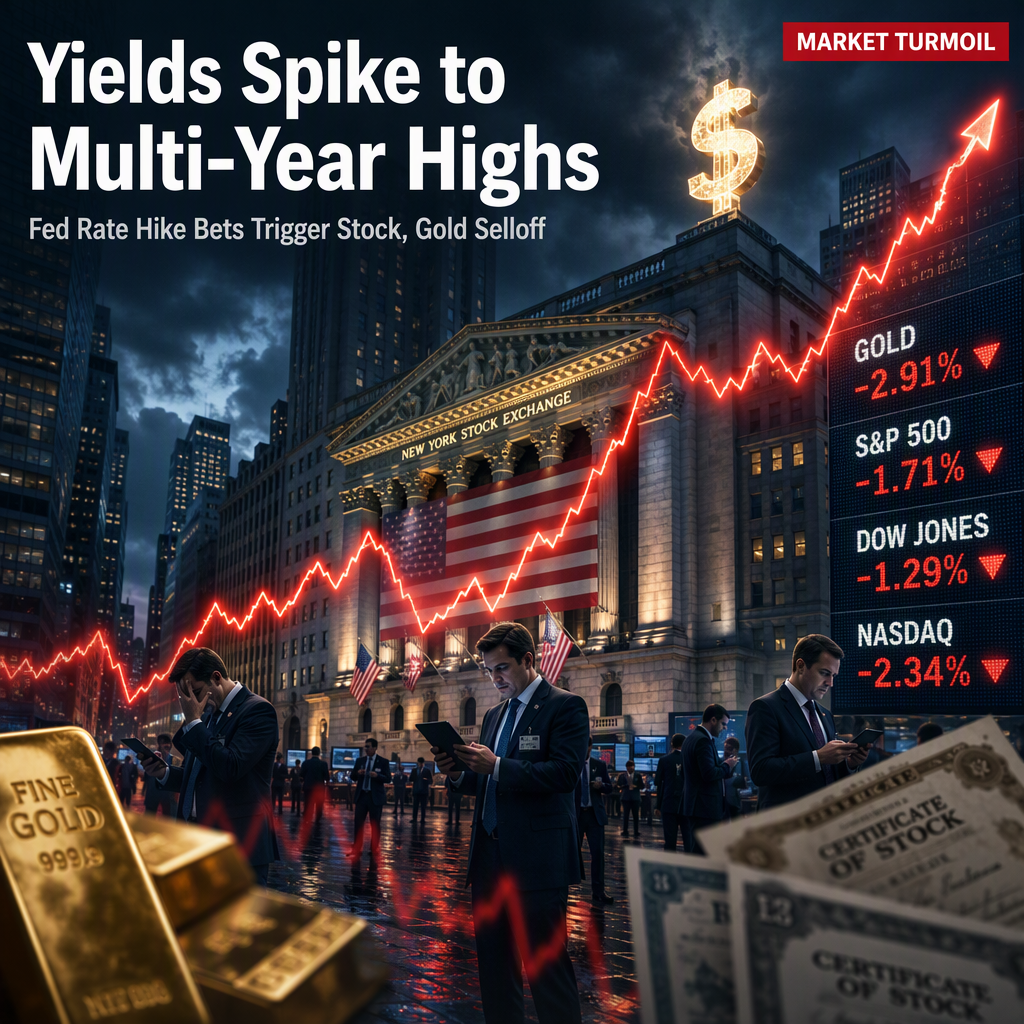
US Treasury yields surged to multi-year highs on Wednesday and Thursday, driven by rising expectations of further monetary tightening by the Federal Reserve (Fed) following robust US S&P Global Purchasing Managers’ Index (PMI) data and a weak US Treasury bond auction [1][2][3]. The benchmark 10-year US Treasury yield jumped 15.2 basis points to 5.15%, its highest level since 2007, while the 30-year yield reached 5.444%, marking a 22-year peak. The 2-year yield also rallied to 4.494%, a two-year high [1][2]. These elevated yields reflect higher borrowing costs across mortgages, credit cards, and corporate loans, posing a significant strain on economic growth and prompting a risk-off reaction in financial markets [2][3].
The strong PMI data, with the Composite PMI rising to a five-year high of 58.4 in September, signaled resilient economic growth and reinforced expectations that the Fed may raise interest rates again in October. The CME FedWatch Tool placed the probability of a rate increase at around 75%, up from 55% a day earlier, while another source reported a surge to nearly 69%, up from 55.4% [1][3]. Fed officials, including New York Fed President John Williams and Governor Michael Barr, emphasized the need for further rate hikes to bring inflation back to the 2% target, with Williams stating it is “reasonable to see another rate hike by end of the year” [1][2][3].
The market reaction was pronounced: Gold (XAU/USD) slid to a one-week low, trading around $4,260, down nearly 0.65% on the day, as higher yields and a stronger US Dollar (DXY at 101.27, a two-month high) reduced gold's appeal [1]. US stock futures declined, with Dow Jones futures down 0.17%, S&P 500 futures losing 0.34%, and Nasdaq 100 futures dropping 0.5%. The previous trading session saw the Dow Jones Industrial Average fall 0.68%, the S&P 500 drop 0.75%, and the Nasdaq Composite slide 1.13%, with communication services, utilities, and consumer discretionary sectors leading the downturn [3]. Deutsche Bank analysts described it as “a rough day all round,” noting the S&P 500 posted its biggest decline in a month [3].
Additional market-moving factors include elevated oil prices amid ongoing uncertainty surrounding US-Iran diplomatic negotiations. Iranian President Masoud Pezeshkian warned at the UN General Assembly that Iran would restrict navigation through the Strait of Hormuz as long as US sanctions and blockades persist, potentially adding to inflation risks and reinforcing expectations of tighter monetary policy [1][3]. MUFG analysts cautioned that FX markets are vulnerable to a carry unwind, with high-yielding emerging market currencies likely to suffer while safe-haven currencies such as the yen and Swiss franc may outperform [2].
Looking ahead, traders are monitoring further Fed commentary, the weekly US Initial Jobless Claims report, and a meeting between US President Donald Trump and Chinese President Xi Jinping for additional market direction [1][3].
CONCLUSION
The surge in US Treasury yields and heightened Fed rate hike expectations have triggered broad-based declines across gold and US equities, while strengthening the US Dollar. Persistent inflation risks, elevated oil prices, and geopolitical tensions are reinforcing the market's risk-off tone. Investors remain focused on upcoming economic data and Fed signals for further guidance on monetary policy and market direction.