
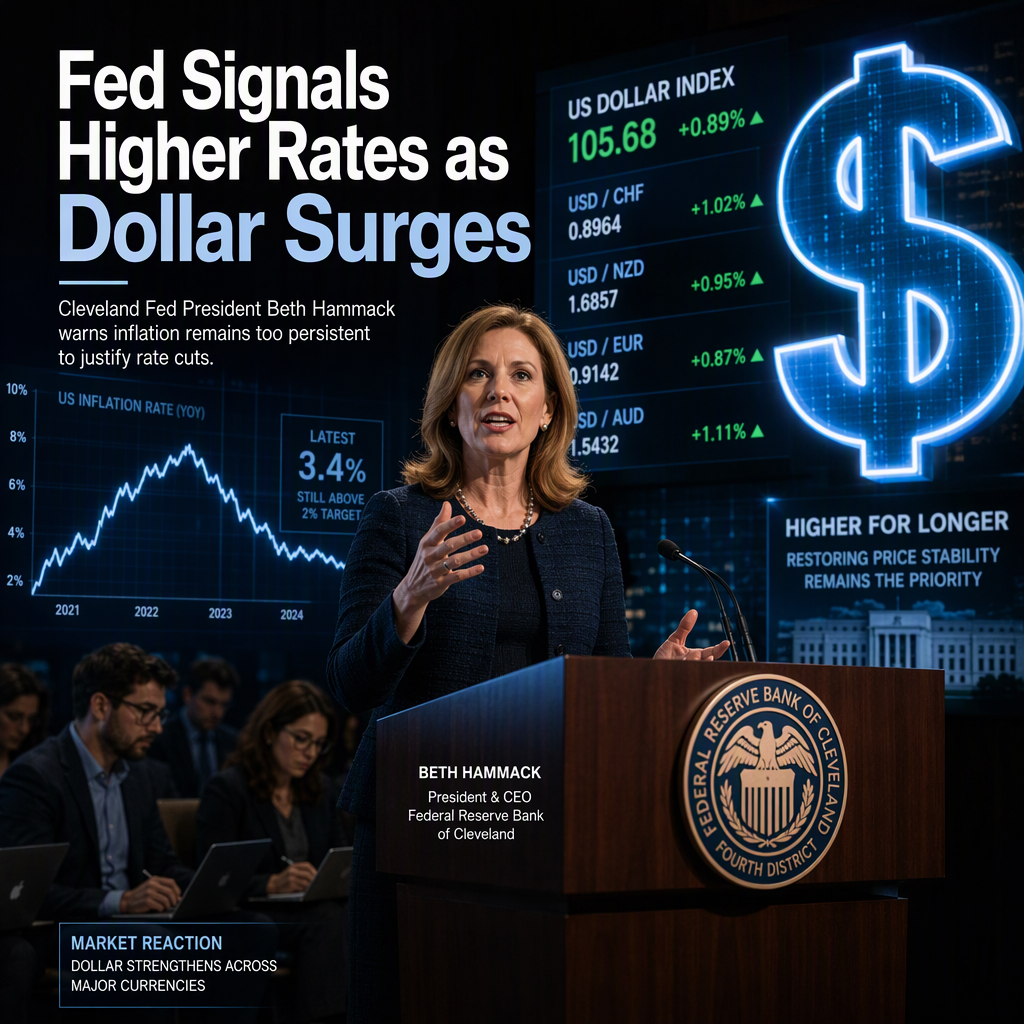
Cleveland Federal Reserve President Beth Hammack stated on Monday that interest rates need to be higher as inflation remains 'too high' and inflationary pressures have broadened across the economy [1]. Hammack emphasized that the Federal Reserve has missed its 2% inflation target for five and a half years and that achieving this goal 'will take some time,' even with appropriate monetary policy [1]. She noted that financial conditions are currently neutral and that more economic tightness is required to address widespread inflation, which is now in the mid-to-high 2% range [1].
Hammack expressed a preference for 'smaller policy rate changes' but advocated for acting relatively quickly, stating that frequent, smaller tweaks lower risks [1]. She warned of the risk of an inflationary mindset becoming ingrained, as firms are planning price hikes beyond input cost rises, and highlighted that demand-side pressures, including those from AI, are not self-correcting [1]. Hammack also pointed out that the steady job market provides scope to tackle inflation without risking employment [1].
On the market side, the US Dollar strengthened against all major currencies, with the most significant gain against the Swiss Franc (+0.54%), followed by the New Zealand Dollar (+0.47%), Euro (+0.37%), and Australian Dollar (+0.37%) [1]. These moves suggest a positive market reaction to Hammack's hawkish stance and the prospect of higher US interest rates [1].
Hammack stressed the importance of the Fed clarifying its reaction function so that businesses and households can plan effectively, and she reiterated the need for a restrictive approach to achieve the 2% inflation target [1].
CONCLUSION
Fed President Hammack’s comments reinforced expectations for higher US interest rates due to persistent and broad-based inflation. The US Dollar responded positively, strengthening against all major currencies. Market participants are likely to anticipate continued monetary tightening in the near term.