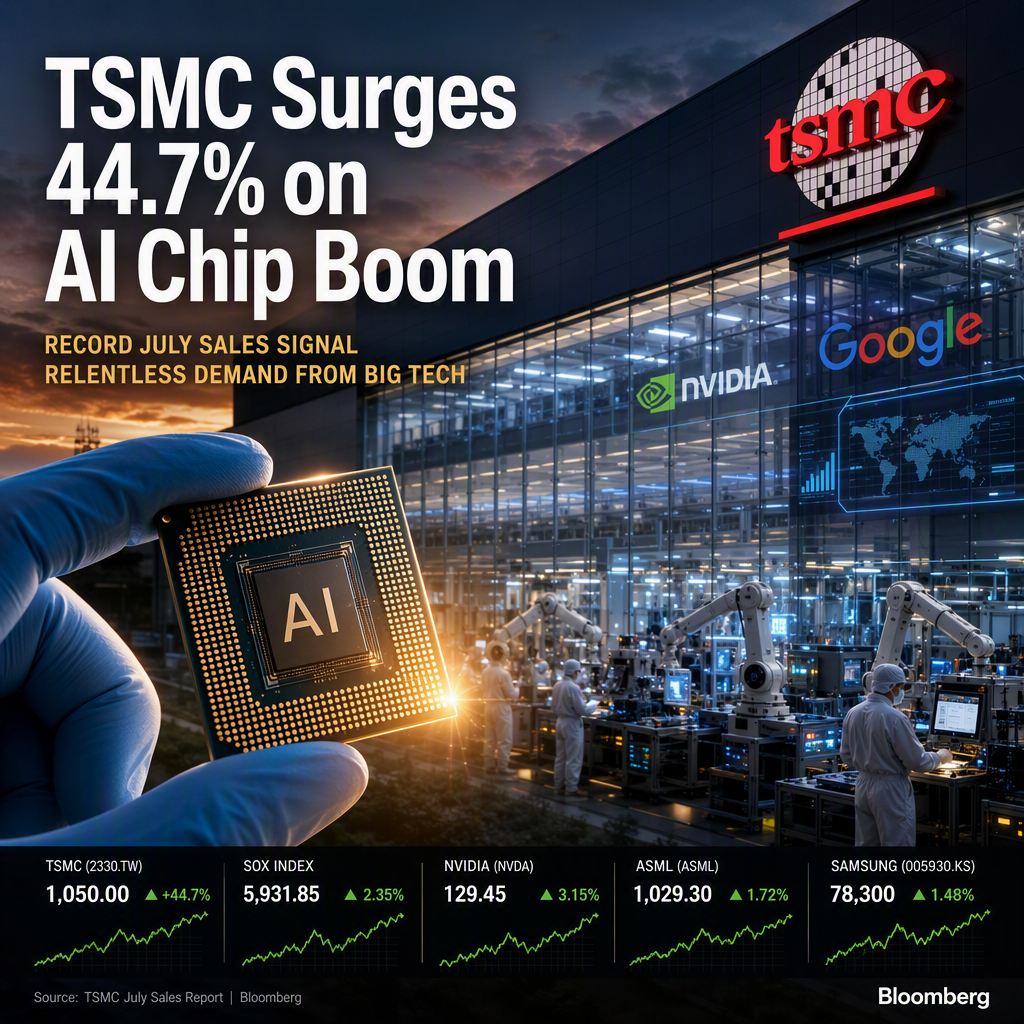
Taiwan Semiconductor Manufacturing Co. (TSMC), the world's largest chipmaker, reported a significant increase in sales for July, driven by robust demand for AI-related chips from major technology companies. TSMC's revenue for July reached 467.58 billion new Taiwan dollars ($14.5 billion), marking a 44.7% year-on-year increase [1]. This surge in sales reflects the ongoing trend of Big Tech companies investing heavily in AI infrastructure, including the design and procurement of advanced semiconductors [1].
TSMC manufactures chips for a diverse range of clients, including Nvidia and Google, making its sales figures a key indicator of broader tech sector demand [1]. The company is now forecasting 40% revenue growth for the year, with July's performance putting it ahead of this target. Ben Barringer, head of technology research at Quilter Cheviot, noted that while the strong July numbers reduce pressure on the upcoming months, semiconductor demand can be volatile and monthly figures should be interpreted with caution [1].
In its recent second-quarter earnings, TSMC reported that high-performance computing, which includes AI chip sales, accounted for 66% of its revenues [1]. The company expressed optimism for the future, projecting 2026 revenue growth slightly above 40% in U.S. dollar terms and raising its capital expenditure guidance to between $60 billion and $64 billion for the year [1]. TSMC Chairman C.C. Wei emphasized that "AI-related demand continues to be extremely robust" [1].
The positive results from TSMC had a ripple effect on European semiconductor stocks, with ASML rising more than 2%, and Infineon and STMicro also trading higher [1]. Despite recent volatility and a 15% decline from its June high, the PHLX Semiconductor index remains up approximately 72% for the year, and TSMC's shares have gained 50% year-to-date [1].
CONCLUSION
TSMC's strong July sales underscore the ongoing strength of AI-driven semiconductor demand, positioning the company ahead of its annual growth targets. The upbeat results have positively influenced global semiconductor stocks, despite recent market volatility. TSMC's continued investment and optimistic outlook suggest sustained momentum in the sector.