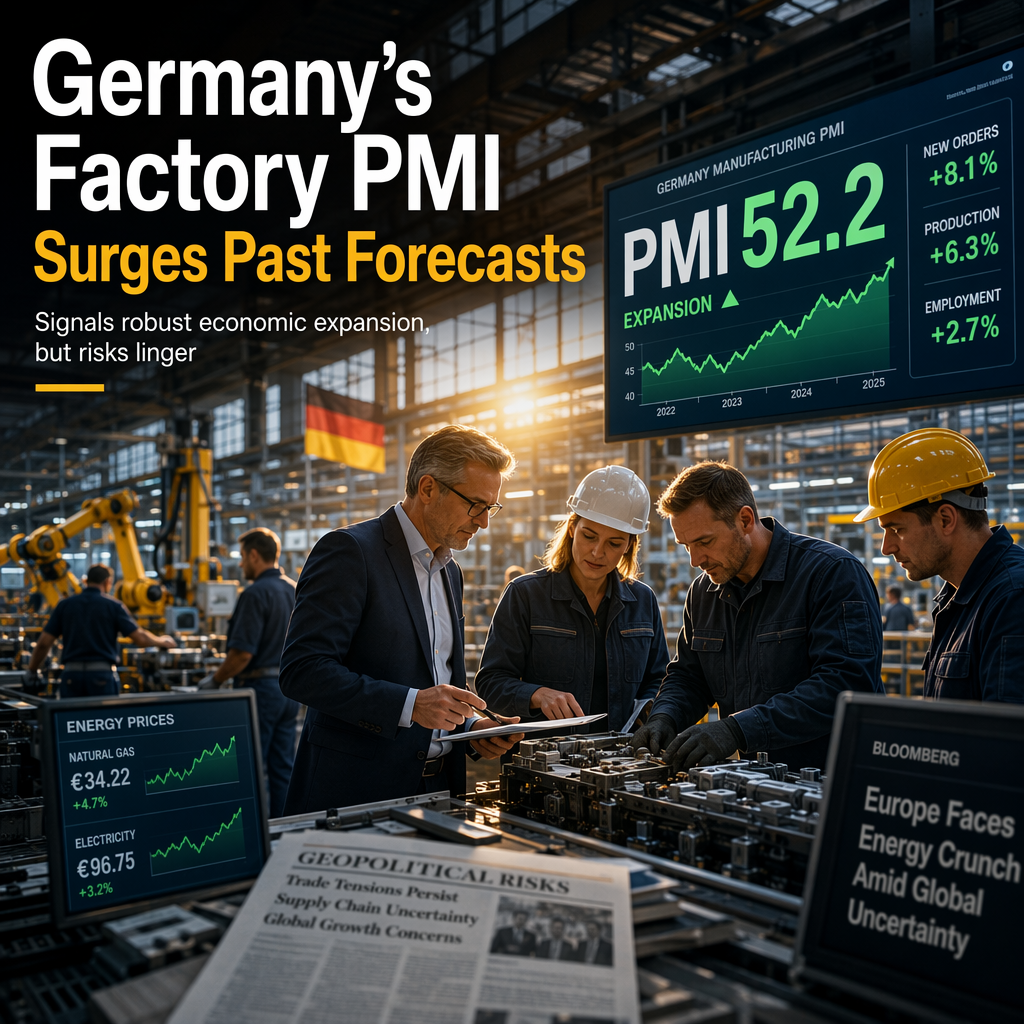
Germany’s flash Manufacturing Purchasing Managers Index (PMI) for July 2026 rose sharply to 52.2, significantly exceeding market estimates of 50.1 and up from 50.3 in June, according to preliminary data released by S&P Global and Hamburg Commercial Bank (HCOB) [1]. This stronger-than-expected increase signals robust expansion in the country’s manufacturing sector, as any reading above 50 indicates growth [1].
The HCOB Composite PMI, which tracks overall business activity, also returned to expansion territory at 51.2 after a period of contraction, rising from 49.8 in June [1]. The improvement in the Composite PMI was largely driven by upbeat factory sector activity, despite the Services PMI continuing to contract, albeit at a slower pace, registering 49.6 compared to the previous 48.8 [1].
Phil Smith, Economics Associate Director at S&P Global Market Intelligence, commented that the German economy made a positive start to the third quarter, with the Composite PMI signaling growth after a three-month contraction following the outbreak of war in the Middle East. However, Smith cautioned that escalating hostilities in the region have recently put renewed upward pressure on global energy prices, making the path to a sustainable recovery uncertain [1].
Despite the positive PMI data, the initial market reaction was negative, with the Euro (EUR) retreating from its intraday high of around 1.1400 against the US dollar following the data release [1].
CONCLUSION
Germany’s manufacturing sector showed unexpected strength in July, with the PMI jumping well above forecasts and signaling renewed economic expansion. However, ongoing geopolitical risks and energy price pressures continue to cloud the outlook, as reflected in the Euro’s muted market response.