
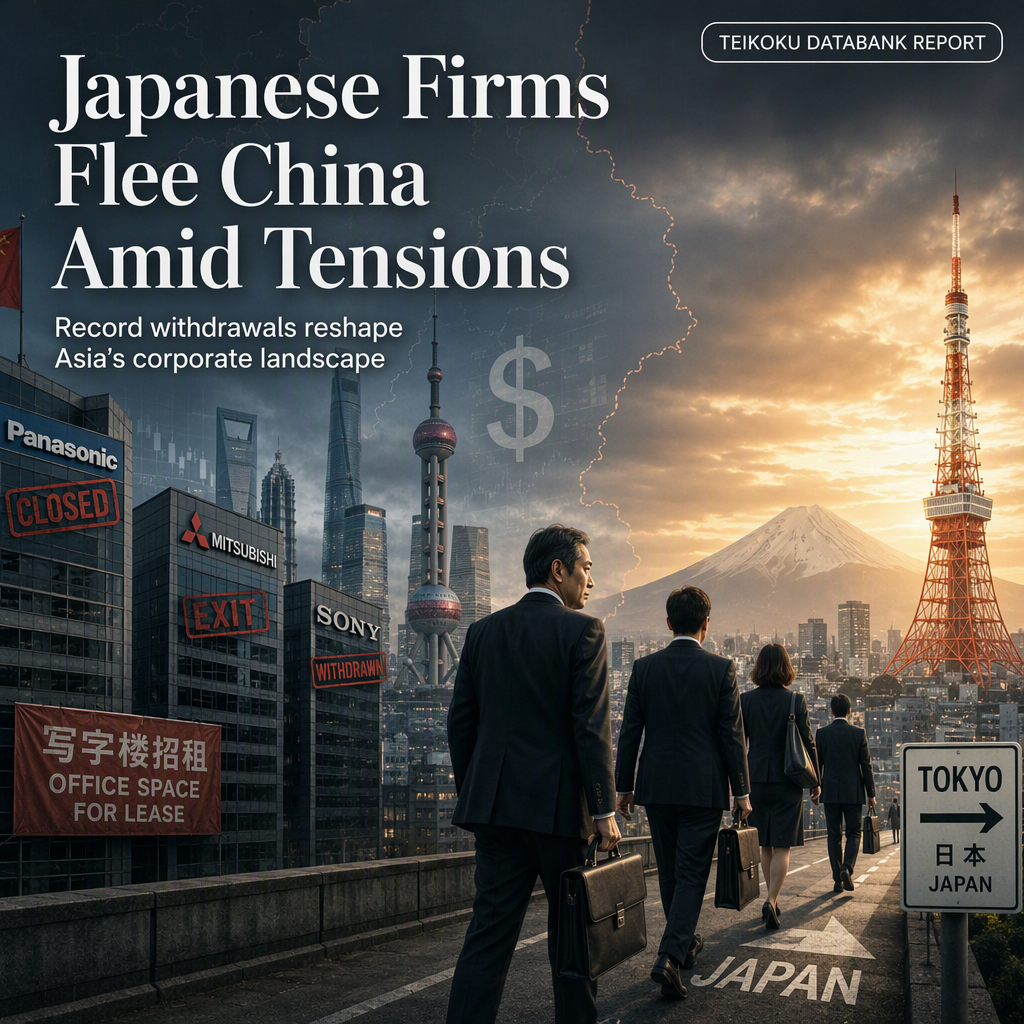
Japanese companies are withdrawing from China at an unprecedented rate, driven by a combination of diplomatic tensions and a slowing Chinese economy [1]. According to Teikoku Databank, the number of Japanese companies operating in China dropped to 10,118 as of June, marking a 22% decrease from June 2024 and a 30% decline from the 2012 peak. This is the lowest figure since Teikoku began tracking the data in 2010 [1].
The exodus has accelerated following a deterioration in China-Japan relations, particularly after Japanese Prime Minister Sanae Takaichi stated in November last year that Japan could become militarily involved if China invaded Taiwan. In response, Beijing has restricted exports of critical minerals to Japanese firms and advised its citizens against traveling to Japan [1]. Jeremy Chan, an analyst at Eurasia Group, noted that Japanese firms and their employees increasingly feel 'unwelcome and unsafe' in China [1].
Teikoku's report highlights that Japanese companies are facing shrinking profitability due to tariff risks, rising labor and manufacturing costs, and intense local competition. Over the past two years, 4,137 Japanese companies have fully withdrawn from China, while only 1,221 have entered, the lowest number outside the Covid-19 pandemic period [1]. Some firms are reducing their dependence on China without fully decoupling [1].
Market dynamics are shifting as Japanese firms become more reliant on the U.S. market. According to Jesper Koll of Monex Group, Topix-listed companies saw the share of profits from China fall to less than 15% so far this year, down from 23% in 2020, while profits from the U.S. rose to 35% from 25% over the same period [1]. Analysts such as Martin Schulz of Fujitsu Research Institute point to U.S. tariffs, public resistance to Chinese goods, and opportunities in India as further incentives for Japanese businesses to diversify away from China [1].
CONCLUSION
Japanese companies are rapidly reducing their presence in China due to escalating diplomatic tensions and economic challenges. This shift is leading to increased reliance on the U.S. market and a significant reorientation of Japanese corporate strategy. The trend is expected to continue as geopolitical and economic pressures persist.