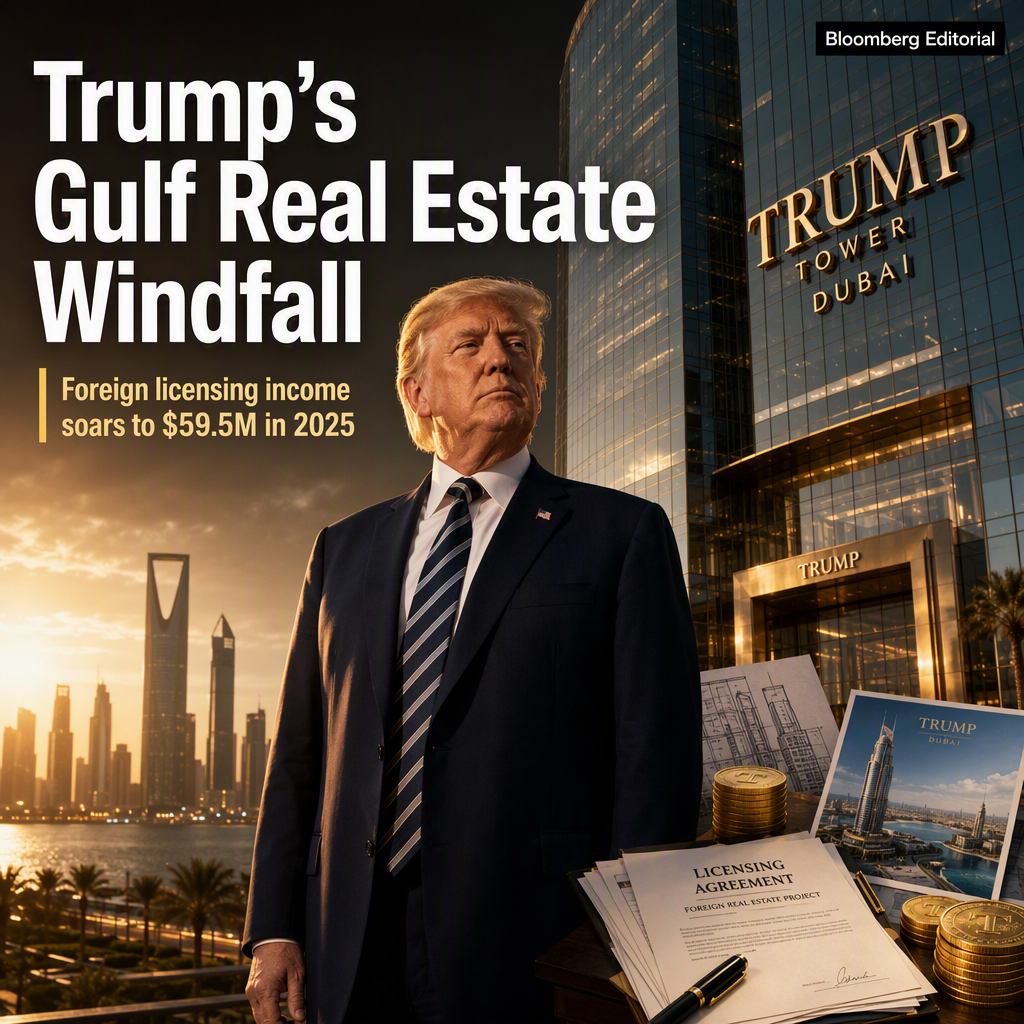
President Donald Trump reported $59.5 million in foreign real estate licensing income in 2025, marking a 71% increase from 2024 and nearly a tenfold rise compared to 2023, according to a CNBC analysis of his financial disclosure [1]. Nearly two-thirds of this income originated from projects in Gulf countries, with $25.8 million linked to Saudi Arabia’s Dar Al Arkan and its subsidiaries, and $11.3 million from Dubai-based developer Damac [1]. The surge in revenue was fueled by the Trump Organization’s reversal of its first-term pledge to avoid new foreign deals, now allowing transactions with private foreign companies while barring new material deals with foreign governments [1].
Four Trump-affiliated licensing LLCs not listed in the 2024 disclosure generated $20.25 million in 2025, accounting for 82% of the increase, while five previously inactive LLCs contributed another $9.64 million [1]. Some developers licensing the Trump name were simultaneously seeking U.S. investments, government approvals, or favorable relations, and certain projects depended on foreign state-owned land, investment, or partnerships [1].
Ethics watchdogs and legal experts cited by CNBC expressed concerns about potential conflicts of interest between Trump’s political leadership and his private business interests, as well as unresolved questions regarding the Constitution’s Foreign Emoluments Clause [1]. However, CNBC found no evidence that the licensing payments influenced administration decisions or resulted in special treatment for developers [1]. The White House stated that “the only special interest guiding” Trump’s decisions is “the best interest of the American people” [1].
The significant increase in foreign licensing income highlights the Trump Organization’s renewed focus on international branding, particularly in the Gulf region, and underscores ongoing scrutiny over the intersection of presidential power and private business dealings [1].
CONCLUSION
Trump’s foreign real estate licensing income reached $59.5 million in 2025, driven largely by Gulf region deals and a shift in the Trump Organization’s foreign business policy. While watchdogs and legal experts raised conflict-of-interest and constitutional concerns, CNBC found no evidence of policy influence or special treatment. The event underscores heightened scrutiny of the president’s business activities during his second term.