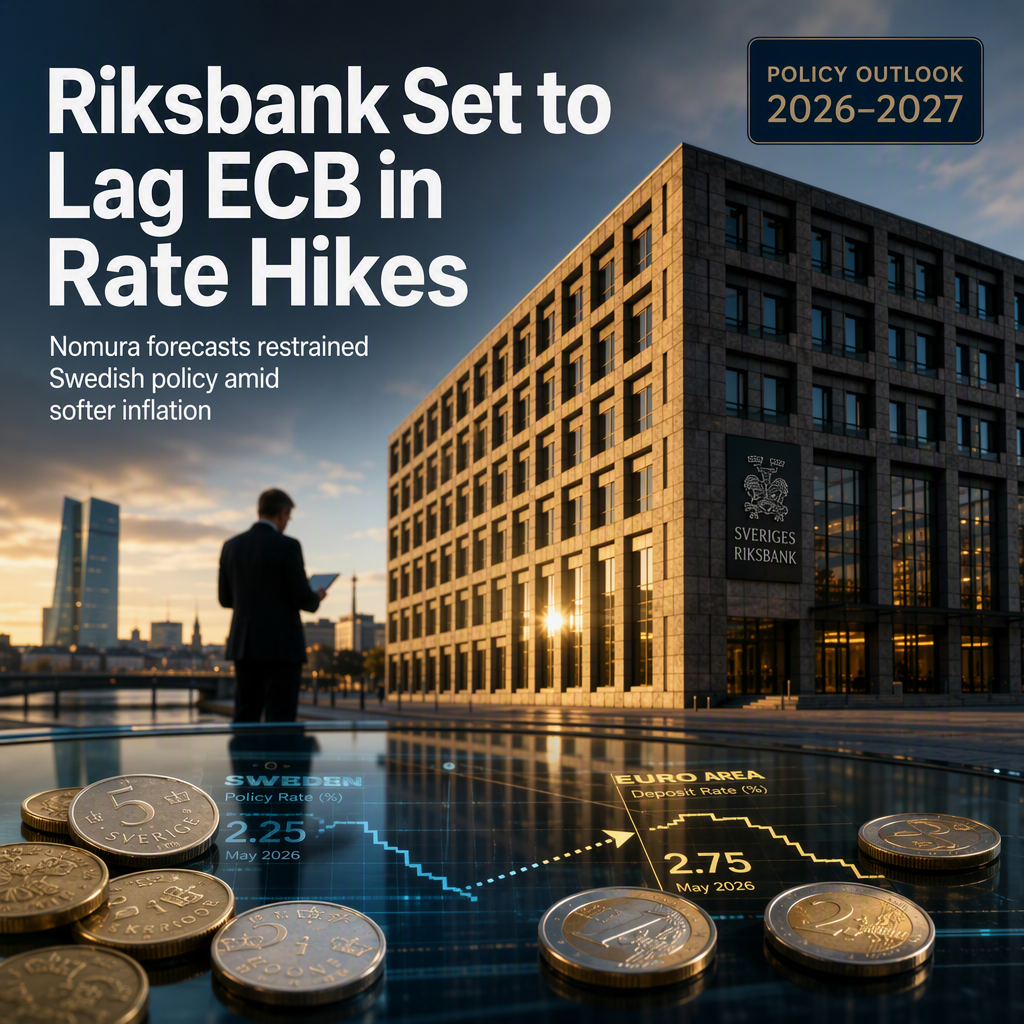
Nomura strategists anticipate that Sweden's central bank, the Riksbank, will maintain its policy rate unchanged for the remainder of 2026 and implement only a single 25 basis point hike to 2.00% in early 2027. This forecast is based on Sweden's softer inflation, below-trend GDP, and a lower neutral rate, which justify a policy path below that of the European Central Bank (ECB), despite the Swedish policy rate historically being higher than the ECB's [1].
Nomura notes that Swedish rates are expected to lag those of the Euro area, stating, 'We expect the Riksbank to leave its policy rate on hold for the rest of the year and raise it once to 2.00% in early 2027, as inflation picks up towards target and accelerating GDP growth creates price pressures.' However, they do not expect the Riksbank to match the ECB’s rate rises this year, raising questions about the consistency of forecasts given the close relationship between the two policy rates [1].
The strategists highlight that the Riksbank’s neutral rate estimate for Sweden has declined in recent years, while the ECB’s estimate for the euro area has not moved as much. Additionally, Sweden experienced weaker economic growth than the euro area in 2023, attributed to the Riksbank's rapid rate hikes, which had an immediate impact on aggregate demand. This swift effect on household cash flow may make the Riksbank more cautious about further rate increases, especially given concerns about a weak economic backdrop, despite a strong Q2 2026 and persistently high unemployment [1].
Nomura also charts developments in neutral policy rate estimates for the Riksbank, Norges Bank, and ECB, noting that Scandinavian central banks typically have higher neutral rate estimates than the ECB. This helps explain why these banks have historically maintained higher rates, but current economic conditions suggest a more limited hiking cycle for the Riksbank compared to the ECB [1].
CONCLUSION
Nomura expects the Riksbank to pursue a more restrained rate hiking cycle than the ECB, citing weaker Swedish economic growth, softer inflation, and a lower neutral rate. The forecast implies Swedish rates will lag Euro area rates, with only one hike anticipated in early 2027. Market participants should monitor Sweden’s economic recovery and inflation trajectory for further policy signals.