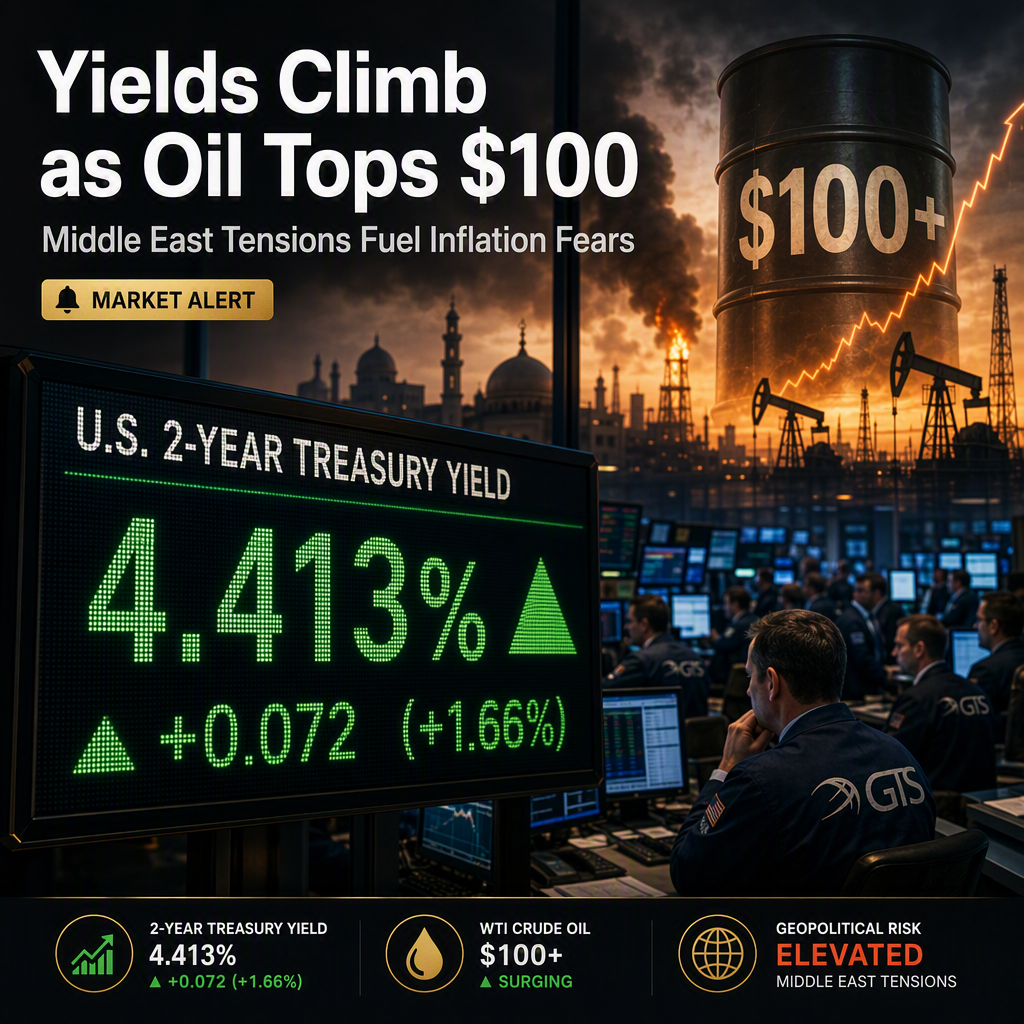
The yield on the U.S. 2-year Treasury note increased by 2 basis points early Wednesday, reaching 4.413% shortly after 5:30 a.m. ET, as oil prices surged above the $100-per-barrel mark and inflation concerns intensified. This movement in the 2-year note, which is typically more sensitive to near-term policy expectations, reflects growing market anxiety over inflationary pressures stemming from rising energy costs and geopolitical instability in the Middle East [1].
International benchmark Brent crude futures climbed above $100 per barrel for the first time since late July, while U.S. West Texas Intermediate futures extended gains by more than 2%, trading around $95 a barrel. The rally in oil prices is attributed to escalating tensions between the U.S. and Iran, with Tehran reporting that its forces struck two American vessels and eight oil tankers in the Gulf in retaliation for the U.S. destroying five Iranian crude oil tankers [1].
While the 2-year Treasury yield rose, the yield on the benchmark 10-year Treasury note remained unchanged, and longer-dated 20- and 30-year Treasury yields were marginally lower. This suggests a complex market environment, as noted by Marc Ostwald, chief economist and global strategist at London's ADM Investor Services, who stated that high energy prices are increasing inflation risks but could also lead to headwinds for growth and potential demand destruction [1].
Investors are closely watching upcoming economic data releases, including ADP employment data on Wednesday, PPI data on Thursday, and August U.S. inflation data on Friday, for further indications of the U.S. economy's resilience amid ongoing conflict and energy supply constraints [1].
CONCLUSION
Rising oil prices and escalating Middle East tensions have pushed the U.S. 2-year Treasury yield higher, reflecting heightened inflation fears. Market participants are bracing for further volatility as they await key economic data releases later in the week. The situation underscores the delicate balance between inflation risks and potential economic headwinds.