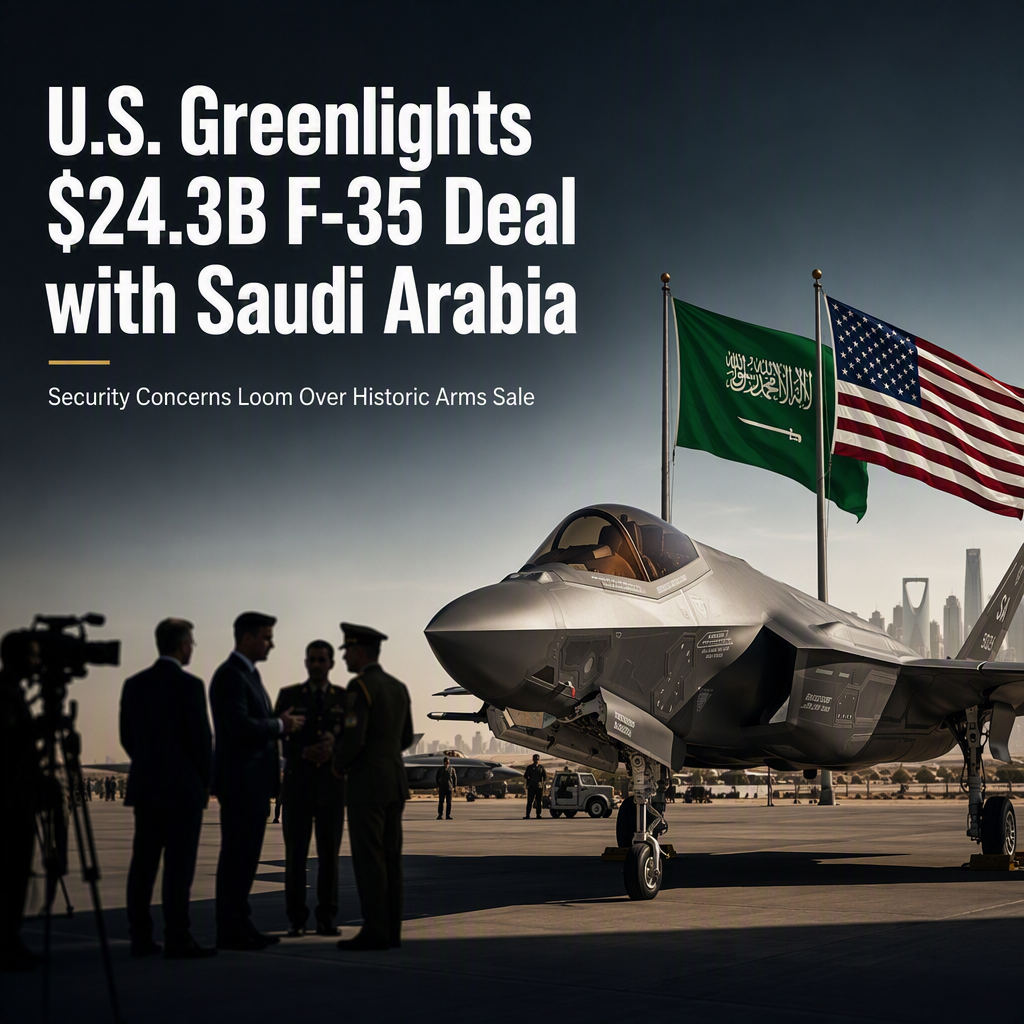
The U.S. State Department has approved a potential $24.3 billion sale of 48 F-35 Lightning II Joint Strike Fighter jets and related equipment to Saudi Arabia, marking a significant development in U.S.-Saudi defense relations [1]. This approval comes as Saudi Arabia faces new challenges in its conflict with Iran and seeks to bolster its military capabilities. Until now, Israel has been the only Middle Eastern country with access to the F-35, which is manufactured by Lockheed Martin and regarded as the most advanced stealth fighter jet in the world [1].
Congress was officially notified of the proposed transfer, and some lawmakers have voiced concerns about the risk of American military technology being acquired by China, given its military partnership with Saudi Arabia [1]. Rep. Raja Krishnamoorthi, D-Ill., publicly warned against the sale, citing intelligence community concerns that the technology could fall into Chinese hands, referencing Beijing's history of intellectual property theft [1]. U.S. officials, as cited by The New York Times, have also raised the possibility of Chinese espionage in Saudi Arabia as a route for acquiring F-35 technology [1].
The sale follows Saudi Arabia's agreement to purchase $142 billion in military equipment and services from the U.S. during President Trump's May 2025 trip to Riyadh, which was described as the largest defense sales package in history [1]. Previous arms deals, including a $110 billion package proposed during Trump's first term, faced congressional scrutiny after the 2018 murder of journalist Jamal Khashoggi [1]. Despite these concerns, the State Department emphasized that the sale would not alter the military balance in the region and would strengthen the U.S. defense industrial base [1].
A State Department spokesperson highlighted President Trump's view of Saudi Arabia as an anchor for regional security, stating that increased capabilities for the Saudi armed forces benefit both U.S. and regional security [1]. The spokesperson also noted that the sale ensures Saudi Arabia continues to buy American, reinforcing the U.S. defense industry [1].
CONCLUSION
The approval of the $24.3 billion F-35 sale to Saudi Arabia represents a major boost for U.S. defense exports and Lockheed Martin, but it has sparked significant security concerns regarding potential technology transfer to China. Congressional scrutiny and geopolitical risks may influence the final outcome, but the deal underscores the strategic importance of Saudi Arabia in U.S. regional policy.