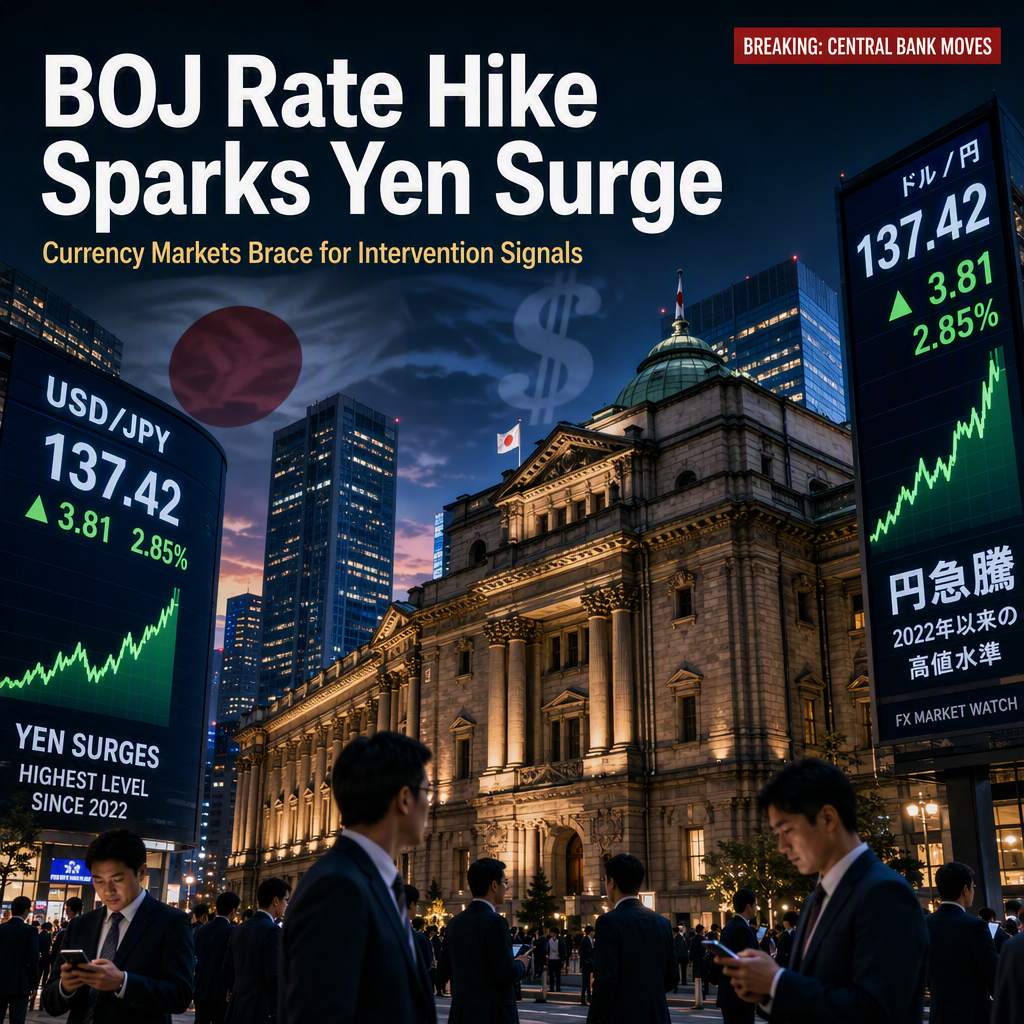
The Bank of Japan (BOJ) raised its policy rate to 1.25% on Friday, marking its second hike in three months and the highest level since 1995 [2][3]. This move came after a period of yen weakness and was accompanied by a rate check by the BOJ, which is often interpreted as a precursor to direct currency market intervention [1][2]. Following the rate check, the yen spiked by more than 1 yen to the upper-156 range against the dollar, reversing its earlier slump and signaling increased vigilance by Japanese authorities regarding currency volatility [1][2].
The BOJ's decision to raise rates was supported by a 7-2 vote, with board members Asada and Sato dissenting, both of whom were appointed this year [3]. BOJ Governor Kazuo Ueda stated that the bank will continue to raise rates as the economy and prices allow, noting that underlying inflation risks running above the 2% target [3]. However, Japanese core inflation eased to 1.7% in August from 1.8% in July, its first slowdown in four months [3].
The rate hike aligns the BOJ more closely with other major central banks, such as the U.S. Federal Reserve and the European Central Bank, both of which have also raised rates recently to combat inflation [2][3]. U.S. Treasury Secretary Scott Bessent expressed support for "decisive" action to shore up the yen in discussions with Governor Ueda in August, signaling a form of 'currency alliance' between the U.S. and Japan [2]. Some analysts have speculated about the possibility of a new Plaza Accord, as Japan intensifies its efforts to counter yen weakness [2].
Market participants are now closely watching key technical levels, with support for the yen expected around 156 and resistance near 158 against the dollar [1][2]. The market has turned more cautious, awaiting further signals from the BOJ and Japanese government officials regarding potential intervention [1]. Technical analysis suggests that a break below the 156 support level could lead to further yen gains, while failure to hold current levels may result in renewed downward pressure [1]. Futures markets indicate expectations for further U.S. rate hikes, which could continue to influence the yen-dollar dynamic [3].
CONCLUSION
The Bank of Japan's rate hike to 1.25% and subsequent rate check have injected volatility into the yen, signaling heightened concern over currency weakness and a willingness to intervene if necessary. Market sentiment has shifted to a more cautious stance, with traders closely monitoring central bank actions and key technical levels. The BOJ's alignment with global rate-hiking peers and ongoing coordination with U.S. authorities are expected to keep the yen in focus for the foreseeable future.