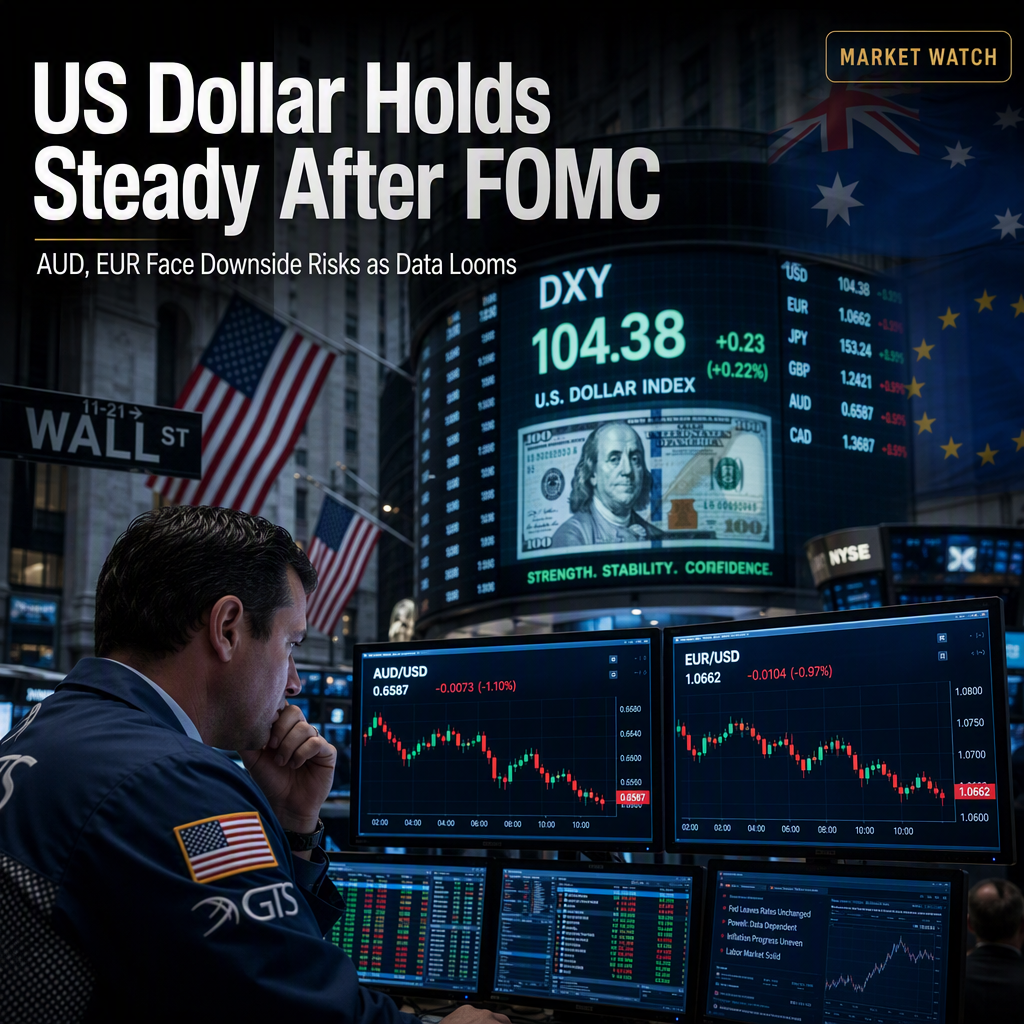
The US Dollar (USD) has entered a phase of consolidation following the recent Federal Open Market Committee (FOMC) meeting, with the DXY index last seen at 100.2. OCBC strategist Christopher Wong notes that the USD eased modestly as US Treasury yields and oil prices retraced from their post-FOMC spikes, suggesting that further gains in the USD may require another leg higher in yields. Wong highlights that upcoming US data on activity, labour markets, and inflation could prompt an unwinding of rate expectations and reopen downside risks for the Dollar, as a fair amount of hawkish expectation is already priced in [2].
Against this backdrop, the Australian Dollar (AUD) has rebounded after a sharp decline, with intraday price action expected between 0.7095 and 0.7130, according to United Overseas Bank’s Quek Ser Leang. Despite the near-term consolidation, UOB maintains a 1–3 week view for a move toward 0.7050, provided the AUD remains below the 0.7140 resistance level. The recent strong rebound saw the AUD close 0.35% higher at 0.7112, but the broader trend remains downward unless the 0.7140 level is breached, which would indicate stabilization of the recent decline [1].
In Europe, the Euro (EUR) has found only limited support from recent hawkish commentary by European Central Bank (ECB) policymakers. ING’s Francesco Pesole points out that while ECB members, including Gabriel Makhlouf and Ante Zigman, have maintained a hawkish tone and left the door open to further rate hikes, the dovish camp remains weak and there is no evidence of second-round effects. Despite this, ING sees downside risks for EUR/USD, particularly as front-end US rates could rise further and the broader commodity and risk environment weighs on the Euro. A test of 1.140 is seen as a near-term risk, though some stabilization is expected today [3].
Market participants are closely watching upcoming US economic data, which could influence both the USD's direction and cross-currency pairs such as AUD/USD and EUR/USD. Resistance and support levels for the DXY are noted at 100.32 and 100.60 (resistance), and 100/99.80 and 99.4/99.2 (support), respectively [2]. President Christine Lagarde is scheduled to speak later today, but ING does not anticipate significant changes to the ECB's message so soon after the recent meeting [3].
CONCLUSION
The US Dollar is consolidating after the FOMC, with further direction likely to be determined by upcoming US economic data. Both the Australian Dollar and Euro face downside risks against the USD, with analysts highlighting key resistance and support levels. Market sentiment remains cautious as traders await new data to clarify the path for major currency pairs.