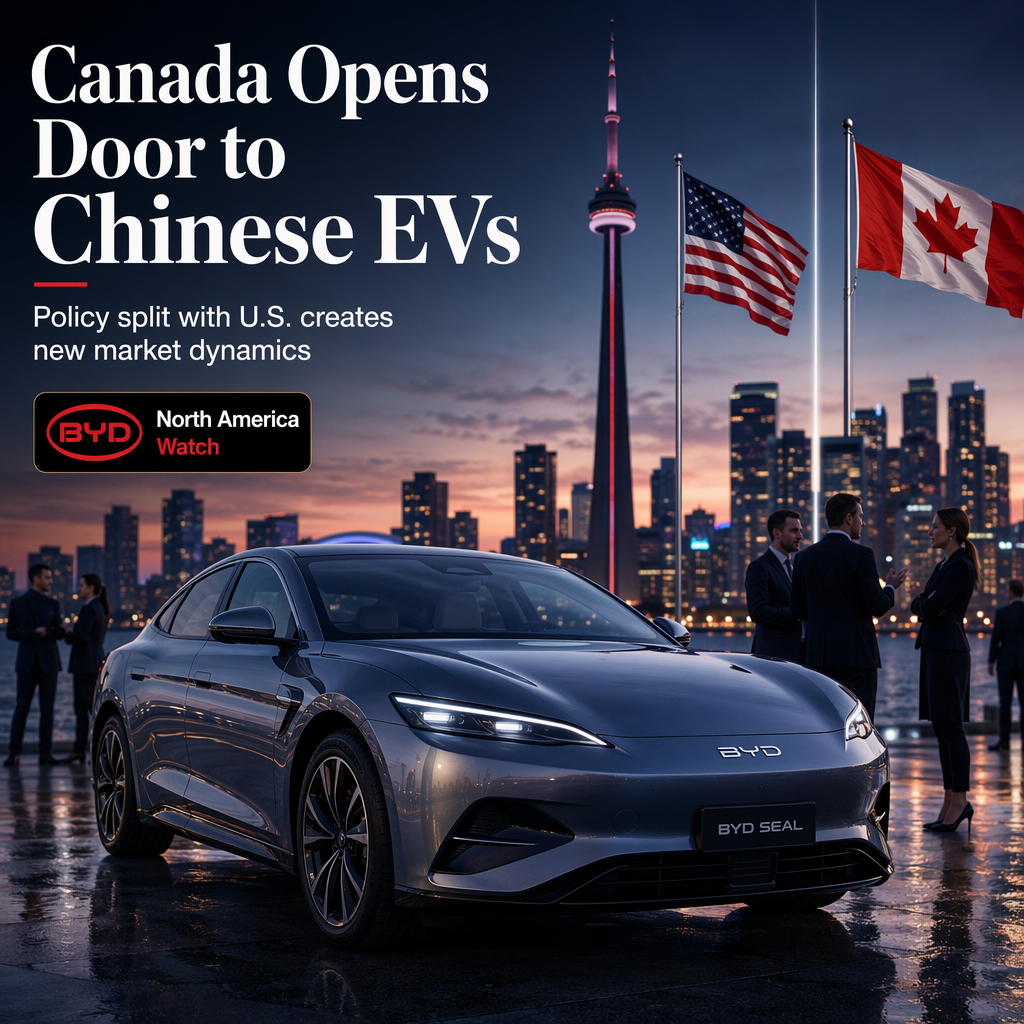
Canadian Prime Minister Mark Carney announced that Canada would no longer fully align with the United States on tariffs imposed on Chinese-made vehicles, signaling a significant policy divergence between the two countries amid rising tensions over the expansion of Chinese electric vehicle (EV) manufacturers, particularly BYD, in the North American market [1]. This shift comes as the U.S. has implemented steep tariffs on Chinese-made EVs to protect domestic automakers from foreign competition, while Canada, under Carney's leadership, is taking a more independent approach and may not follow Washington's lead on tariff hikes [1].
The policy split creates an opportunity for BYD, one of China's leading EV manufacturers, to establish a foothold in North America. Analysts suggest that the differences in tariff strategies could allow Chinese automakers to access the Canadian market and potentially use it as a springboard into the broader North American market, despite U.S. protectionist measures [1]. Carney's statement, 'Canada would no longer fully align with the U.S. on tariffs on Chinese-made vehicles,' highlights the growing rift in the historically unified trade front between the two countries [1].
Market watchers are closely monitoring how BYD and other Chinese EV makers will respond to these changing trade dynamics. The divergence in tariff policies raises questions about supply chain integrity and the future competitiveness of North American automakers. Analysts warn of potential market disruptions if tariff policies continue to diverge among key trading partners [1].
The evolving situation underscores the complex interplay of international trade, industrial policy, and the rapid growth of China's EV giants. As Canada and the U.S. navigate this new terrain, the North American auto market faces increased uncertainty, with BYD poised to exploit any openings created by discord between the continent's largest economies [1].
CONCLUSION
Canada's decision to diverge from U.S. tariff policy on Chinese-made vehicles introduces significant uncertainty into the North American auto market. This move could provide BYD and other Chinese EV makers with new opportunities in the region, potentially disrupting established supply chains and competitive dynamics.