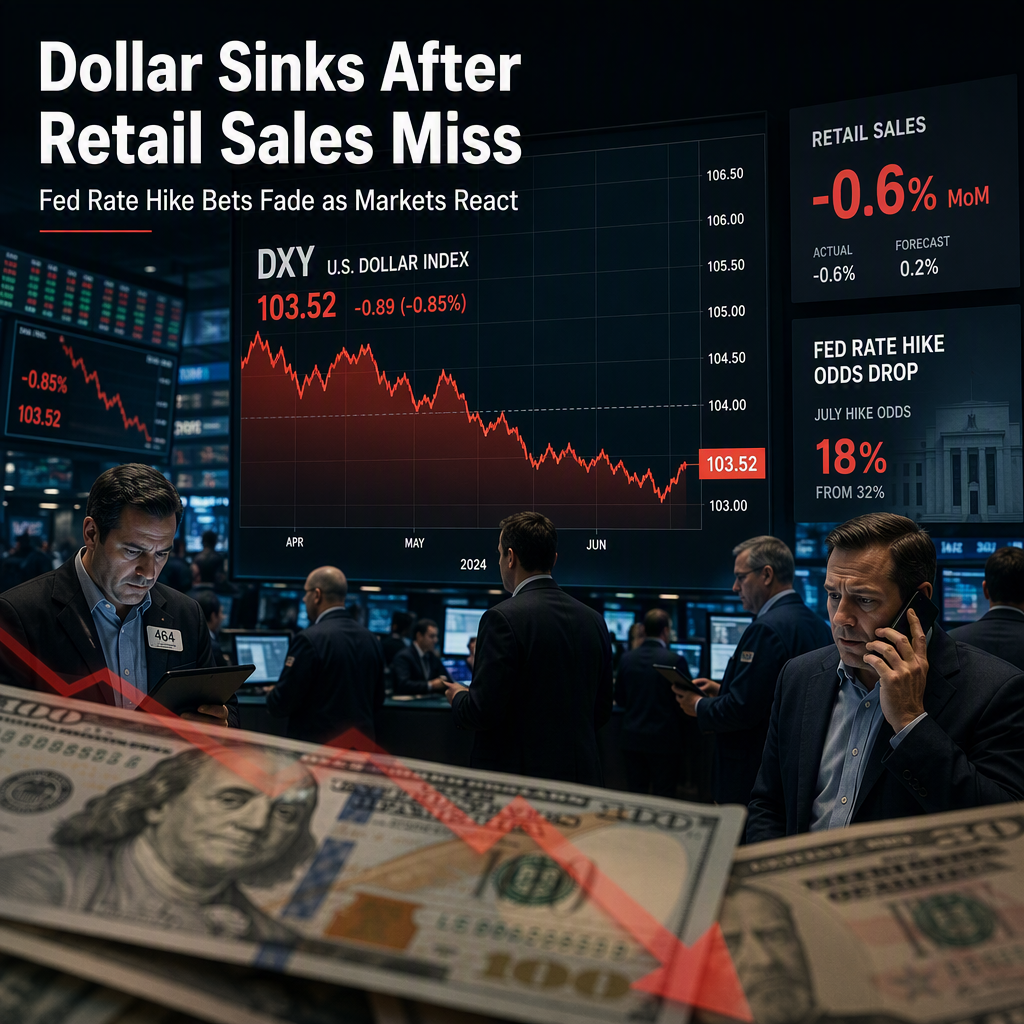
The US Dollar (USD) experienced notable weakness following the release of July retail sales data, which showed a contraction of 0.6% month-over-month to $763.6 billion, reversing the previous month's 0.2% expansion and falling short of market expectations for a 0.1% increase [2]. On a yearly basis, retail sales were up 5.0%, and total sales for the May through July 2026 period rose 6.3% compared to the same period a year ago [2]. The disappointing retail sales print contributed to marked losses for the Greenback, with the US Dollar Index (DXY) retreating to the 99.50 region and extending its recent pullback from monthly highs [2].
Short-term US yields have been declining as market participants scale back expectations for further Federal Reserve (Fed) rate hikes, particularly after weaker labor data and a mixed Producer Price Index (PPI) report [1]. MUFG’s Lee Hardman noted that the slowdown in private employment and wage growth, alongside limited evidence of energy price spillover into core inflation, gives the Fed more leeway to keep rates on hold [1]. Despite these headwinds, the Dollar index remains above its 200-day moving average at around 99.20, supported in part by strong US equities, especially AI-related tech stocks, and robust S&P 500 earnings [1].
The US July PPI came in slightly below expectations at 4.7% year-over-year (consensus: 4.9%), with volatile trade and transportation services dragging the headline lower, while broader services price pressures remained firm [4]. At the same time, long-term borrowing costs at a 30-year Treasury auction rose to their highest since 2001, reflecting investor concerns over federal debt and persistent inflation [4]. Fed’s Hammack reiterated support for higher policy rates to curb inflation, emphasizing the need for the Fed to act now [4]. Weekly jobless claims were mixed, with continuing claims slightly lower than expected and initial claims higher, resulting in a muted market reaction [4].
The softer US inflation data and the scaling back of Fed rate hike expectations have also pressured the USD against other major currencies. For example, the Australian Dollar (AUD) rebounded, supported by hawkish commentary from Reserve Bank of Australia (RBA) officials, while the USD struggled to regain momentum [3]. According to the CME FedWatch Tool, the probability of a Fed rate increase at the September meeting dropped to 34.8%, down from around 60% two weeks earlier [3].
Looking ahead, market participants are awaiting further data releases, including the preliminary University of Michigan Consumer Sentiment Index for August, which is expected to ease to 54.5 from 55.2 in July [3][4]. These releases, along with ongoing inflation and labor market developments, are expected to provide additional direction for the USD and broader financial markets.
CONCLUSION
The US Dollar has come under pressure following weaker-than-expected July retail sales and softer inflation data, prompting markets to scale back expectations for further Fed rate hikes. While the DXY remains above key technical support, the outlook is clouded by mixed economic signals and rising long-term borrowing costs. Investors are closely watching upcoming consumer sentiment data and Fed commentary for further clues on the policy path and USD direction.