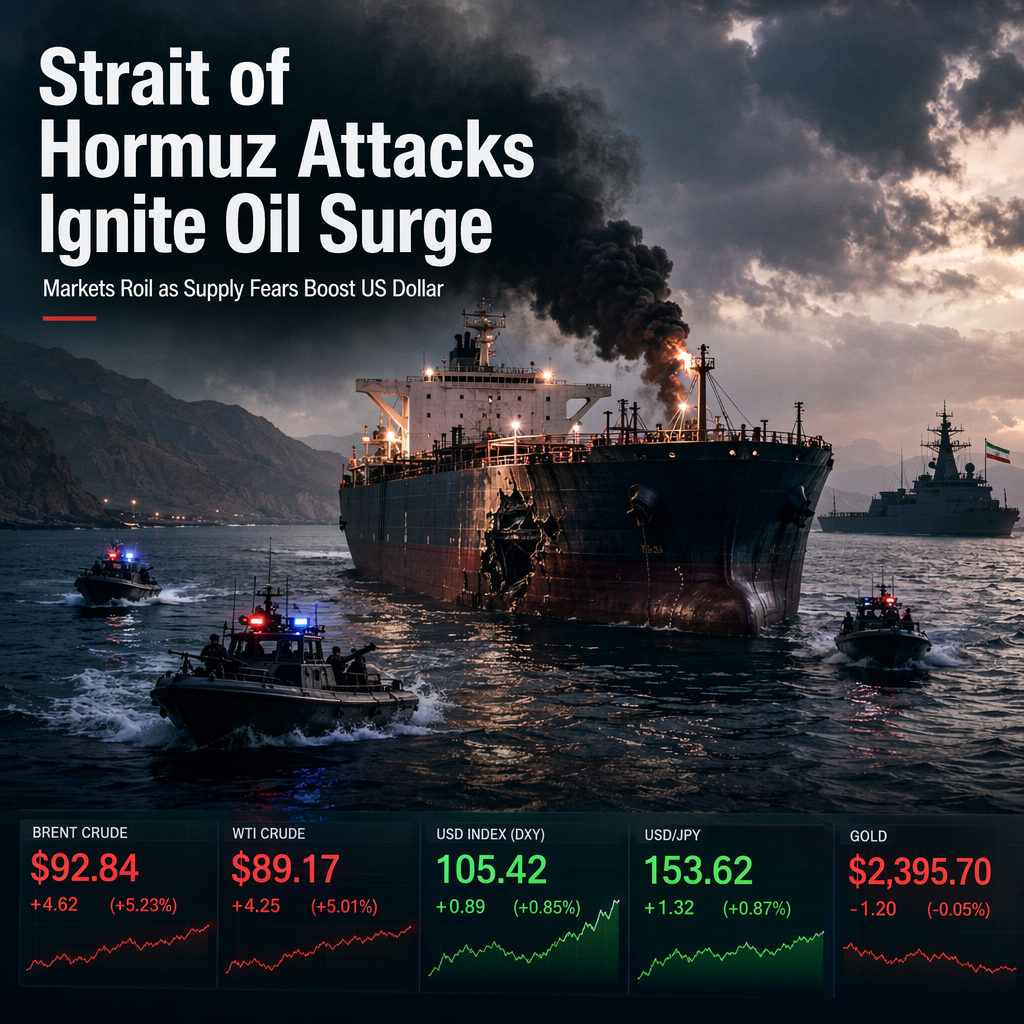
Fresh attacks on oil tankers near the Strait of Hormuz have reignited supply concerns and driven significant market movements on Tuesday. According to the United Kingdom Maritime Trade Operations (UKMTO), three tankers were hit in the Strait of Hormuz over the past 24 hours, reviving the geopolitical risk premium in the oil market [1]. Iran has reiterated that only vessels using its approved route and coordinating with the Islamic Revolutionary Guard Corps (IRGC) are considered safe [1]. Source 2 reports that the IRGC attacked ships attempting to pass through the Omani route, ignoring repeated warnings, which further fueled tensions in the region [2].
As a result, West Texas Intermediate (WTI) crude oil surged by approximately 2.65% to trade around $70.44, reflecting heightened supply risks despite recent improvements in shipping following an interim US-Iran peace deal [1]. The oil market remains focused on the upcoming US Energy Information Administration (EIA) weekly inventory report, with US crude inventories having fallen for ten consecutive weeks, indicating a tight supply outlook [1].
The spike in oil prices has had notable currency market implications. The British Pound (GBP) slipped against the US Dollar (USD), with GBP/USD trading at 1.3373, down 0.11% on the day [2]. The US Dollar Index (DXY) edged up 0.05% to 100.93, as higher energy prices increased speculation that the US Federal Reserve (Fed) may consider raising interest rates to combat inflationary pressures [2]. Money markets now assign a 60.42% probability to a Fed rate hike at the September meeting, while the odds for rates remaining unchanged at the July 29 meeting stand at nearly 75% [2].
Technical analysis for WTI indicates a bearish near-term bias, with prices remaining below the 200-day Simple Moving Average (SMA) at $73 and the 100-day SMA at $86. Immediate support is seen at $67, with a deeper bearish extension exposing $60 as the next structural floor [1]. For GBP/USD, the pair remains capped beneath the 50/100/200-day SMA cluster at 1.3403, suggesting a consolidative phase within a broader corrective setup [2].
In the UK, the absence of significant economic data left the Pound vulnerable to external shocks, while political developments saw Andy Burnham, the likely next Prime Minister, reiterate his commitment to fiscal rules, which helped ease market concerns about potential fiscal slippage [2].
CONCLUSION
The attacks in the Strait of Hormuz have triggered a sharp rise in oil prices and strengthened the US Dollar, as markets reassess the risk of supply disruptions and the potential for further Fed rate hikes. Currency and commodity markets remain sensitive to ongoing geopolitical developments and upcoming US economic data releases.