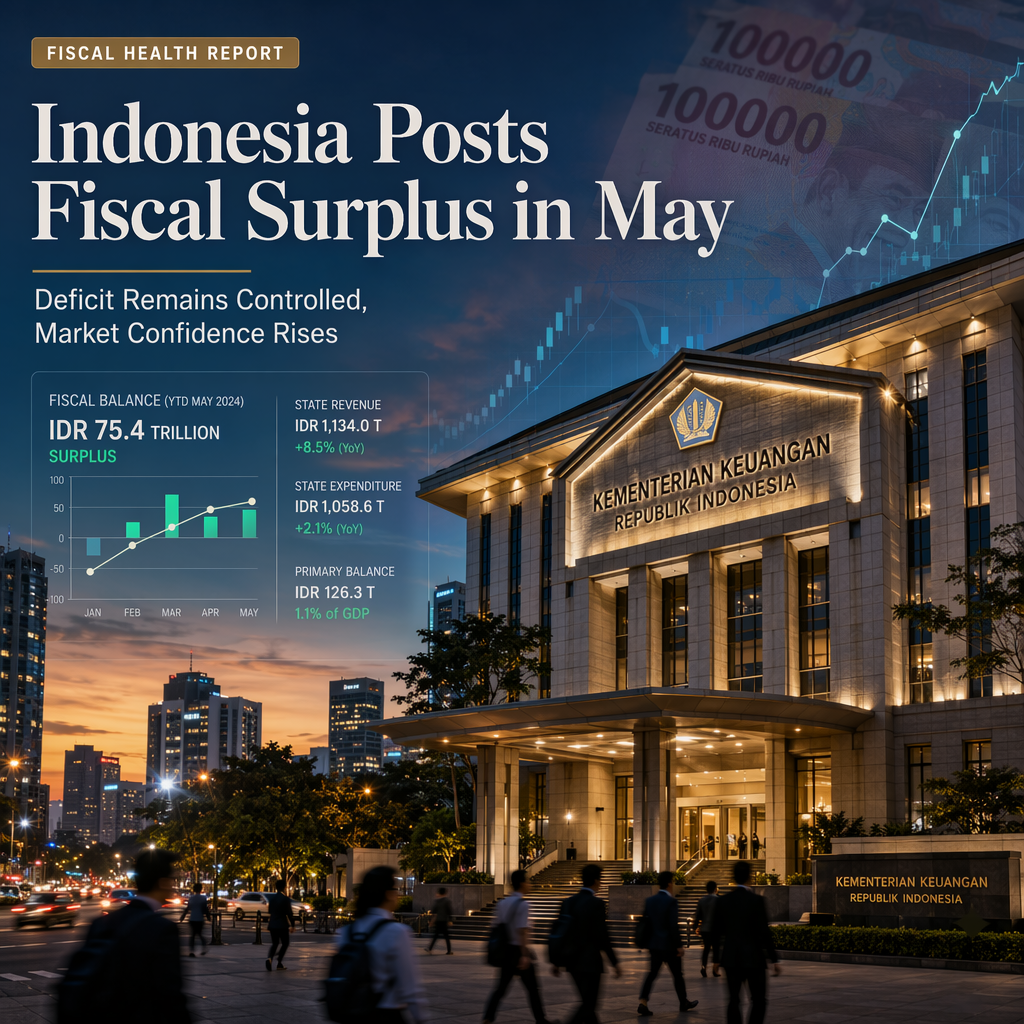
Indonesia's fiscal position showed improvement in May, as the primary balance returned to a surplus of IDR58.6 trillion, according to UOB Global Economics & Markets Research economists Enrico Tanuwidjaja and Vincentius Ming Shen [1]. Despite rapid growth in government expenditure, particularly on social programs, the fiscal deficit only widened slightly to 0.70% of GDP from 0.63% in April, remaining well below the statutory ceiling of 3% of GDP. This indicates that Indonesia retains significant fiscal policy flexibility [1].
The economists attribute the strong fiscal performance to robust tax-driven revenue, supported by the implementation of the Coretax system, and elevated central government spending [1]. Looking forward, UOB maintains its fiscal deficit projection at approximately 2.9% of GDP for 2026, reflecting ongoing government spending momentum [1]. However, they note that the deficit could narrow if revenue-enhancing measures, such as tax reforms, are effective and expenditure rationalization is implemented. Specifically, a reduction in the Free Nutritious Meals Program budget from IDR335 trillion to IDR268 trillion—or potentially even below IDR200 trillion, as suggested by recent news—could contribute to a smaller deficit [1].
The report emphasizes the importance of prudent fiscal management to sustain Indonesia's fiscal health and flexibility in the coming years [1].
CONCLUSION
Indonesia's fiscal metrics remain robust, with a primary surplus in May and a controlled deficit well below the statutory ceiling. Continued tax reforms and spending rationalization could further improve the fiscal outlook, supporting market confidence in Indonesia's economic management.