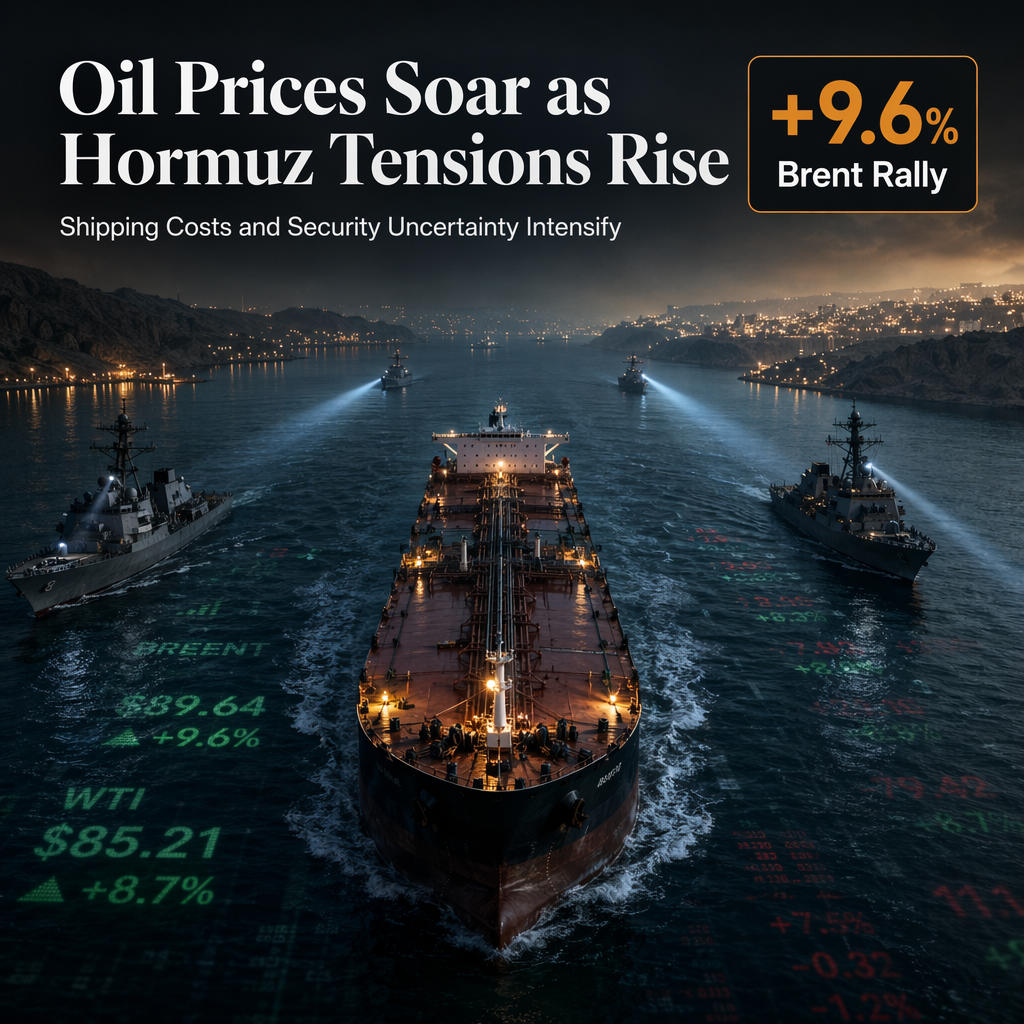
Oil prices experienced a sharp rally as tensions between the US and Iran escalated, leading to disruptions in vessel traffic through the Strait of Hormuz. According to ING strategists Warren Patterson and Ewa Manthey, ICE Brent crude settled 9.6% higher in a single day, climbing back above $83 per barrel, with this upward momentum persisting into early morning trading and no signs of easing tensions between the two nations [1].
The market faces significant uncertainty due to the increased risk of attacks and the potential for a renewed US blockade on Iran. Additionally, both Iran and President Trump have proposed competing tolls for ships passing through the Strait of Hormuz, further complicating the outlook for energy markets and shipping costs [1]. Iran is reportedly insisting on charging a toll for passage, while President Trump has stated that the US will charge a fee equivalent to 20% of a cargo's value for providing safe passage, though details on implementation and seriousness remain unclear [1].
To illustrate the potential impact, ING strategists note that a 20% fee on a Very Large Crude Carrier (VLCC) carrying 2 million barrels at $80 per barrel would amount to approximately $32 million, or an additional cost of $16 per barrel. This is substantially higher than the $1 per barrel toll proposed by Iran [1].
Despite US assurances that the Strait of Hormuz remains open, the persistent risk of attack continues to unsettle shipping companies and energy markets, contributing to the ongoing price surge and heightened volatility [1].
CONCLUSION
The escalation of US–Iran tensions and uncertainty over shipping tolls in the Strait of Hormuz have driven oil prices sharply higher, with Brent crude surging 9.6% in a day. Market participants face significant cost and security uncertainties, and the situation remains fluid with no immediate resolution in sight.