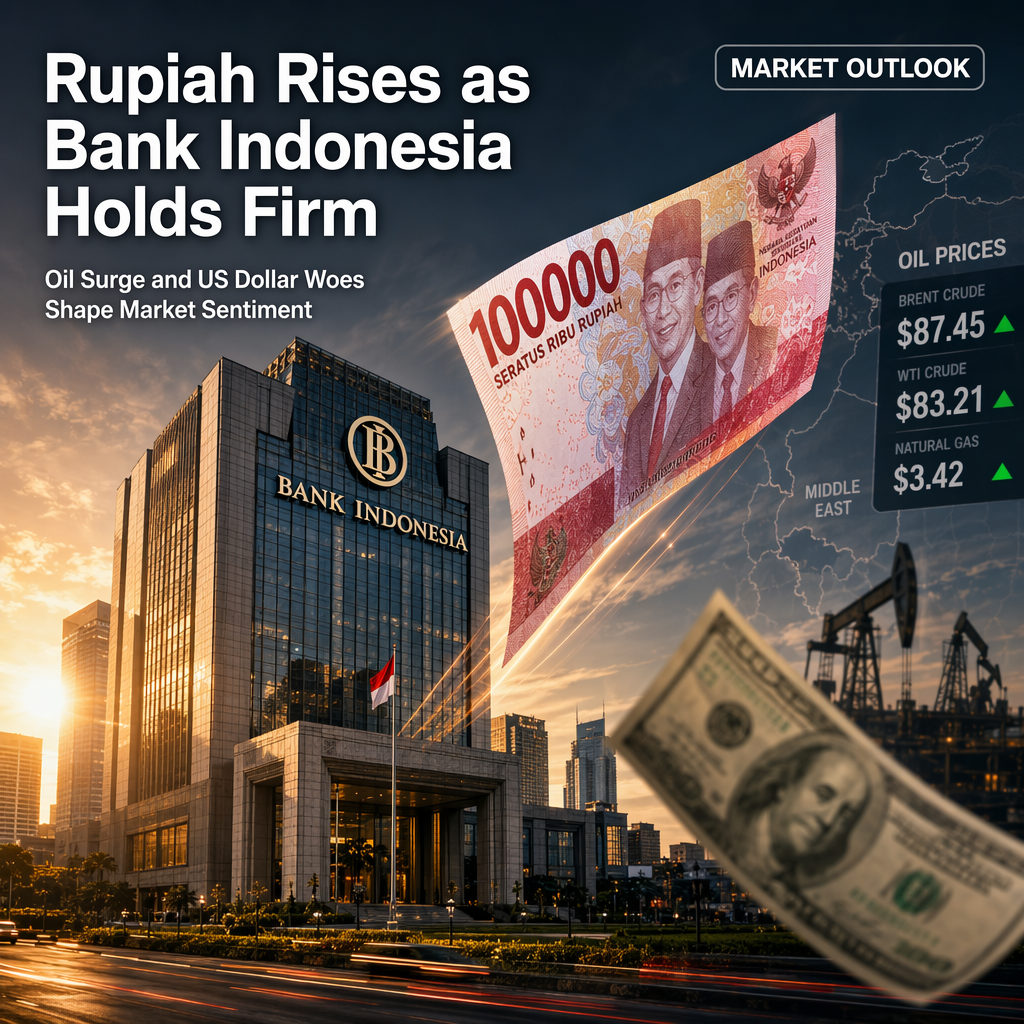
The Indonesian Rupiah (IDR) advanced against the US Dollar (USD), with the USD/IDR pair trading around 18,020 during Asian hours on Friday after previously registering gains of over 0.5% the day before [1]. This movement comes in the wake of Bank Indonesia's (BI) unexpected decision to keep its benchmark interest rate unchanged at 5.75% in July, opting for targeted currency stabilization measures instead of further rate hikes [1]. The central bank's approach aims to support the currency without tightening monetary policy further.
Indonesia's proposed defense spending cuts are intended to bolster the country's fiscal health, though the positive impact on the Rupiah may be limited by rising global oil prices, which are contributing to inflationary pressures [1]. The escalation of conflicts in the Middle East, particularly between the US and Iran, has pushed crude oil prices higher, fueling expectations that the US Federal Reserve (Fed) might resume interest rate hikes [1].
According to the CME FedWatch tool, money markets are currently pricing in a 35.8% chance of a Fed rate hike this month and an 82.1% probability of at least a quarter-point hike in September [1]. Despite increased safe-haven demand due to geopolitical tensions, the US Dollar has struggled, allowing the Rupiah to hold its gains [1].
The market remains cautious, with risk aversion prevailing due to ongoing geopolitical risks and inflation concerns. The interplay between Indonesia's fiscal measures, central bank policy, and external factors such as oil prices and US monetary policy continues to shape the outlook for the Rupiah [1].
CONCLUSION
The Indonesian Rupiah's recent strength reflects Bank Indonesia's steady policy stance and targeted interventions, even as external pressures from rising oil prices and US rate hike expectations persist. Market sentiment remains cautious, with the Rupiah's outlook dependent on both domestic fiscal discipline and global economic developments.