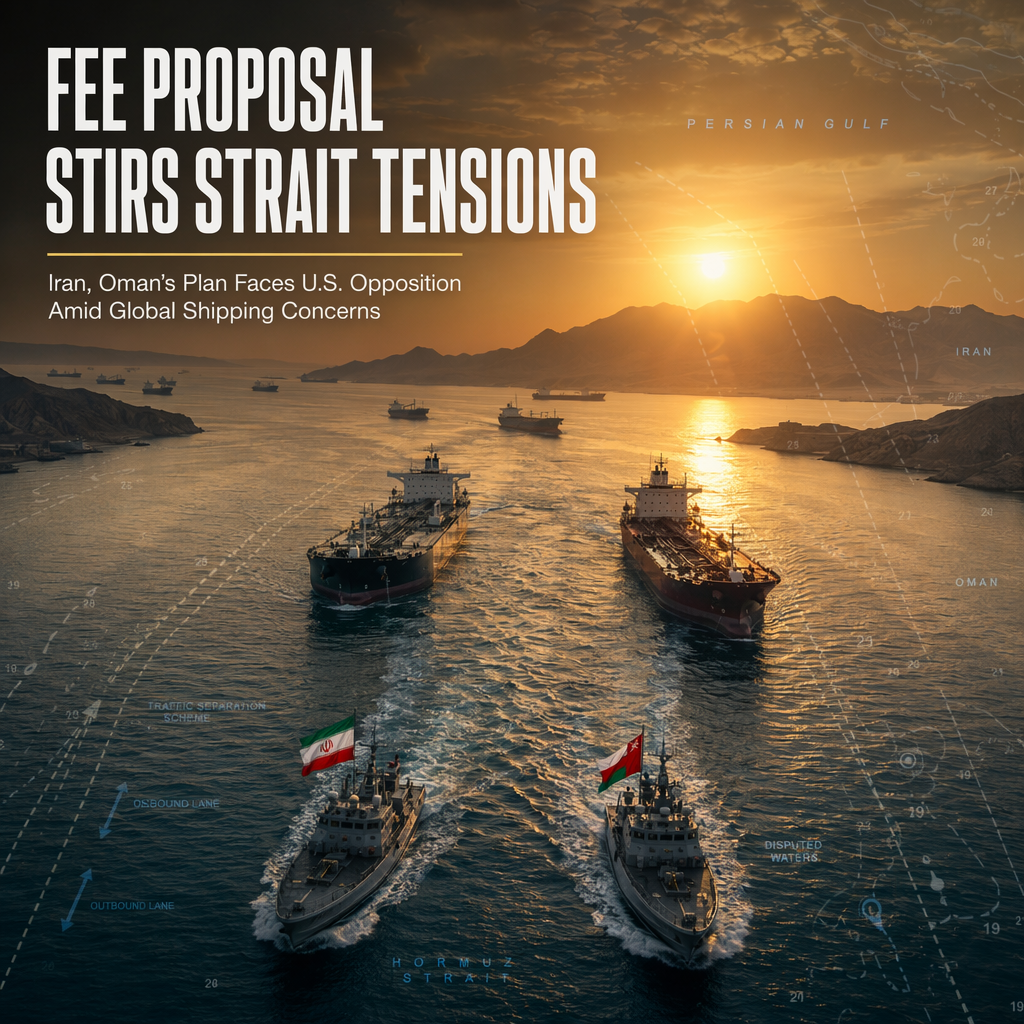
Iran and Oman have jointly presented a proposal to the United States regarding the administration of the Strait of Hormuz, which includes the collection of administrative fees by both countries, according to four sources cited by NBC News [1]. This proposal follows a memorandum of understanding signed last month between the U.S. and Iran, allowing ships to transit the strait safely and freely for 60 days, after which the administration of the waterway would be determined by Iran and Oman in consultation with other Persian Gulf states [1].
Omani Foreign Minister Sayyid Badr bin Hamad Al Busaidi clarified in an interview that Oman does not support mandatory fees for ships transiting the Strait of Hormuz, but distinguished between mandatory tolls and voluntary charges, referencing models used in the Strait of Malacca and Singapore [1]. Despite this, two sources familiar with the discussions and a regional source confirmed that the plan has been delivered to the U.S., though a Middle East official stated that Oman has not yet submitted a formal proposal [1].
U.S. negotiators have expressed concerns about the proposal but intend to discuss it further with Oman, with confidence that technical differences can be resolved [1]. The proposal reportedly does not include mandatory tolls, and the Omanis have maintained their commitment to allow shipping traffic to pass without such charges [1]. White House spokesperson Anna Kelly reiterated President Trump's position that Iran cannot impose tolls on the Strait, emphasizing its status as an international waterway [1]. Secretary of State Marco Rubio also stated that no country is permitted to charge tolls or fees on international waterways, referencing existing international law [1].
A Middle East official indicated that Iran is advocating for the fees and believes the U.S. may eventually agree to some form of them. The official added that any fees would be collected in consultation with the international community and the International Maritime Organization, with potential revenue sharing between Iran and Oman if participating countries agree [1]. The introduction of fees would represent a significant change from the pre-war situation, when commercial ships carrying 20% of the world’s oil and natural gas supply transited the strait without fees [1].
CONCLUSION
The proposal by Iran and Oman to introduce administrative fees for the Strait of Hormuz marks a potential shift in the management of this critical waterway. While the U.S. has voiced strong opposition to any mandatory tolls, discussions are ongoing, and the outcome could have significant implications for global energy markets and maritime law.