
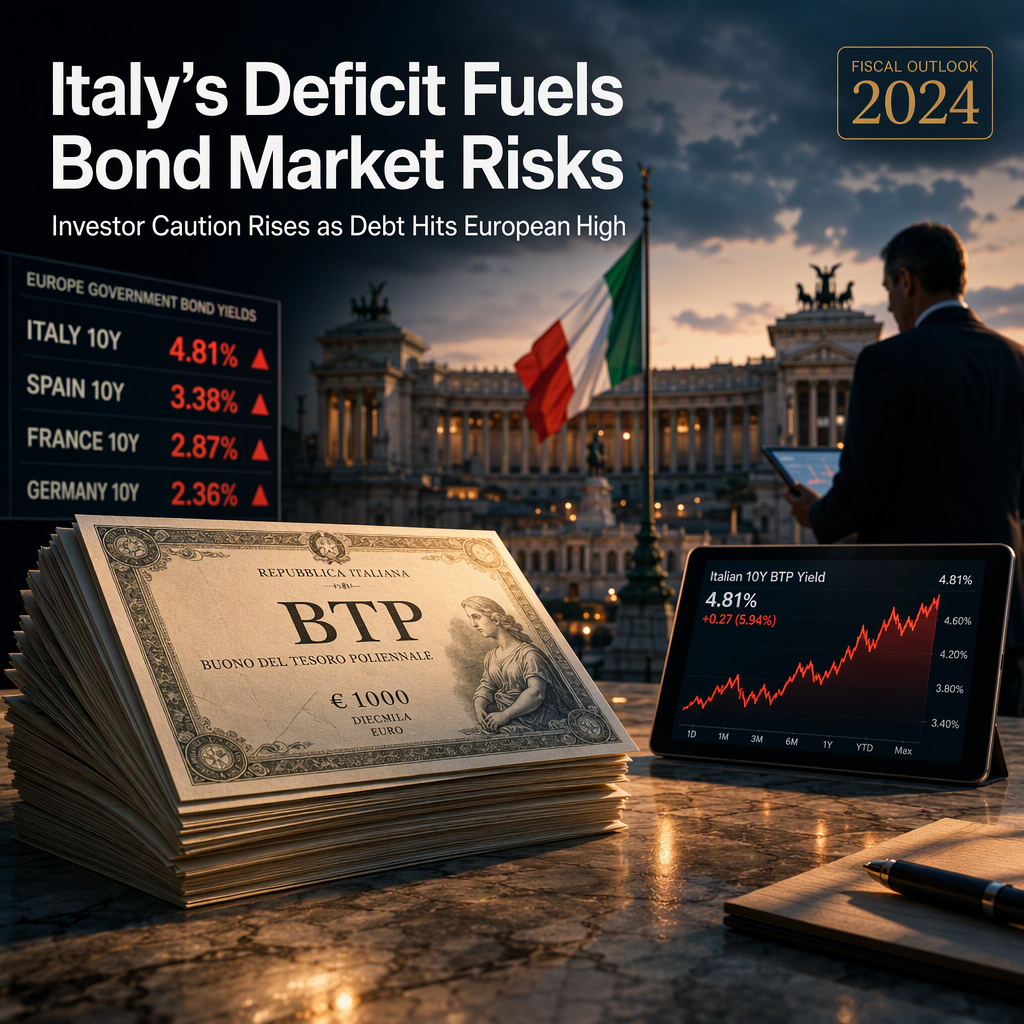
Italy's government bonds are under renewed scrutiny as the country's deficit widens and its debt-to-GDP ratio is projected to become the highest in Europe, according to Goldman Sachs analysts [1]. The Italian government, led by Prime Minister Giorgia Meloni's center-right coalition, approved an additional 28 billion euros ($31 billion) in borrowing over the next two years for defense and energy spending on October 2. These allocations are set to increase Italy's 2027 deficit target to 3.4% of GDP and its 2028 target to 3.2%, both higher than previous April projections of 2.8% and 2.5%, and above Goldman Sachs forecasts [1]. The spending measures are split evenly between defense and energy, each accounting for about 0.3% of GDP per year in 2027 and 2028 [1].
Investor concerns have intensified following recent turmoil in French government bonds, with France's benchmark 10-year OAT yield reaching 4.85% and Italian 10-year BTPs at 4.55%. The spread between 10-year German Bunds and Italian BTPs stood at 108 basis points as of 1:40 p.m. CET [1]. Goldman Sachs' Filippo Taddei warned that Italy's fiscal risk premia could rise ahead of the next general election, due no later than December 22, 2027, as the widening deficit and close electoral race may limit opportunities for fiscal consolidation [1].
Italian lawmakers recently voted to overhaul the country's electoral process, moving from a hybrid model to a more proportional system. While Meloni's coalition claims this will foster more stable governments, opposition voices argue it is designed to help Meloni retain power [1]. The final pre-election budget is expected to be delivered next week [1].
Taddei noted that "looser fiscal policy, tighter financial conditions and a close electoral race appear poised to weaken the debt outlook after four years of fiscal consolidation" [1]. These developments have prompted a 'significant upward surprise' in Italy's fiscal trajectory, raising concerns among investors about the sustainability of government borrowing across Europe [1].
CONCLUSION
Italy's widening deficit and increased borrowing for defense and energy are raising investor concerns about the country's fiscal outlook and government bond risks. With the debt-to-GDP ratio set to become the highest in Europe and a close-run election on the horizon, analysts expect fiscal risk premia to rise. The market is reacting with caution, as Italy's fiscal trajectory diverges from previous consolidation efforts.