
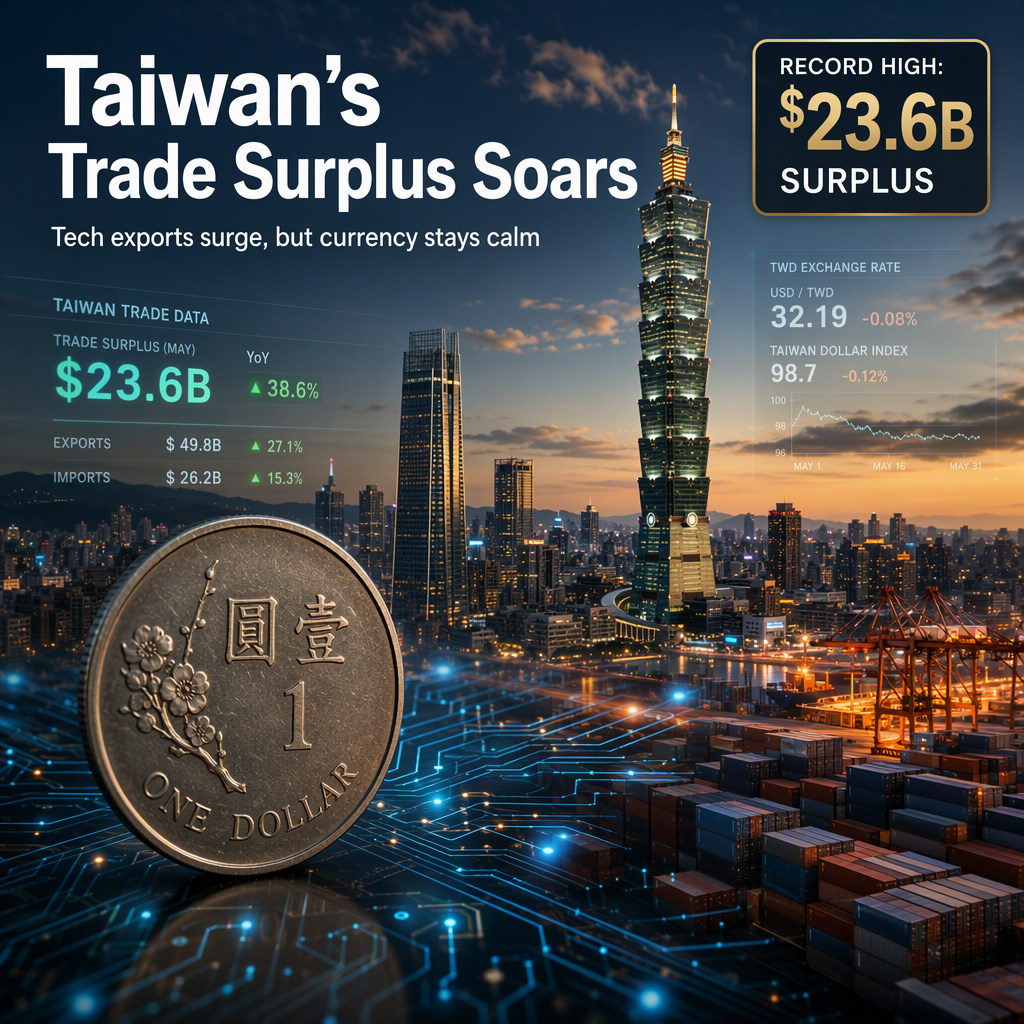
Taiwan recorded a record trade surplus in September, reaching US$23.6 billion, driven by a 60.9% year-on-year surge in exports, particularly in tech-related machinery and electrical equipment [1]. Export prices also rose significantly, up 25.8% year-on-year in September, highlighting Taiwan's position as a key beneficiary of higher global tech prices [1]. Despite these strong trade figures and a robust performance in the Taiwanese equity market, which has attracted substantial foreign inflows, the Taiwan Dollar has remained relatively stable and has not appreciated as might be expected under such conditions [1].
According to ING’s Lynn Song, this muted currency response is attributed to two main factors: increased outward investment by Taiwanese corporates seeking to expand production capacity, and capital outflows driven by the significant yield spread between Taiwan and developed markets such as the US [1]. Additionally, Taiwan's Central Bank of China has implemented measures to ensure foreign exchange stability, further dampening any upward pressure on the Taiwan Dollar [1].
Recent inflation data showed a year-on-year increase of 2.7%, and the combination of strong trade data and rising inflation suggests that economic growth remains robust [1]. ING notes that these conditions provide a solid case for the Central Bank of China to consider a rate hike at its December meeting, although it emphasizes that there is still a long way to go before any decision is made [1].
CONCLUSION
Taiwan's record trade surplus and strong export growth have not translated into a stronger Taiwan Dollar, due to capital outflows and central bank intervention. While robust economic indicators may prompt a rate hike in December, the currency remains stable for now, reflecting broader capital and policy dynamics.