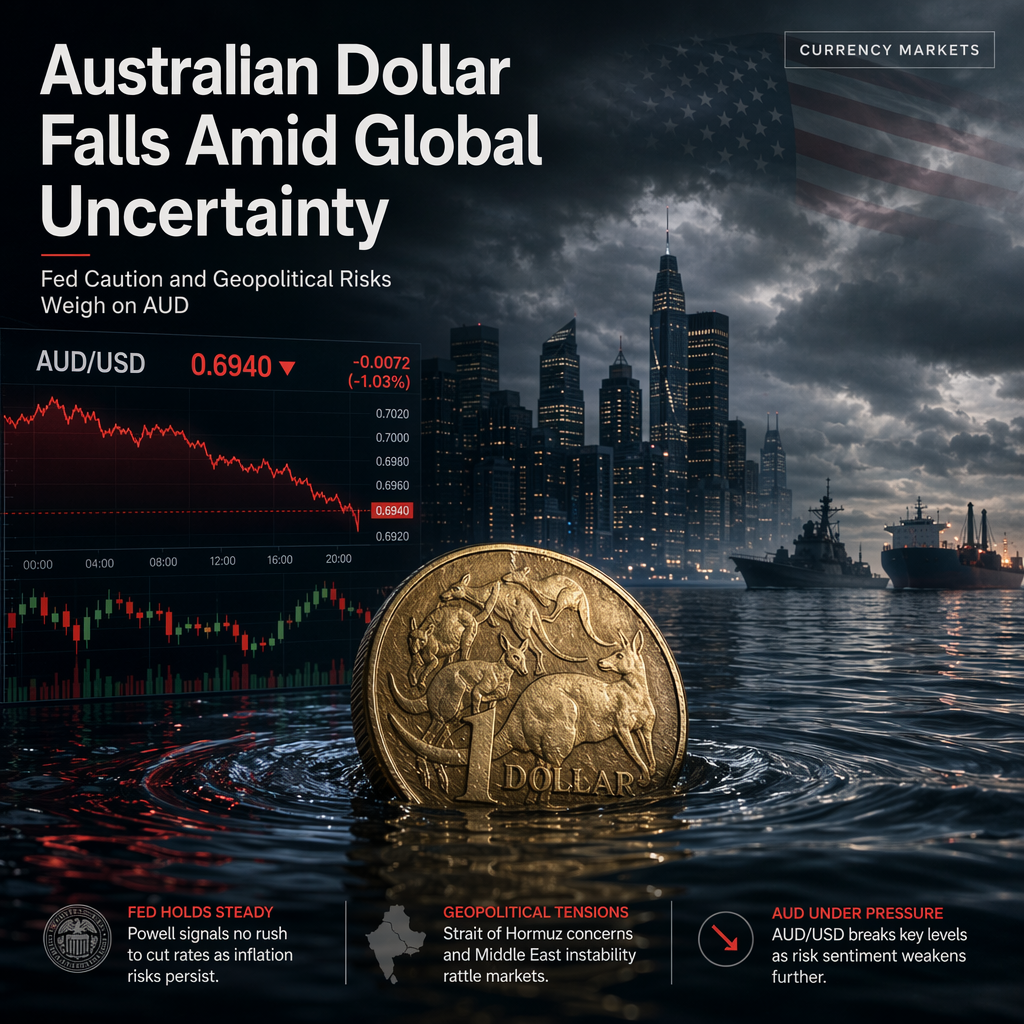
The Australian Dollar (AUD) declined against the US Dollar (USD), with the AUD/USD pair falling toward 0.6940 as the Greenback remained supported by cautious remarks from Federal Reserve officials and ongoing uncertainty regarding US inflation data [1]. Despite the latest US labor data showing the ADP Employment Change 4-week average easing to 21K from 24.25K—indicating a softer pace of private hiring and a cooling labor market—the USD held firm. This resilience was attributed to investor caution ahead of upcoming US economic data and the Federal Reserve's continued data-dependent policy stance [1].
New York Fed President John Williams commented that the US economy is experiencing steady, trend-like growth and that the job market remains stable. However, he emphasized that inflation remains elevated, which keeps pressure on the Fed to maintain a restrictive monetary policy. Williams stated that monetary policy is currently well-positioned to achieve the Fed’s goals, but future decisions will depend on incoming data and evolving risks [1].
Geopolitical tensions also contributed to market risk aversion, as hostilities resurfaced in the Strait of Hormuz. An alleged Iranian attack on an oil tanker overnight sent oil prices higher and increased market caution. Iranian Foreign Minister Araqchi stated that negotiations on a final peace deal would not commence if threats continued, further heightening uncertainty [1].
From a technical perspective, AUD/USD is consolidating just above the 20-period Simple Moving Average (SMA) at 0.6936, with resistance levels at 0.6943, 0.6949, and 0.6955, and the 100-period SMA at 0.6957 acting as a stronger cap. The Relative Strength Index (RSI) is around 54, indicating mildly constructive but not impulsive momentum. A break below the 0.6936 support could expose the pair to deeper corrective risk, while a sustained move above 0.6957 would be needed for a more decisive bullish extension [1].
CONCLUSION
The Australian Dollar weakened amid cautious Fed commentary and renewed geopolitical tensions, with technical indicators suggesting limited upside momentum. Market participants remain focused on upcoming US data and ongoing risks, which are likely to drive near-term direction for AUD/USD.