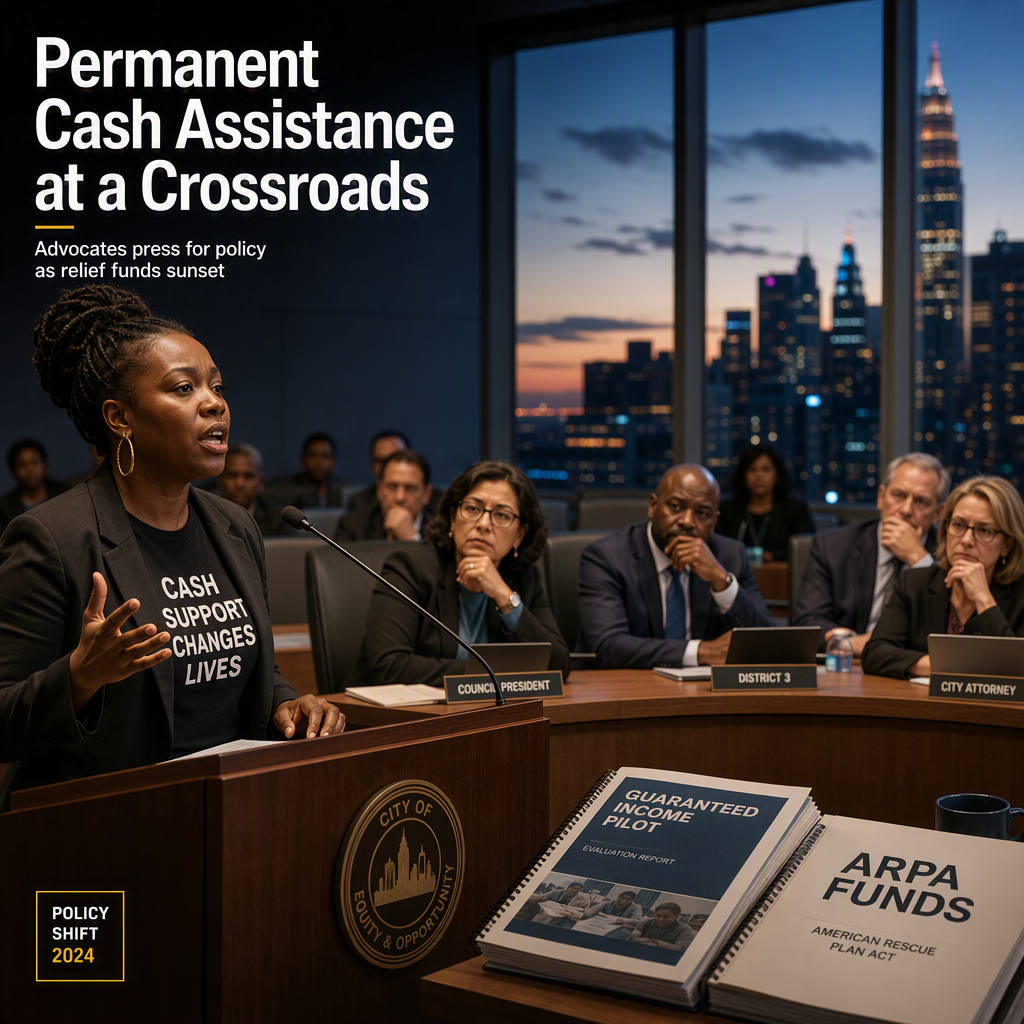
Guaranteed income advocates are working to transform pandemic-era cash assistance programs into permanent government policy, as federal COVID-19 relief funds approach their expiration date [1]. According to a report published on August 12 by Economic Security Project (ESP) researchers Shafeka Hashash, Maya Tellman, and Rayan Semery-Palumbo, there is a strong case for institutionalizing 'no-strings-attached' cash assistance, citing data from over 250 cash and guaranteed-income pilots across 40 states and the District of Columbia [1]. The report claims these findings demonstrate that direct cash transfers are a 'legitimate policy tool,' referencing the COVID-19 pandemic as an example of successful large-scale transfers that reached households quickly [1].
City leaders across the United States are facing a financial cliff as federal pandemic aid nears its final spending deadline. Under federal law, local governments had until December 31, 2024, to legally obligate their American Rescue Plan Act (ARPA) funds, and most obligated funds must be fully spent by December 31, 2026 [1]. In Evanston, Illinois, municipal officials recently announced an expansion of the city's guaranteed income program using the remainder of previously allocated ARPA funds before the spending deadline [1]. Evanston is among more than 100 U.S. municipalities that have launched universal basic income-style pilots since 2018, with many early experiments funded by a mix of private philanthropic dollars and emergency federal stimulus, which are now running out [1].
The looming shortfalls are prompting local officials to seek alternative ways to make cash handouts permanent, similar to recent tax-funded budget maneuvers in Cook County, Illinois [1]. Rather than advocating for immediate, universal cash handouts nationwide, the ESP report suggests a tactical shift: tying direct payments to specific life events, such as having a child, housing relocation, or post-incarceration reentry [1]. The authors argue that cash assistance is most effective during periods of personal or financial hardship, particularly in moments of transition like job loss or work disruption, as it allows recipients to make strategic decisions rather than hurried ones [1].
The report also notes that linking cash assistance to major life changes may make these programs more politically palatable to skeptical voters, stating that 'cash delivered at a moment of transition borrows a political logic that the public already accepts' [1].
CONCLUSION
As federal COVID-19 relief funds expire, guaranteed income advocates and local officials are exploring ways to institutionalize cash assistance programs, with a focus on tying payments to specific life events. The shift aims to sustain and expand these initiatives despite dwindling funding, potentially impacting future policy debates and municipal budgets.