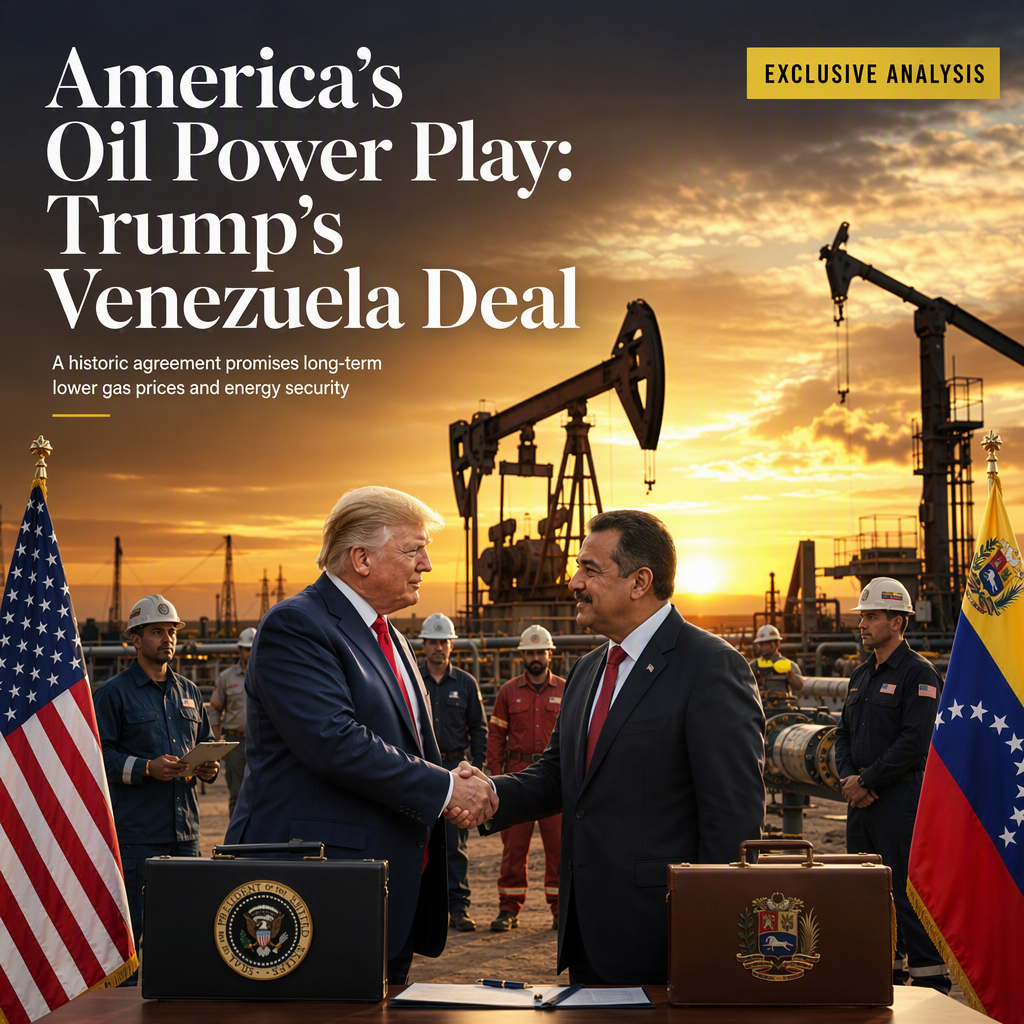
President Donald Trump announced that the United States has entered into an agreement with Venezuela to secure majority U.S. control of more than 65 billion barrels of proven Venezuelan oil reserves, a move described by oil trader Phil Flynn as a 'generational win' for American gas prices [1]. Trump stated that the deal, which he called 'THE BIGGEST OIL DEAL IN WORLD HISTORY,' was brokered by Secretary of State Marco Rubio and Secretary of War Pete Hegseth in partnership with Venezuelan interim President Delcy Rodriguez, and emphasized that it was achieved 'at no cost to the American Taxpayer' [1].
According to Trump, this transaction more than doubles American oil reserves, greatly increases the U.S. oil supply, and is expected to substantially lower gas prices for Americans 'long into the future,' while also supporting Venezuela's path toward prosperity [1]. Phil Flynn echoed these sentiments, noting that U.S. technology could transform Venezuela's oil industry and that the deal addresses concerns about depleted U.S. oil reserves, likening Venezuela to 'the biggest strategic petroleum reserve in history' [1].
Secretary Rubio praised the agreement as a 'huge win' for both countries, highlighting its role in securing stable reserves and low-cost oil in the Western Hemisphere, which he said would help lower gas prices in the U.S. [1]. However, Flynn cautioned that Americans should not expect immediate relief at the pump, stating, 'If you're looking for gasoline prices to fall 10 cents overnight, probably not going to happen,' but added that the deal would exert psychological downward pressure on prices by signaling reduced geopolitical risks [1].
The agreement follows a U.S. operation in January to capture former Venezuelan leader Nicolás Maduro, which led to a transition in power prior to the oil deal [1]. Flynn suggested that the deal is a sign that global conflicts keeping oil prices high are beginning to subside [1].
CONCLUSION
The U.S.-Venezuela oil deal is being hailed as a transformative move that could double American oil reserves and lower gas prices over the long term. While immediate price drops are unlikely, the agreement is expected to ease market concerns and signal a shift toward greater energy security and geopolitical stability.