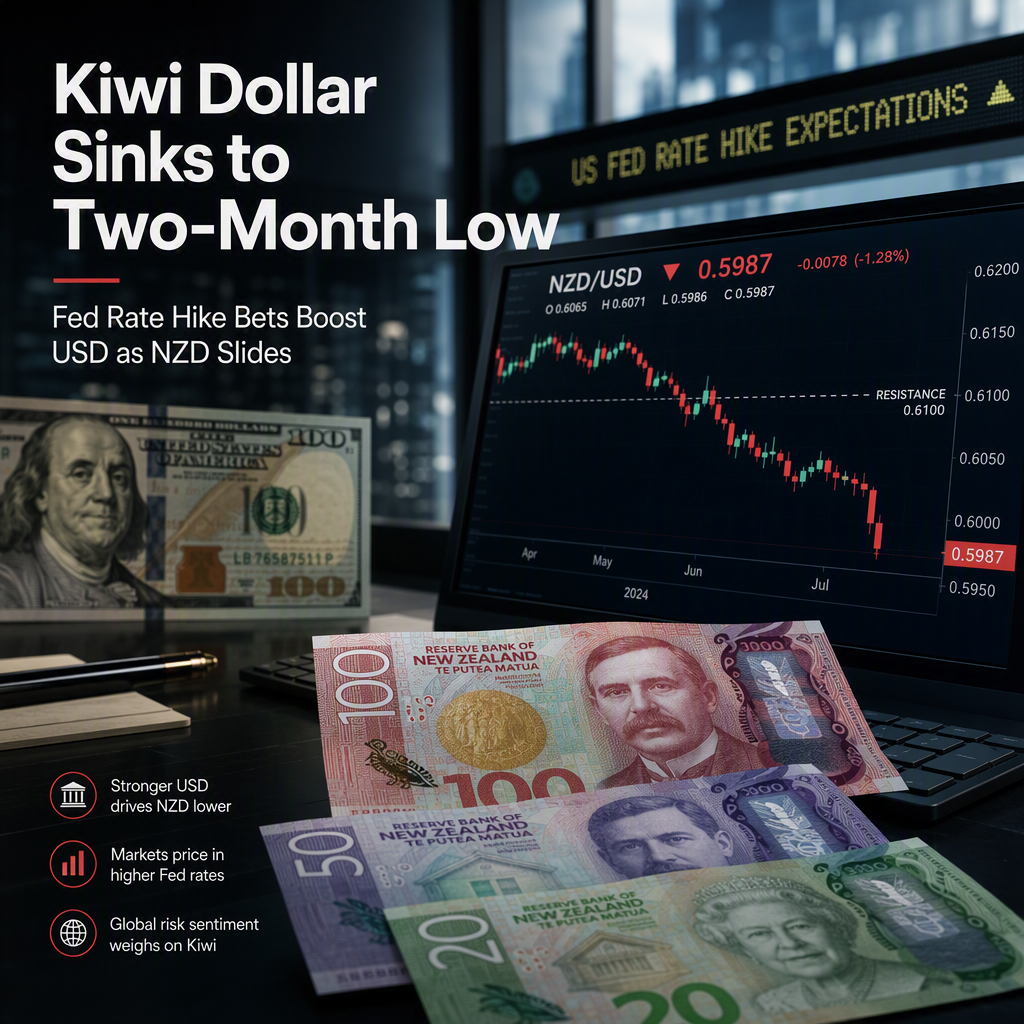
The New Zealand Dollar (NZD) has fallen to its lowest level since mid-July, with NZD/USD trading near 0.5780, down approximately 0.6% on Tuesday. The currency pair slipped below 0.5760 overnight after retreating from a session high near 0.5820, marking a significant decline in the Kiwi's value against the US Dollar (USD) [1]. This drop is largely attributed to market positioning ahead of a potential Federal Reserve (Fed) rate hike this week, which has strengthened the USD and pushed US Treasury yields higher. The NZD, known for its sensitivity to shifts in risk appetite, has been particularly impacted by these developments [1].
Technical analysis indicates a bearish near-term bias for NZD/USD, with the pair trading at 0.5778 on the 4-hour chart. The price remains below both the 20-period Simple Moving Average (SMA) at 0.5811 and the 100-period SMA at 0.5890, suggesting continued downward pressure. The Relative Strength Index (RSI) is near 30.8, signaling emerging oversold conditions that may slow further declines but are unlikely to trigger a sustained recovery unless resistance levels are breached. Immediate resistance is noted at 0.5781 and 0.5790, while support lies at 0.5772 and 0.5766. A decisive move above the resistance band would be required to ease the current bearish momentum [1].
Looking ahead, market participants are also awaiting China's release of August Industrial Production and Retail Sales data later in the day. Production is expected to increase to 4.8% from 4.5%, and retail sales are anticipated to firm. A stronger-than-expected industrial production rebound could provide some relief for the Kiwi, potentially stabilizing its decline. Conversely, weaker data would likely exacerbate the downward pressure, leaving NZD/USD exposed toward the 0.5750 area, where Monday's low is situated [1].
CONCLUSION
The New Zealand Dollar's decline to a two-month low is driven by expectations of a US Fed rate hike and stronger US Dollar, with technical indicators pointing to continued bearish momentum. Upcoming Chinese economic data could influence the Kiwi's trajectory, but for now, the market remains cautious and risk-sensitive.