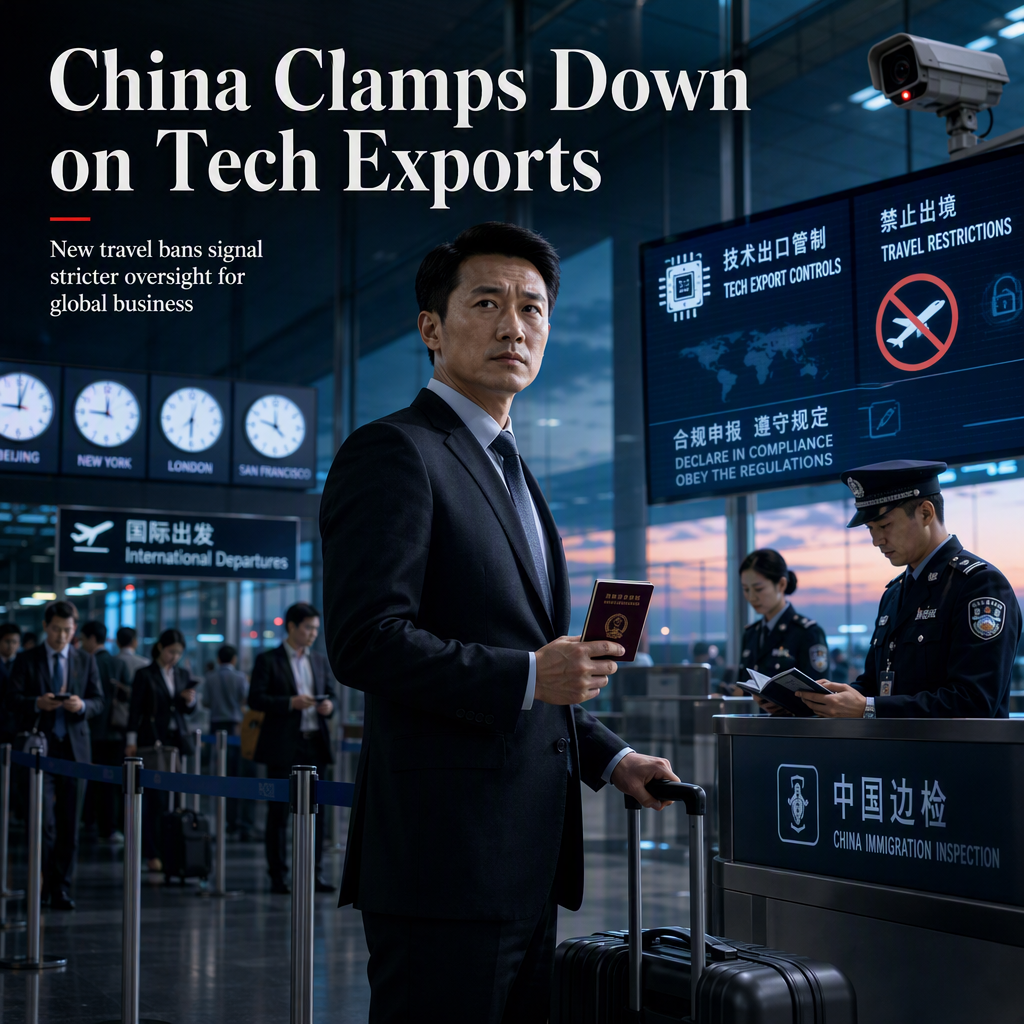
China has formally implemented new restrictions preventing its citizens from leaving the country if they are found to have violated technology export controls, marking an expansion of Beijing's oversight on tech outflows and cross-border business activities [1]. These rules, which took effect starting Tuesday, build upon earlier measures that strengthened oversight of overseas investment as of July 1 [1]. According to Shuai Peng, CEO of Lex Magister, the new regulations require all companies with global operations to ensure compliance, especially when executives are involved in negotiations abroad [1].
The scope of the new rules is broad, impacting not only semiconductor and artificial intelligence companies but also all industries covered under the Commerce Ministry's export controls list [1]. However, Peng noted that participation in international conferences, such as the annual Consumer Electronics Show in Las Vegas, is not expected to face significant restrictions [1]. The main objective of the policy is to close loopholes that previously allowed individuals and capital to exit China without government oversight, a practice that has seen many Chinese businesses establish overseas operations in jurisdictions like Singapore [1].
Guo Shan, a partner at Hutong Research, highlighted that the impact of these measures will likely be most pronounced in Singapore and Japan, due to Beijing's concerns about uncontrolled technology transfers to Singapore and illegal rare-earth exports to Japan [1]. Despite these targeted effects, Guo does not anticipate that the new rules will materially affect broader global business sentiment toward China [1].
The new exit-entry rules were announced in late July, reflecting China's ongoing efforts to tighten control over technology and capital flows [1].
CONCLUSION
China's expanded tech export controls and new restrictions on overseas travel for violators signal increased regulatory scrutiny over technology and capital outflows. While the measures are expected to impact certain regions and industries, analysts cited in the article do not foresee a significant shift in overall global business sentiment toward China.