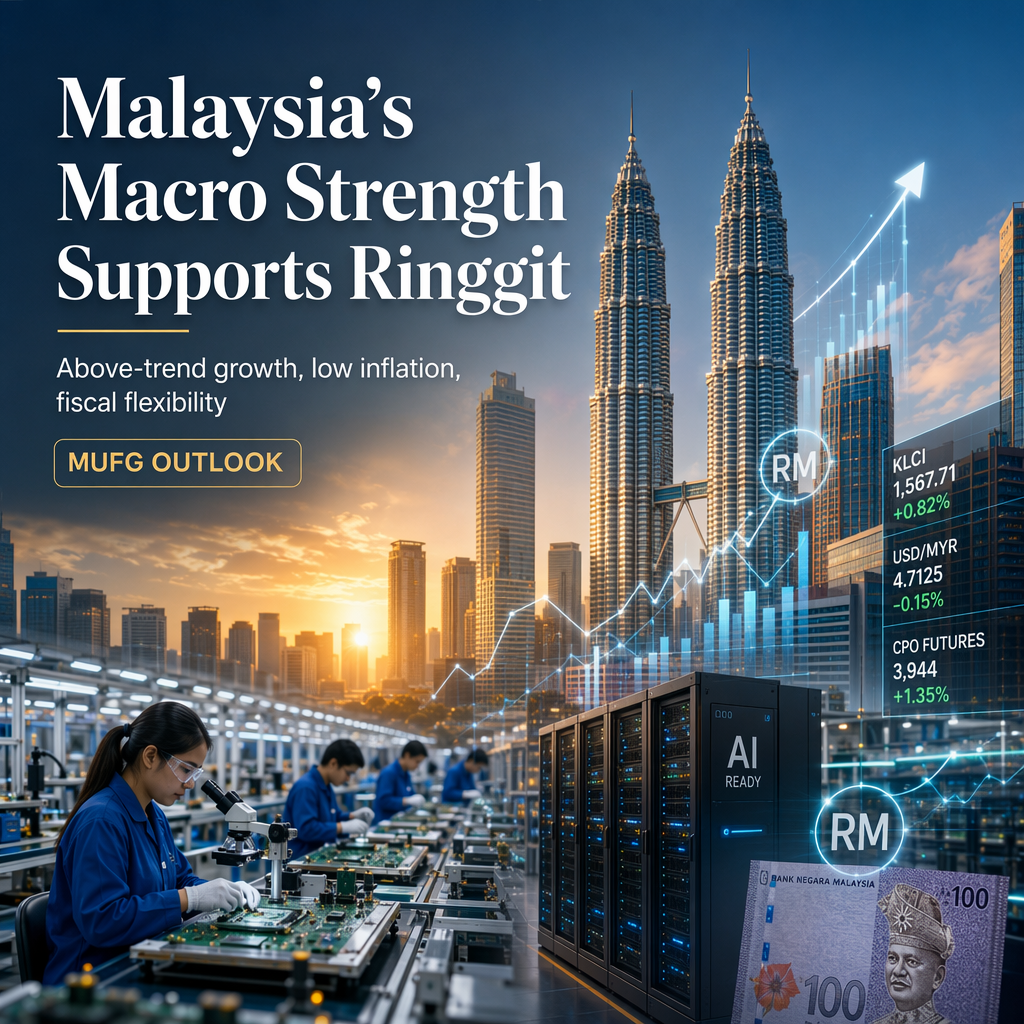
MUFG highlights that Malaysia continues to stand out as one of Asia’s stronger-performing economies, supported by above-trend growth, low inflation, and robust external demand, particularly in the electronics sector [1]. The Malaysian economy grew by 5.8% year-on-year in Q2, accelerating from 5.4% in Q1, and has maintained growth above the 4.9% trend for the past four quarters, despite challenges such as the Middle East conflict [1]. Key drivers of this growth include healthy household consumption, rising wages, low unemployment, and strong investment activity, with the electronics sector benefiting from global demand for computing equipment and AI-related infrastructure [1].
Inflation in Malaysia remains relatively contained compared to regional peers, with headline inflation at only 2% year-on-year in June [1]. Government fuel subsidies have played a significant role in shielding consumers from volatile energy prices, preserving household purchasing power, and reducing pressure on Bank Negara Malaysia (BNM) to tighten monetary policy [1]. As a result, MUFG expects BNM to maintain a neutral policy stance and keep the Overnight Policy Rate unchanged at 2.75%, noting that markets may have overpriced the likelihood of a rate hike [1].
Additionally, Malaysia’s status as a net energy exporter means that higher energy prices could boost government revenues, providing fiscal flexibility to sustain fuel subsidy programs and limit inflation pass-through to consumers [1]. MUFG concludes that the combination of above-trend growth and moderate inflation gives Malaysia one of the most balanced macroeconomic profiles in the region [1].
CONCLUSION
Malaysia’s economy is demonstrating resilience with strong growth, low inflation, and policy stability, according to MUFG. The central bank is expected to keep rates unchanged, and higher energy prices may further support fiscal flexibility. Overall, the outlook for the ringgit and Malaysia’s macroeconomic stability remains positive.