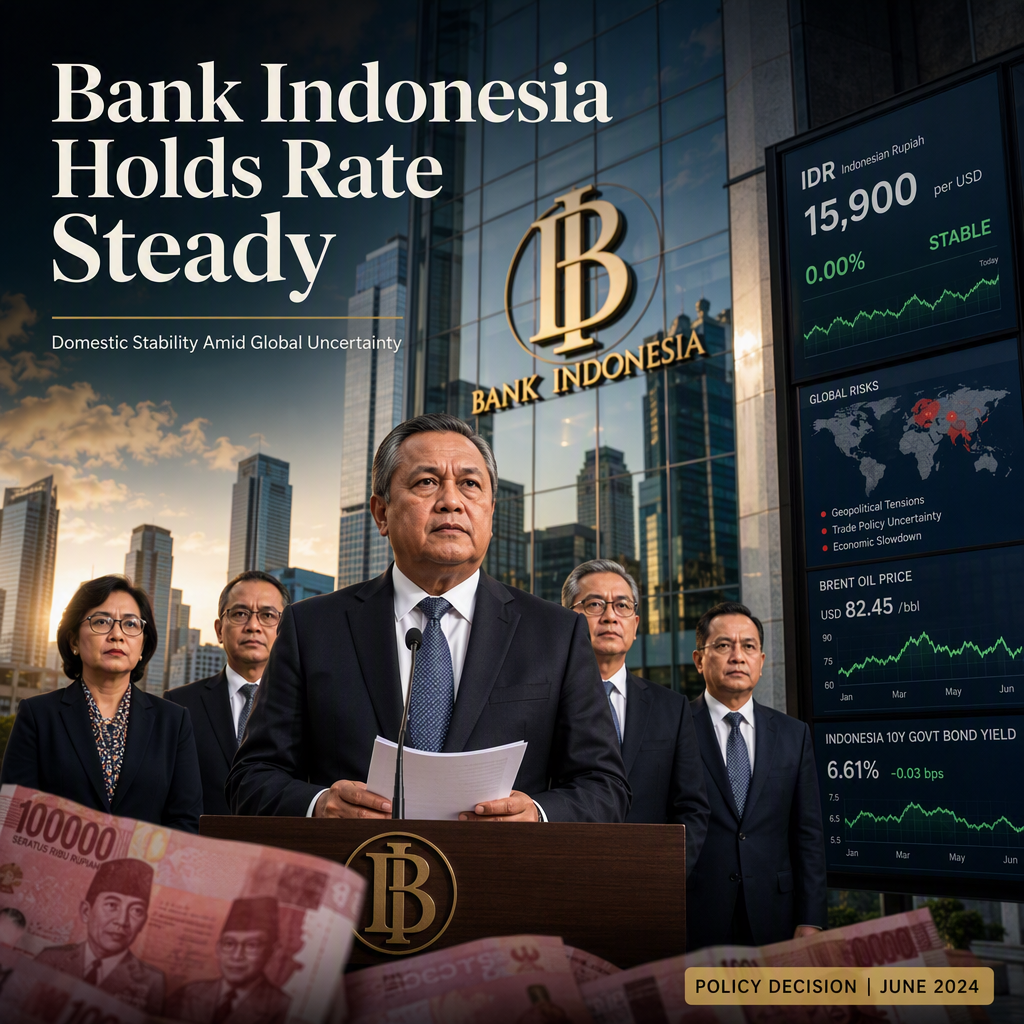
Bank Indonesia (BI) decided to keep its policy rate unchanged at 5.75%, a move that was widely anticipated by the market, according to DBS Group Research economist Radhika Rao [1]. Acting Governor Destry maintained a neutral policy bias while emphasizing ongoing global risks as a key consideration for the decision [1]. The stability of the Indonesian Rupiah (IDR) and a strong domestic growth report for the second quarter were cited as primary factors supporting the rate pause [1].
The article notes that policy risks for Indonesia are currently viewed as being driven by external factors, with the currency and bond markets remaining vulnerable to geopolitical developments, elevated global oil prices, crack spreads, and developed market (DM) yields [1]. Few changes were made to the measures announced in July, but BI extended the hedging discount to include foreign direct investment (FDI) and foreign borrowings by domestic banks, in addition to portfolio investors [1]. Additionally, a flexible rollover mechanism was introduced to extend swaps based on the remaining life of underlying assets, subject to pre-conditions [1].
Domestically, catalysts have become more constructive after the government reinforced its growth-supportive priorities for 2027 while maintaining a commitment to fiscal consolidation [1]. DBS expects BI to maintain its rate pause in September, with the possibility of one 'insurance' rate hike in the fourth quarter of 2026 if financial conditions and market sentiment deteriorate [1]. The article also mentions that a calming effect on US long-end rates, following buybacks, should help relieve pressure on the backend of regional rate curves [1].
CONCLUSION
Bank Indonesia's decision to hold rates reflects confidence in domestic stability but ongoing caution regarding external risks. The central bank's recent policy adjustments and the government's growth focus suggest a constructive outlook, though vigilance remains warranted given global uncertainties.