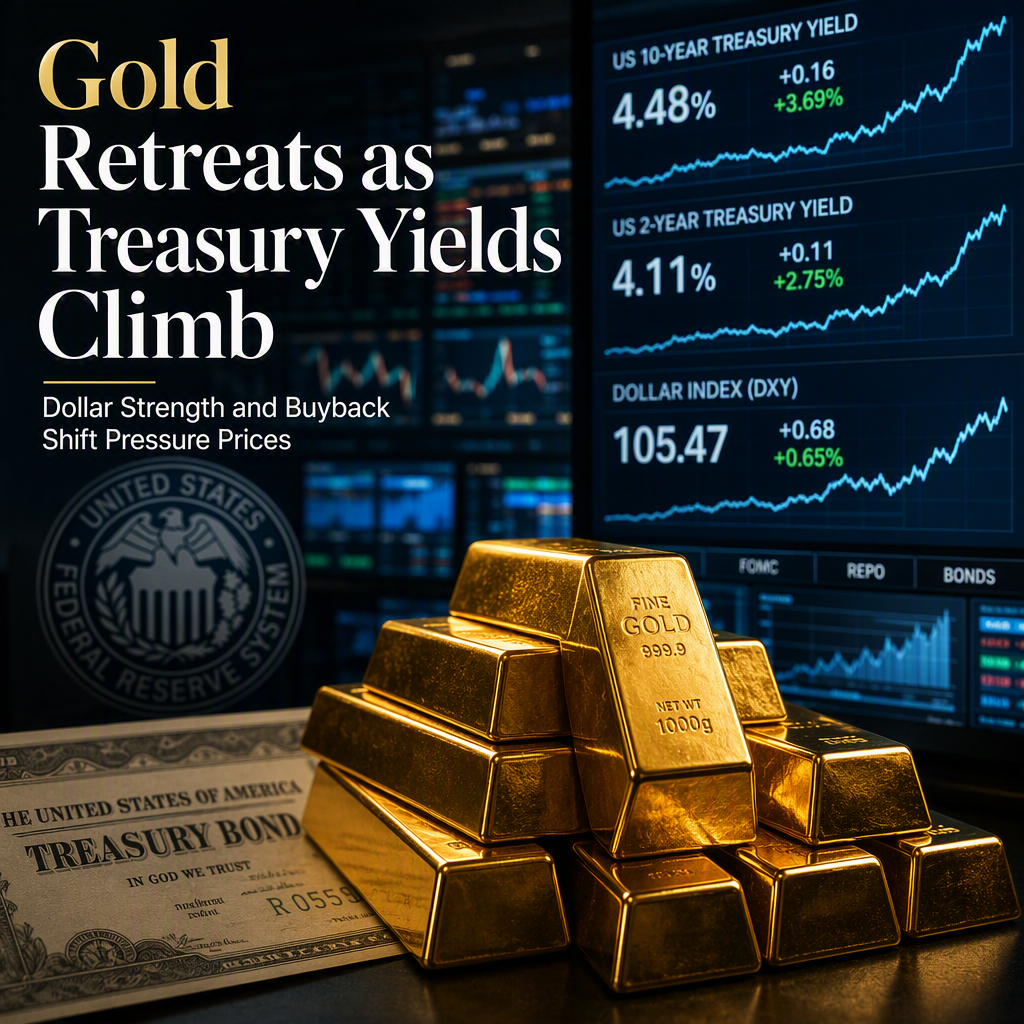
Gold (XAU/USD) pulled back by approximately 0.33% on Thursday, trading at $4,509 after reaching a daily high of $4,540, as US Treasury yields recovered some of their previous losses and the US Dollar strengthened, with the Dollar Index (DXY) rising 0.14% to 98.91. This recovery in yields and the dollar exerted downward pressure on gold prices, despite the metal maintaining a bullish bias above the $4,500 level [1].
The US Treasury Department announced an adjustment to its bond buyback program, focusing on the long end of the curve (10- to 30-year bonds) to provide liquidity in that segment. Traders interpreted this as a form of Yield Curve Control (YCC) aimed at preventing a sharp rise in the 30-year yield. In response to these developments, gold had previously surged over 4.35%, reclaiming the $4,500 mark, but subsequently pulled back as solid US jobs data and higher Treasury yields weighed on the market [1].
US Initial Jobless Claims for the week ending August 15 came in at 206,000, lower than both the previous reading of 212,000 and the expected 210,000, while the 4-week moving average increased by 5,000 to 204,000. Comments from Federal Reserve officials highlighted ongoing concerns about inflation and the impact of robust economic growth on the bond market. St. Louis Fed President Alberto Musalem noted the influence of growth and capital expenditure, while San Francisco Fed's Mary Daly pointed out that rising long-term yields are a global concern and may reduce their effectiveness as indicators. The latest Fed meeting minutes indicated that several policymakers remain open to further rate hikes if inflation persists [1].
Money markets are currently pricing in a 68% probability that the Fed will keep rates unchanged at the September meeting, with a 32% chance of a 25-basis-point hike. Looking ahead, the US economic calendar features S&P Global Flash PMIs on Friday, which could provide further market direction [1].
Technically, gold remains upward-biased after reclaiming the 200-day Simple Moving Average (SMA) and breaking a five-month-old downward resistance trendline from all-time highs near $5,600. The Relative Strength Index (RSI) remains bullish, suggesting potential for further gains if market conditions support it [1].
CONCLUSION
Gold prices have retreated slightly as US Treasury yields and the dollar recover, following the Treasury's adjustment to its bond buyback program. Despite the pullback, gold maintains a bullish technical outlook above $4,500, with market participants closely watching upcoming US economic data and Federal Reserve policy signals for further direction.