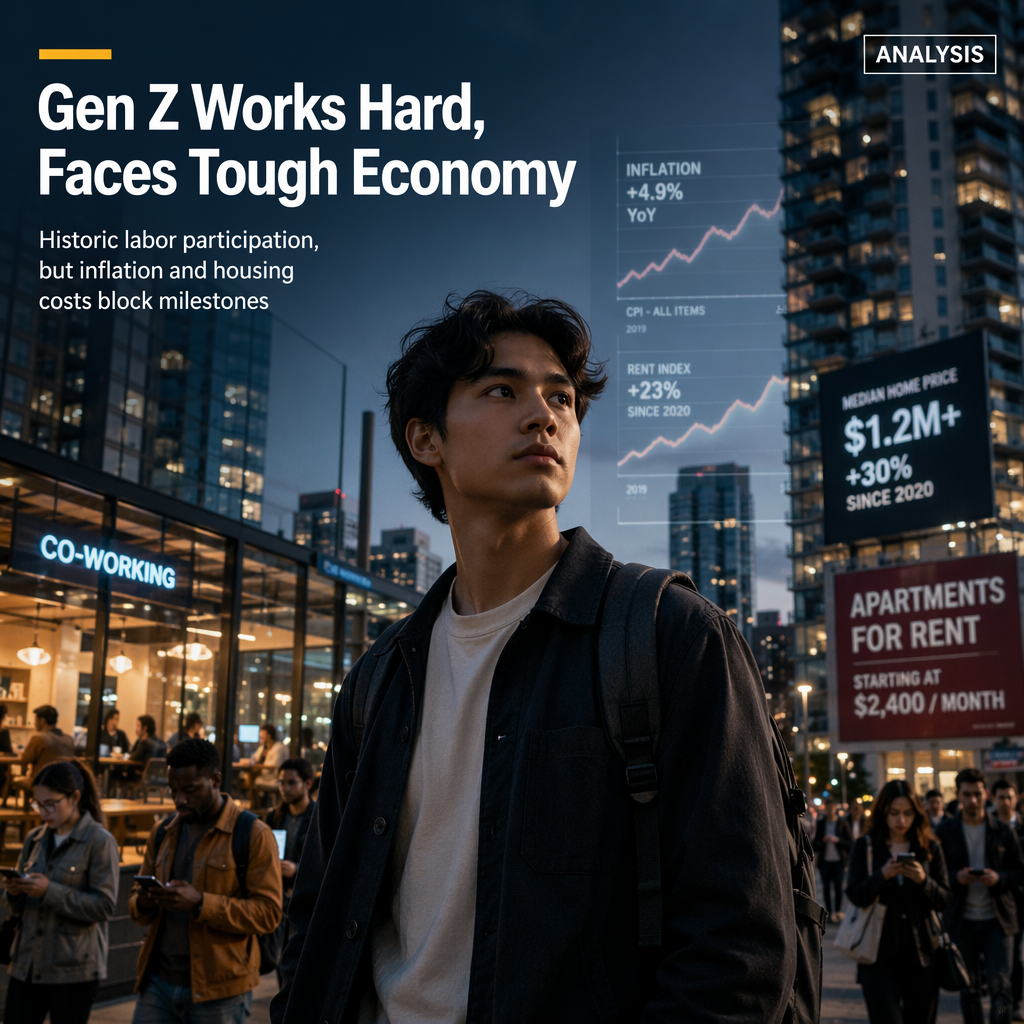
Recent discussions have highlighted the economic challenges facing Generation Z, defined as Americans born between 1997 and 2012, as they navigate a difficult economic landscape. Despite criticism from White House press secretary Karoline Leavitt, who initially suggested Gen Z's frustrations were due to 'laziness,' labor force participation among young Americans remains historically strong. Leavitt later clarified her remarks, stating that many Gen Z Americans are hardworking, entrepreneurial, and deeply patriotic, and that her comments were directed at those embracing socialism and communism, not the entire generation [1].
Labor force participation among Americans aged 25 to 54 stood at about 83% in May, near its highest level in decades, according to Bureau of Labor Statistics data. Participation among those aged 20 to 24 has also remained above pre-pandemic levels [1]. Economists note that Gen Z entered adulthood during one of the most challenging economic environments in decades, characterized by high inflation, soaring housing costs, and a cooling white-collar job market. These factors have led many young adults to delay milestones such as homeownership, marriage, and having children, as household expenses continue to outpace wage growth [1].
Experts like Heritage Foundation Chief Economist EJ Antoni and Richard Stern of the Plymouth Institute for Free Enterprise emphasize that high labor participation rates among young people should not be mistaken for a lack of work ethic. Stern specifically points out that Gen Z's preference for flexible or remote work does not equate to laziness, and that labor participation rates for 16- to 19-year-olds and 20- to 24-year-olds are all high [1].
The Trump administration's economic agenda, including tax cuts and deregulation, is being positioned as a means to improve economic conditions for younger Americans, according to Leavitt [1]. However, the article notes that the current economic environment remains a significant barrier to achieving traditional markers of the 'American dream' for many in Gen Z.
CONCLUSION
Gen Z is participating in the workforce at historically high rates, but faces significant economic headwinds such as high inflation and unaffordable housing. While political debate continues over the causes of Gen Z's frustrations, experts agree that the generation's work ethic is strong, and that economic conditions, not attitude, are the primary obstacle to traditional milestones.