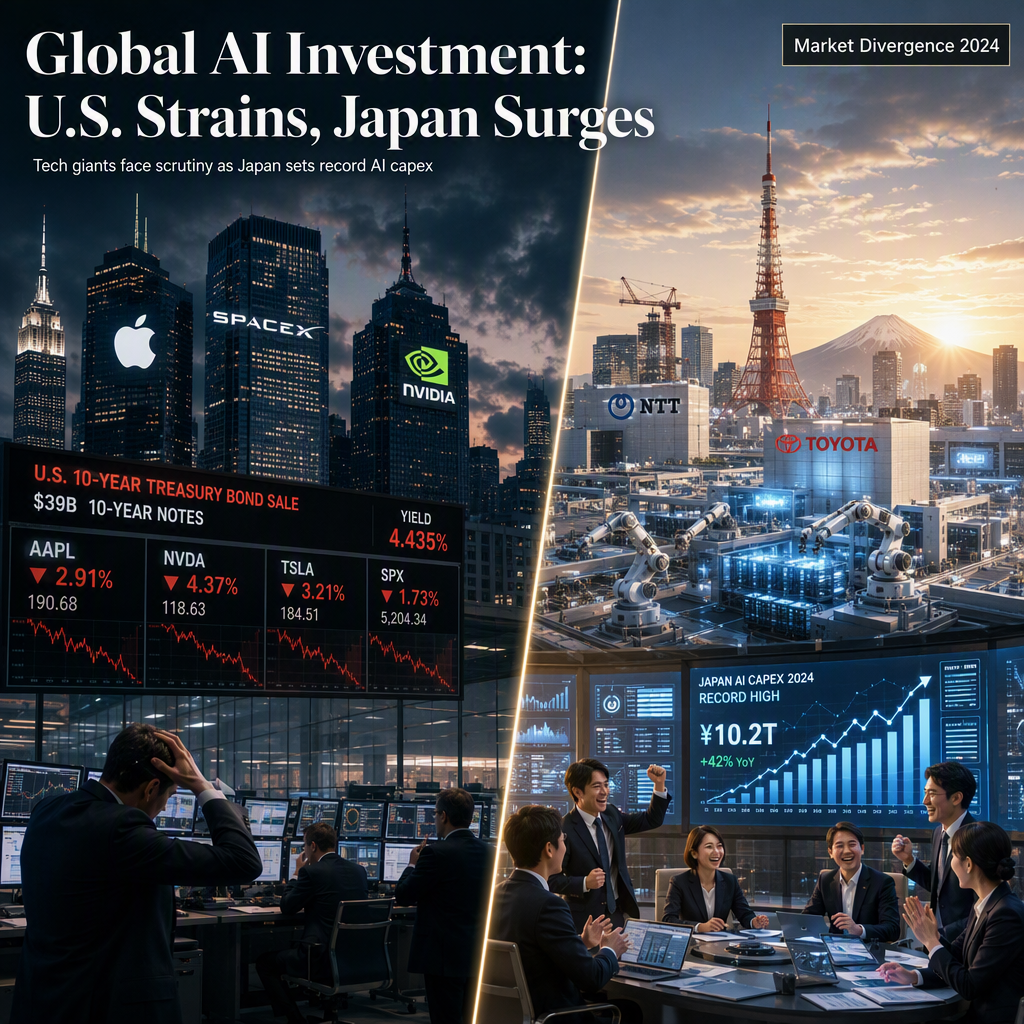
The global race for artificial intelligence dominance has triggered a surge in corporate fundraising, with U.S. tech giants aggressively seeking billions of dollars through bond and share offerings. This has resulted in global corporate bond sales reaching $3.7 trillion in the first half of the year, as companies secure capital for technology expansion. However, higher borrowing costs are beginning to weigh on investor sentiment, raising concerns about the sustainability of the current pace of investments. SpaceX, which saw its market capitalization balloon to $3 trillion after its IPO, has experienced a subsequent slump in share price, highlighting investor risk awareness and concerns about lofty valuations. Market participants are now questioning the risks associated with aggressive fundraising and rising leverage among tech giants, especially as borrowing becomes more expensive and investor scrutiny increases. Technical indicators such as moving averages and volume trends are being closely watched amid recent volatility in SpaceX shares and the broader tech sector [1].
In contrast, Japanese companies are leading a record year for capital expenditure, driven by investments in AI infrastructure, data centers, chipmaking, and power grids. NTT and Toyota are at the forefront, with significant spending on AI and factory upgrades, while Nippon Steel and Honda are also investing heavily to modernize production lines. Memory makers in Japan are reportedly flush with $90 billion in cash flow due to the ongoing AI gold rush. Market sentiment remains strongly bullish for Japanese capex, with analysts noting that the surge is a direct response to competitive pressures from global tech giants and the need to modernize production. Capex levels are breaking previous records, and further investment is supported at current price levels, with resistance only likely if global demand slows. Trading advice emphasizes the strength of Japanese industrial stocks tied to AI and semiconductor supply chains, recommending investors monitor capex announcements and adjust positions accordingly [2].
While the long-term prospects for AI remain robust, the funding spree in the U.S. is showing signs of strain due to higher borrowing costs and increased investor scrutiny. Meanwhile, Japan's capital spending surge reflects a broader trend of investment in AI and advanced manufacturing, positioning the country for sustained growth and innovation. Analysts caution that rising leverage and hidden debts among U.S. tech giants could pose risks if market conditions worsen, whereas Japanese industry is making a historic push to secure its place in the AI era [1][2].
CONCLUSION
The global AI investment boom is facing challenges as higher borrowing costs and increased investor scrutiny strain U.S. tech fundraising, exemplified by SpaceX's post-IPO share slump. In contrast, Japanese companies are experiencing a record surge in capital expenditure, driven by bullish sentiment and strategic investments in AI and manufacturing. The market takeaway is a divergence in sentiment: caution in the U.S. tech sector versus optimism in Japanese industrial stocks tied to AI.