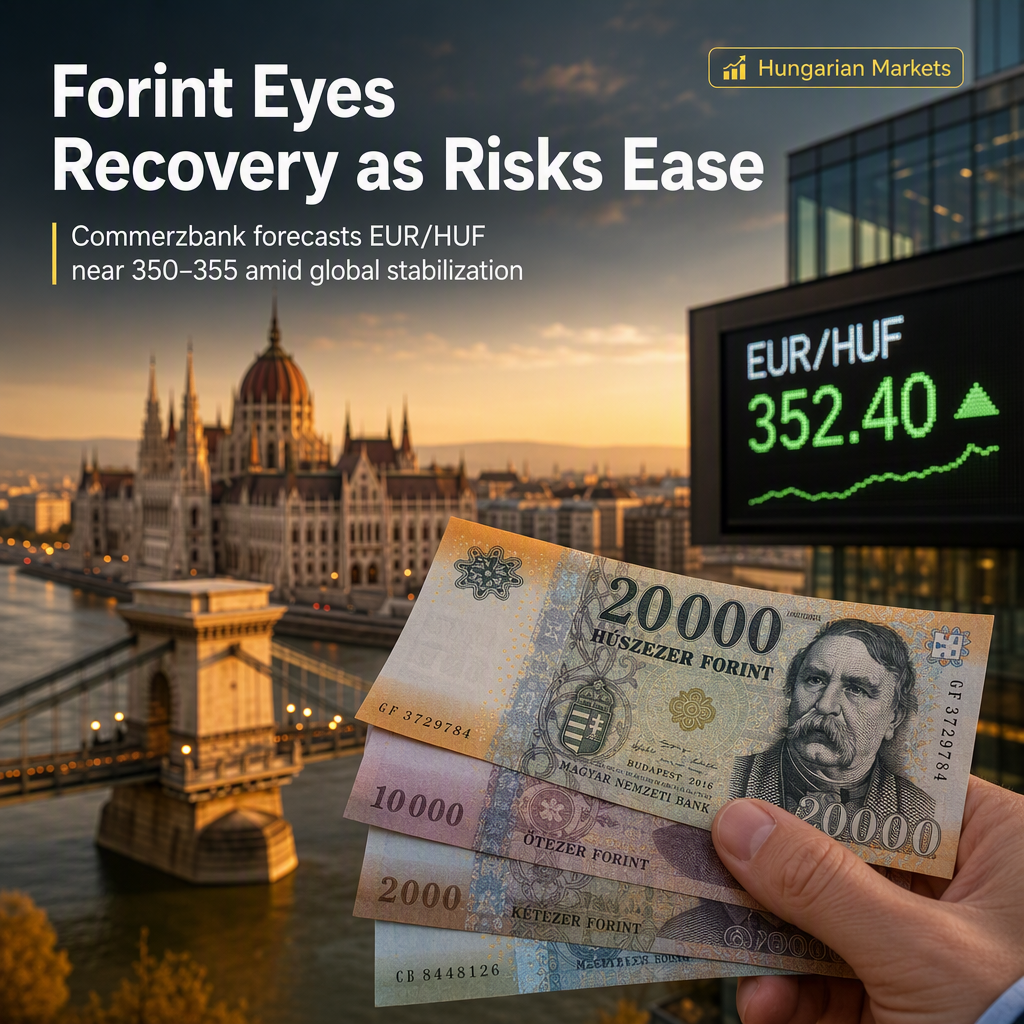
Commerzbank analyst Tatha Ghose highlights that the Hungarian Forint (HUF) has only partially retraced its post-election gains and anticipates a potential recovery against the Euro if global risk conditions stabilize. Ghose projects that the EUR/HUF exchange rate could return towards the 350–355 range in the coming months, contingent on improvements in the global risk environment [1].
The analysis notes that the recent correction in the forint should not be overemphasized, attributing the currency's underperformance to its status as the highest-beta risk play in Central and Eastern Europe (CEE), which made it particularly vulnerable during the recent global risk-off episode. Factors such as energy shocks, geopolitical risks, and drought have raised stagflation concerns—characterized by weaker growth prospects and higher inflation risk—which have disproportionately impacted the forint compared to other regional currencies like the zloty or the koruna [1].
Ghose emphasizes that the recent move in the forint was more a partial unwinding of a strong prior rally rather than a reassessment of Hungary’s political landscape. He points out that regime-change expectations have not disappointed, Tisza’s ratings remain strong, and Magyar is advancing with reforms on multiple fronts. If the global risk backdrop stabilizes, the forint is expected to recover part of its recent losses, with EUR/HUF potentially moving back towards the 350-355 area [1].
However, the report also warns of longer-term headwinds. Ghose cites challenges such as slow trend growth, the need for meaningful reforms, and tighter fiscal policy, all of which will present significant hurdles. Additionally, as the Hungarian central bank (MNB) continues to cut rates and underlying inflation momentum ceases to improve, Hungary’s real interest rate is likely to narrow. This, combined with weak growth, is expected to exert renewed pressure on the forint into 2027 [1].
CONCLUSION
Commerzbank anticipates a near-term recovery for the Hungarian Forint against the Euro if global risk conditions improve, with EUR/HUF potentially returning to the 350–355 range. However, structural challenges and narrowing real interest rate support could weigh on the forint in the longer term, especially into 2027.