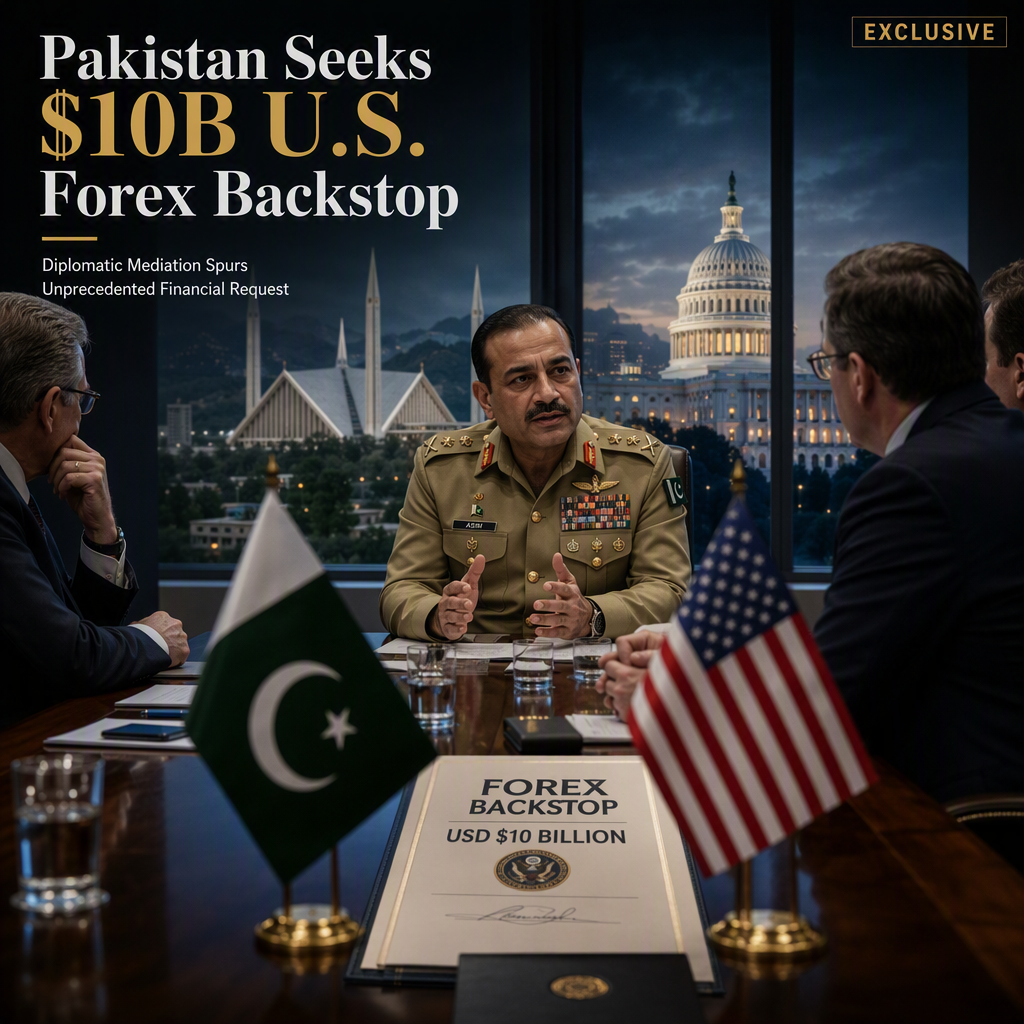
Pakistan has recently applied for a U.S. foreign currency backstop facility worth up to $10 billion, aiming to bolster its ability to withstand foreign reserve-related shocks and provide a safety net against future currency volatility and external shocks [1]. The request follows Pakistan's role in mediating between the U.S. and Iran, a diplomatic effort led by Field Marshal Asim Munir, the country's military chief [1].
While official details of the proposed backstop arrangement have not been disclosed, analysts suggest it would likely involve the U.S. Federal Reserve or U.S. Treasury providing Pakistan with access to dollar liquidity in times of crisis, possibly through a swap line or standby credit arrangement—an unprecedented move for Pakistan, which has traditionally relied on the International Monetary Fund and bilateral partners such as China and Saudi Arabia for such support [1].
Experts warn that the funding could subject Pakistan to increased scrutiny from Washington, particularly regarding its financial dealings with China and its commitments under the China-Pakistan Economic Corridor (CPEC) megaproject [1]. Analysts note that U.S. backing will likely come with conditions, including demands for greater transparency on Pakistan’s external debt, which could limit Islamabad’s strategic options and require more disclosures about its financial system [1].
The application for the $10 billion facility comes at a time when Pakistan’s foreign exchange reserves are under significant pressure, with the central bank struggling to maintain import cover and stabilize the rupee amid concerns over debt repayments and external financing gaps [1]. Islamabad’s move is seen as an effort to diversify its sources of financial support and reduce reliance on traditional partners [1].
CONCLUSION
Pakistan's application for a $10 billion U.S. forex backstop marks a significant shift in its financial diplomacy, potentially increasing its alignment with Washington while inviting greater scrutiny of its external debt, especially to China. The move highlights Islamabad’s urgent need to stabilize its reserves and currency, and could have far-reaching implications for its strategic and financial relationships.