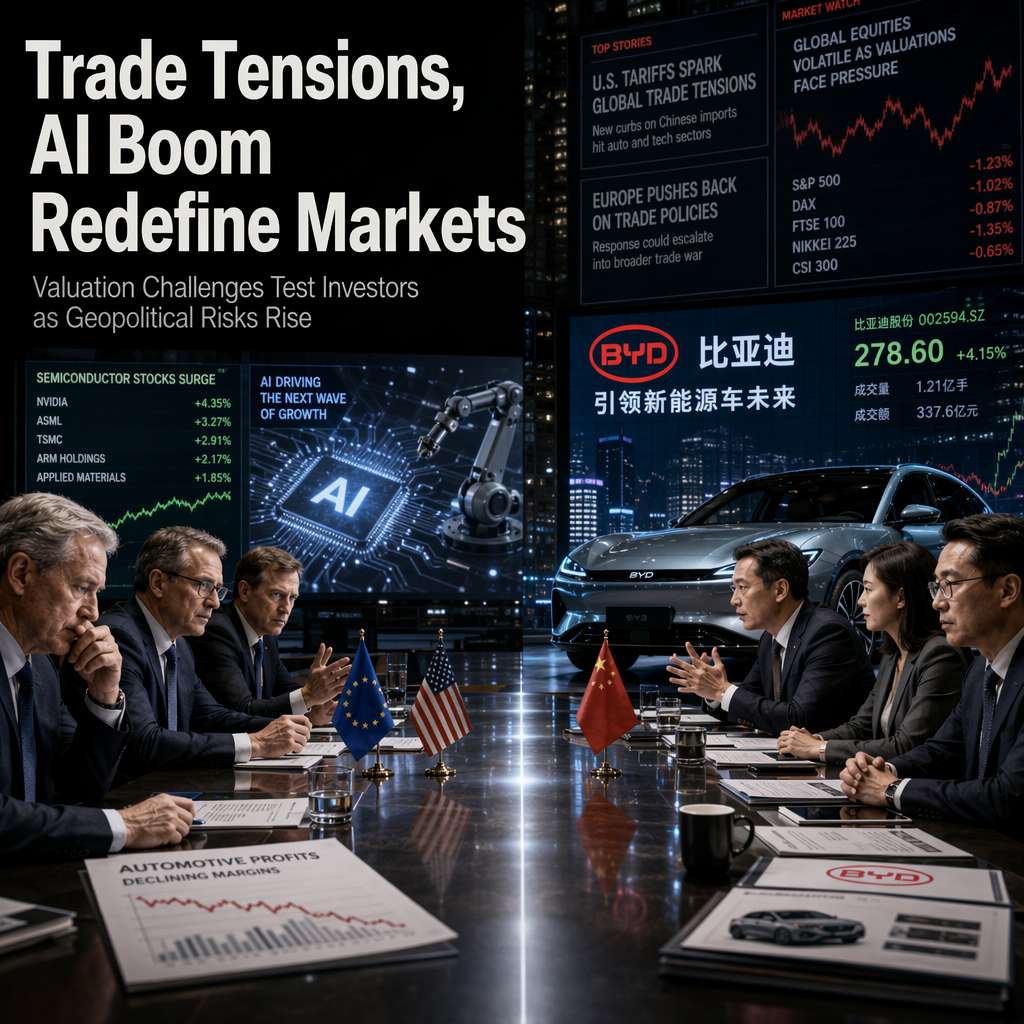
BNY’s Geoff Yu highlights that increasing Western scrutiny and potential tougher actions against Chinese automakers could intensify pressure on Europe’s legacy car manufacturers. White House senior trade adviser Peter Navarro has urged Europe and other Western governments to adopt stricter measures against Chinese firms, noting that Chinese automakers are making aggressive gains in foreign markets while Western responses remain insufficient. Navarro emphasized that the U.S. is the only major auto market that has successfully kept BYD out, although the company is now approaching U.S. borders. He also pointed out that current tariffs and policies have not prevented Chinese brands from expanding in Europe, even as established carmakers such as Volkswagen and BMW have been forced to cut jobs and lower their earnings guidance [1].
On the earnings front, results from U.S. banks and TSMC reinforce the ongoing AI-led growth cycle, with robust capital markets activity, stable client demand, and strong demand for AI-linked semiconductors. This suggests that the market’s growth is grounded in tangible performance rather than mere optimism [1]. However, the report notes that while value opportunities persist, it is becoming increasingly difficult to acquire verified growth at reasonable prices. Warren Buffett’s observation that widespread risk-taking makes genuine bargains scarce is echoed in the current market environment, where the most reliable growth engines are trading at premium valuations [1].
Despite supportive earnings and effective FX carry strategies, the report warns that geopolitical risks are underpriced, speculative leverage is attracting policy scrutiny, and the top-performing assets are already expensive. These factors collectively limit the appeal of European equities, even as the core growth story remains intact [1].
CONCLUSION
The articles indicate that while AI-driven growth and strong earnings continue to support equity markets, rising trade tensions and premium valuations are creating headwinds, particularly for European equities. Investors face a challenging environment where geopolitical risks and speculative behavior are increasingly relevant, making it harder to find undervalued growth opportunities.