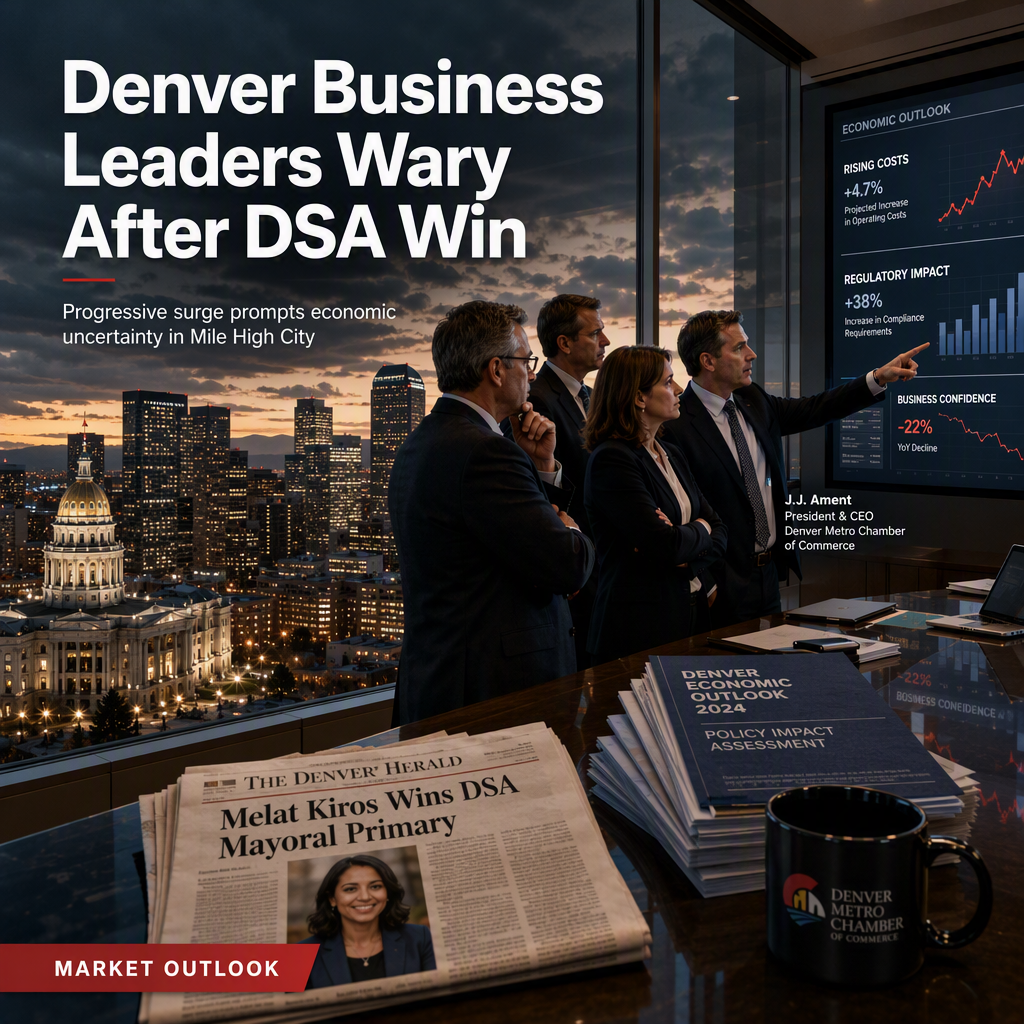
Democratic socialist candidate Melat Kiros secured a victory in Denver's Democratic primary in June, defeating 15-term incumbent Diana DeGette, with affordability cited as a top concern among voters [1]. The win marks a significant shift as democratic socialists gain momentum in Colorado, prompting apprehension among Denver business leaders regarding the potential clash between progressive policies and the economic realities of operating in the city [1].
J.J. Ament, president and CEO of the Denver Metro Chamber of Commerce, highlighted that while the chamber is nonpartisan and does not endorse individual candidates, it actively promotes pragmatic, pro-business policies and free enterprise at the member level [1]. Ament noted that Colorado has undergone substantial changes over the past decade, moving from one of the top 10 states for business to a state where increasing regulations and higher taxes have made it more challenging for businesses to thrive [1]. He emphasized that single-party control, regardless of political affiliation, can lead to increased regulation, higher fees, and taxes, raising the cost of doing business [1].
Ament expressed concern that DSA-backed policies, such as raising the minimum wage and corporate taxes, could negatively impact workers and small businesses, citing the example of restaurant owners who have struggled with government interference in minimum wage and tipped wage policies [1]. He argued that policies intended to benefit consumers and workers may not always achieve their intended outcomes [1]. The chamber has previously warned that Colorado is becoming "increasingly hostile to business" as DSA-backed candidates gained seats on the Denver City Council in 2023 [1].
Looking ahead, Ament stated that the chamber's goal is to help people understand the economic realities of running a business and to promote policies and incentives that simplify and reduce the cost of starting a company [1].
CONCLUSION
The victory of Melat Kiros and the rise of democratic socialists in Denver have raised concerns among business leaders about the potential for increased regulation and higher costs. While affordability remains a key issue for voters, the business community is wary of policies that may inadvertently harm workers and small businesses. The market takeaway is a cautious outlook, with business leaders advocating for pragmatic, pro-business solutions amid shifting political dynamics.