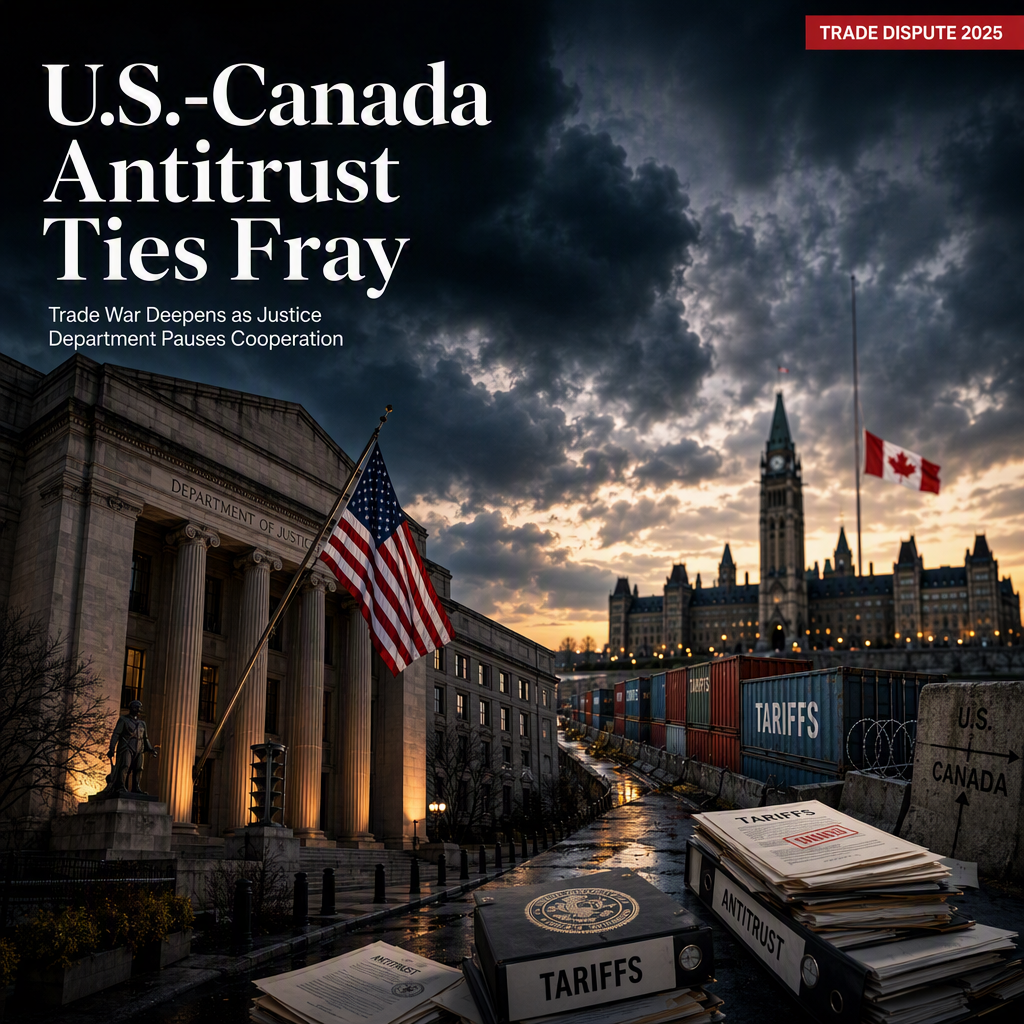
The U.S. Justice Department's antitrust division was instructed earlier this week to halt all collaborative work with the Canadian government as trade tensions between the two countries escalate, according to emails obtained by The Wall Street Journal and reported by Fox News [1]. Lynda Marshall, chief of the antitrust division's international section, directed officials on Wednesday to pause cooperation on cases and policy engagement with Canadian authorities, though no reason was provided for this directive [1]. Further, section chiefs were told in a separate email on Friday to submit lists of ongoing cooperation areas with Canada by the end of the day [1].
However, the DOJ disputed the report, stating that the "alleged direction was never given to anyone." Instead, the department clarified that the division was only asked to "temporarily hold off on a scheduled meeting on a specific investigation until the DOJ's antitrust team had more time to prepare" [1].
This development occurs against the backdrop of intensifying trade tensions following President Donald Trump's executive order to rename Lake Ontario to "Lake America," a move that, while only applicable to the U.S. federal government, has contributed to the ongoing strain in U.S.-Canada relations since Trump's return to the White House in January 2025 [1]. The trade war has resulted in tariffs on tens of billions of dollars in cross-border trade [1].
In response to the Trump administration’s new 50% tariffs on approximately $20 billion worth of Canadian goods, which took effect last month, the Canadian government announced it would impose retaliatory tariffs on the U.S. starting September 8 [1]. Prime Minister Mark Carney stated that Canada "will match Washington's new tariffs dollar for dollar in order to protect Canadian workers, farmers, families, and businesses" [1].
CONCLUSION
The U.S. DOJ's pause in antitrust cooperation with Canada marks a significant escalation in the ongoing trade dispute, with both countries imposing substantial tariffs on each other's goods. Market participants should closely monitor further developments, as these actions signal heightened tensions and potential disruptions in cross-border trade.