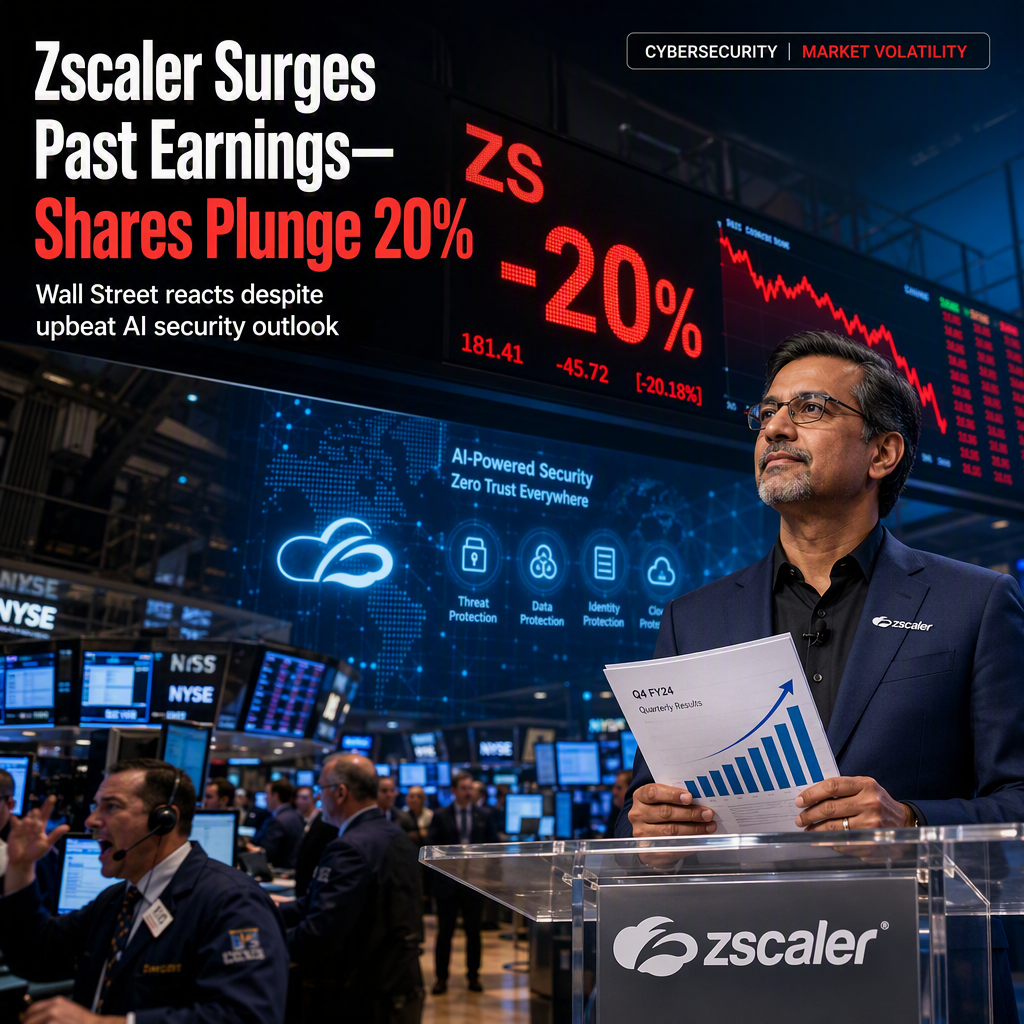
Zscaler (ZS) reported fiscal fourth-quarter results that surpassed Wall Street expectations, driven by heightened demand for cybersecurity solutions amid rising artificial intelligence risks. The company posted adjusted earnings per share of $1.19, exceeding the expected $1.09, and revenue of $898 million, above the anticipated $877 million. This represented a 25% year-over-year revenue increase from approximately $719 million. Zscaler's net loss narrowed to $3.4 million, or 2 cents per share, compared to a net loss of $17.6 million, or 11 cents per share, a year earlier. Annual recurring revenue also climbed 25% to $3.77 billion, beating the $3.75 billion estimate from StreetAccount [1].
Despite these strong results and positive guidance, Zscaler shares fell 20% on Friday. The company provided fiscal first-quarter guidance of $935 million to $939 million in revenue and adjusted EPS of $1.15 to $1.16, both above consensus estimates. For the full year, Zscaler anticipates revenue between $3.91 billion and $3.94 billion and adjusted EPS of $4.86 to $4.90, again surpassing analyst expectations [1].
CEO Jay Chaudhry attributed the performance to the adoption of Zscaler's Zero Trust cloud security architecture and highlighted the company's new Zero Trust iteration for AI agents, which is gaining early momentum and is expected to accelerate into fiscal years 2028 and 2029. Chaudhry emphasized the company's unique position and significant barriers to entry in the AI security space, stating, "It's a longer-term opportunity, but I think it's a fantastic opportunity with significant barriers to entry" [1]. Over the past year, bookings reached $100 million, growing more than 50% sequentially this quarter [1].
While the broader cybersecurity sector has seen strong gains due to the proliferation of sophisticated cyber threats and agent-led attacks, Zscaler's stock has underperformed, dropping 20% this year. Last quarter, the company experienced its worst trading day ever following a "prudent approach" to guidance after two sales leader departures. Nevertheless, Chaudhry remains optimistic, asserting that Zscaler's differentiation will become increasingly recognized as AI agent adoption grows [1].
CONCLUSION
Zscaler delivered a strong quarter with earnings and guidance exceeding analyst expectations, yet the stock declined sharply. Despite sector tailwinds and management's bullish outlook on AI-driven security, investor concerns persist, leading to significant share price volatility.