
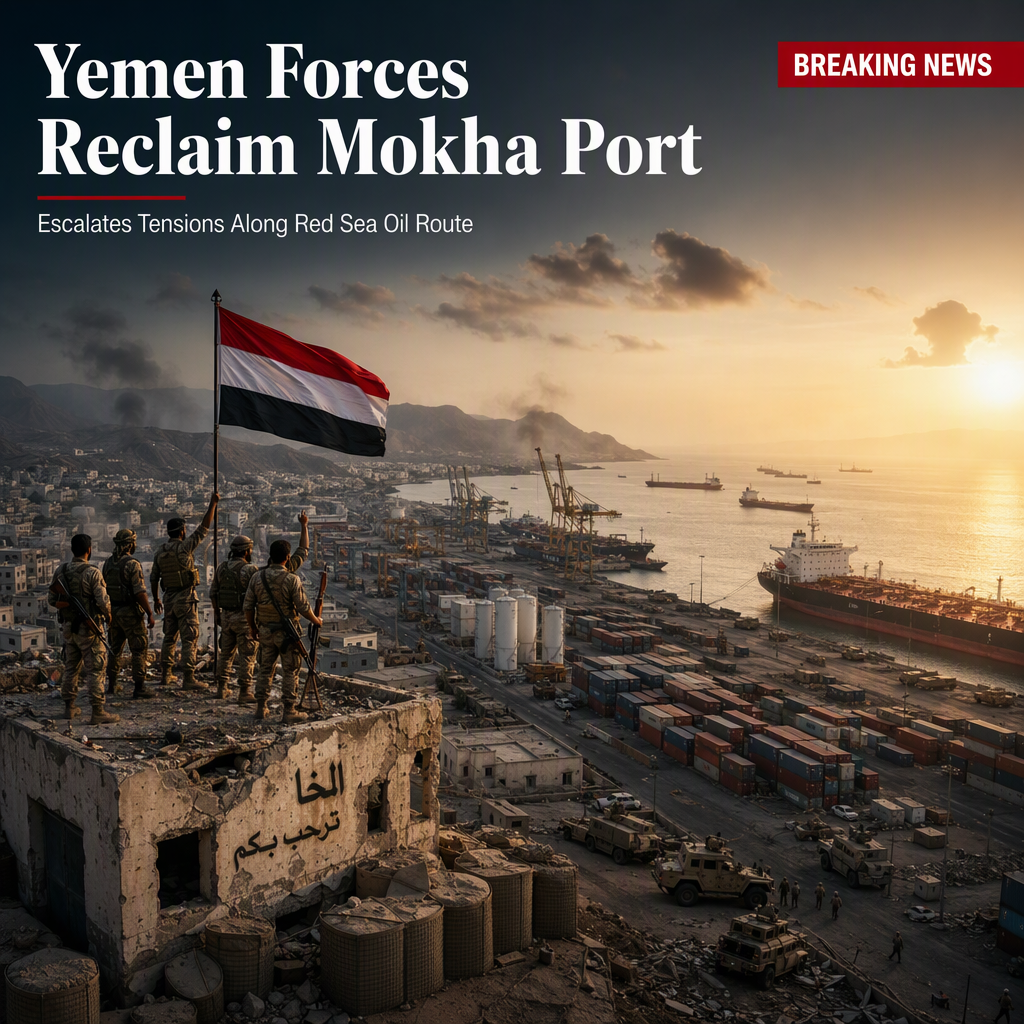
Yemen government forces announced the recapture of the strategic port city of Mokha from the Iran-backed Houthi militia, marking a significant development in the ongoing conflict over control of critical Red Sea oil routes [1]. The government, supported by Saudi Arabia, stated that its forces had taken Mokha following intense battles and had also launched a 'strategic offensive' on Sanaa, the capital held by the Houthis since 2014 [1]. However, the Houthis have reportedly denied that Mokha had fallen, and CNBC could not independently verify the claims [1].
Mokha, located approximately 75 kilometers north of the Bab el-Mandeb Strait, is a historically significant port and was seized by the Houthis in early September, which previously raised concerns about their potential control over the vital maritime chokepoint [1]. The recent recapture is seen as an attempt to loosen the Houthis' grip on this crucial oil route [1].
In response to escalating tensions, Saudi Arabia, Turkey, and Pakistan agreed to activate 'deterrence measures' and rapidly deploy forces to support Saudi Arabia and counter Houthi attacks in Yemen. This agreement followed an emergency meeting between the countries' defense ministers in Riyadh, emphasizing a unified commitment to collective defense [1]. On the same day, two airports in Saudi Arabia (Jazan and Najran) were targeted in attacks, injuring three people and causing limited damage, according to Saudi Arabia's aviation authority [1].
The ongoing conflict and Iran's closure of the Strait of Hormuz have already unsettled energy markets, with oil prices slightly lower on Tuesday morning as market participants closely monitor the situation. International benchmark Brent crude futures with December expiry traded 0.3% lower at $100.12 per barrel, after briefly dipping below $100 earlier in the session [1]. Analysts suggest that energy market nervousness is 'likely to persist' amid the sprawling Middle East conflict, which began with U.S. and Israeli strikes on Iran in late February [1].
CONCLUSION
The recapture of Mokha port by Yemen government forces marks a significant shift in the control of key Red Sea oil routes, intensifying regional tensions and prompting coordinated military responses from Saudi Arabia, Turkey, and Pakistan. Despite a slight dip in oil prices, market uncertainty is expected to continue as the conflict evolves and critical energy infrastructure remains at risk.