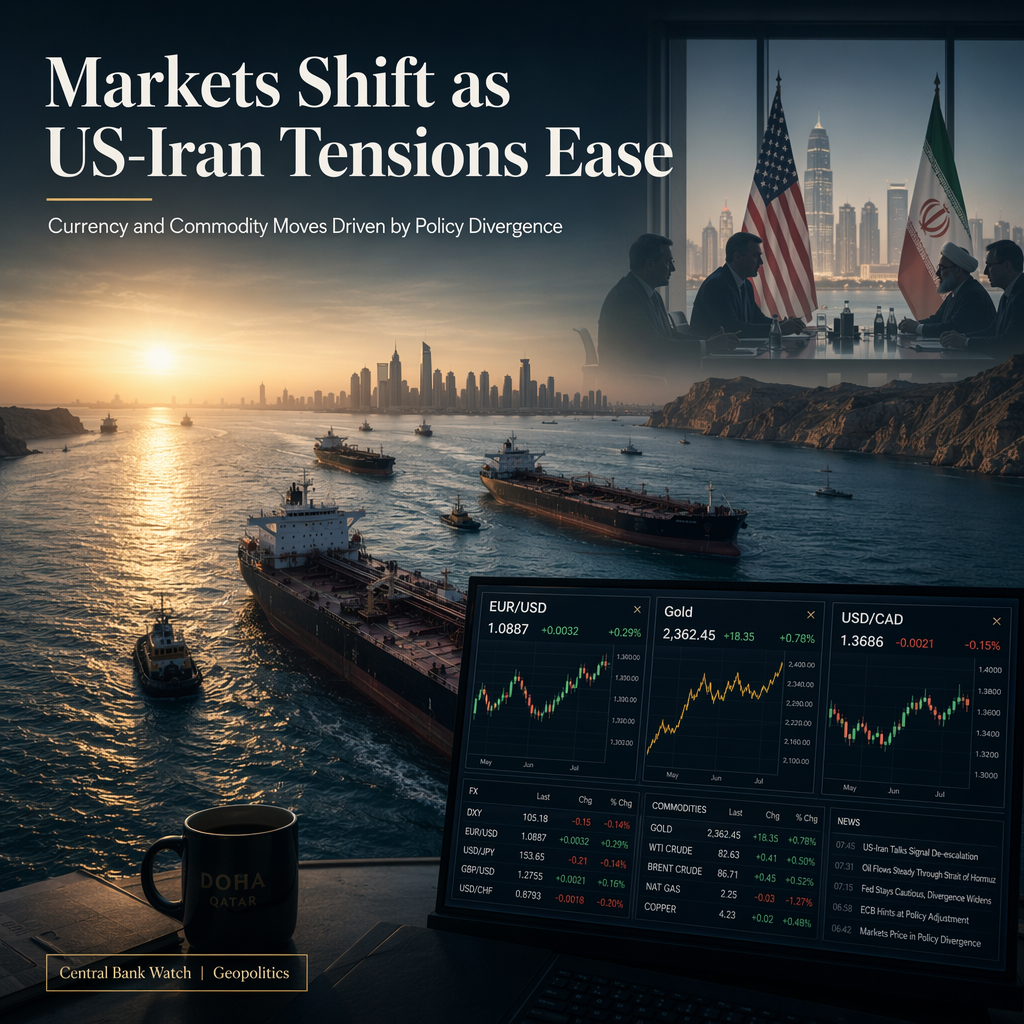
The core event across all sources is the recent de-escalation of tensions between the United States and Iran, particularly following strikes near the Strait of Hormuz, and its subsequent impact on financial markets. US and Iranian officials have agreed to stand down on attacks to allow vessels to move freely, with negotiations set to resume in Doha on Tuesday [4]. Iranian President Masoud Pezeshkian has called for the release of $6 billion of Iranian assets frozen in Qatar as a confidence-building measure ahead of these talks [4]. Despite the easing tensions, Iran's Foreign Minister Abbas Araghchi warned that responsibility for the Strait of Hormuz remains with Tehran, keeping investors alert to potential supply disruptions [4].
In the currency markets, the Euro (EUR) has shown a corrective rebound against the US Dollar (USD), trading near 1.1400 after briefly spiking to 1.1434 before retreating [1][2]. The EUR/USD pair remains contained below resistance at 1.1430, with a broader bearish trend intact and initial support at the 13-month low of 1.1320 [1]. UOB analysts report that the earlier selloff in EUR/USD has stabilized, with the pair expected to oscillate between 1.1335 and 1.1470 in the near term [2]. MUFG highlights that the US Dollar Index (DXY) is trading just below year-to-date highs, supported by expectations of monetary policy divergence between the Fed and the ECB, and outlines scenarios for EUR/USD ranging from 1.1400–1.1800 if the Fed holds rates, or below 1.1000 if multiple hikes occur [6].
Gold (XAU/USD) has weakened, trading around $4,050 and down 0.96% on the day, as investors reduce exposure to safe-haven assets following the US-Iran de-escalation [4]. OCBC analysts note that gold may struggle to attract a clear haven bid despite renewed tensions, with shallow rallies expected unless oil prices remain contained or real yields ease [5]. Resistance for gold is seen at 4100, 4160, and 4260, while support lies at 3960 and 3820 [5]. The CME FedWatch tool indicates markets are pricing in a 48% chance of a Fed rate hike as early as September, with attention turning to the upcoming US Nonfarm Payrolls (NFP) report, expected to show 114K jobs added and an unchanged unemployment rate at 4.3% [4].
The USD/CAD pair trades flat at around 1.4193, maintaining a bullish near-term bias above the 20-period EMA at 1.4065, with the RSI at 78.9 indicating overbought conditions and potential for a corrective pause [3]. Investors are awaiting key US employment data, including NFP, JOLTS Job Openings, ISM Manufacturing PMI, and ADP Employment Change, which are expected to significantly impact the Fed's policy outlook [3][4].
Looking forward, analysts from MUFG and OCBC emphasize the importance of upcoming central bank forums and labor market data in shaping monetary policy expectations. MUFG maintains a long USD/NOK recommendation, citing the Fed's hawkish repricing, and expects further insight from the ECB annual policy forum in Sintra [6].
CONCLUSION
The de-escalation between the US and Iran has eased immediate geopolitical risks, leading to reduced safe-haven demand for gold and a stabilization in EUR/USD. However, markets remain cautious, with attention focused on upcoming US employment data and central bank policy forums. The outlook for the US Dollar remains strong, underpinned by policy divergence, while gold and Euro movements are likely to be dictated by further developments in Fed and ECB policy.