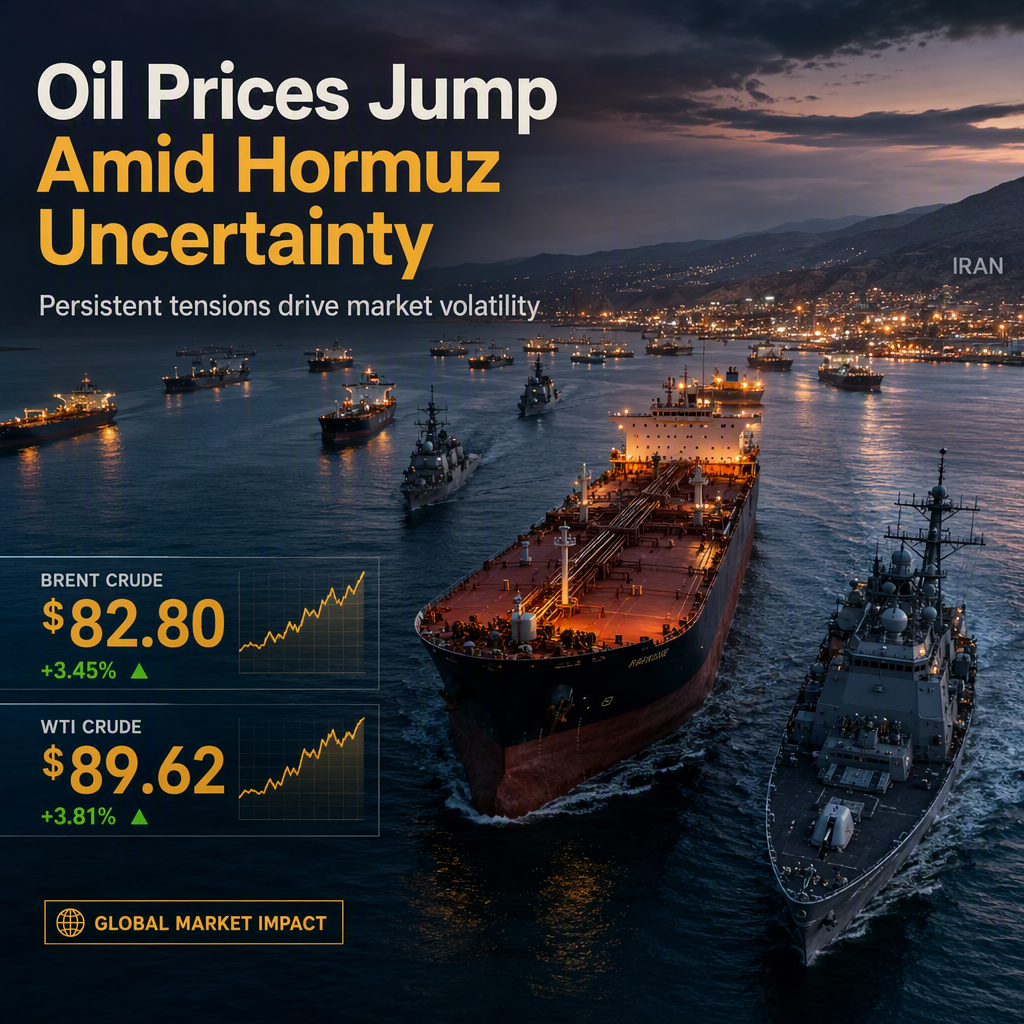
Oil prices continued their upward trajectory as tensions surrounding the Strait of Hormuz persisted, despite U.S. President Donald Trump’s assertion that the U.S. Navy has '100%' control of the critical waterway. Trump stated, 'It's open now,' and claimed the U.S. was 'the only one that has control of the Strait of Hormuz right now.' However, market sentiment reflected skepticism, with ongoing fears and uncertainty driving crude prices higher [1].
U.S. crude prices rose 2% early on Tuesday, building on an over 5% gain from Monday to reach $82.80 per barrel as of 3:53 a.m. ET. Brent crude similarly climbed 2.2% to $89.62 per barrel. The continued rise in oil futures indicates that the supply crunch caused by the closure of the Strait is not expected to ease soon. The lack of an agreement between Tehran and Washington, with prospects for a deal deteriorating over the weekend, has further fueled market anxiety [1].
Jefferies economist Modupe Adegbembo warned that while the current rise in oil prices remains contained, market moves may become less 'benign' if the deadlock extends into the following week. This highlights the potential for increased volatility should the situation remain unresolved [1].
In broader market context, Asian equities traded mixed, with South Korea's Kospi in positive territory, while Hong Kong and mainland Chinese markets declined. The ongoing uncertainty in oil markets is contributing to this cautious sentiment across global markets [1].
CONCLUSION
The ongoing uncertainty over control of the Strait of Hormuz and the lack of progress in U.S.-Iran negotiations have driven oil prices sharply higher. Market participants remain wary, with analysts warning of potential volatility if the deadlock persists. The situation continues to exert significant influence on global markets.