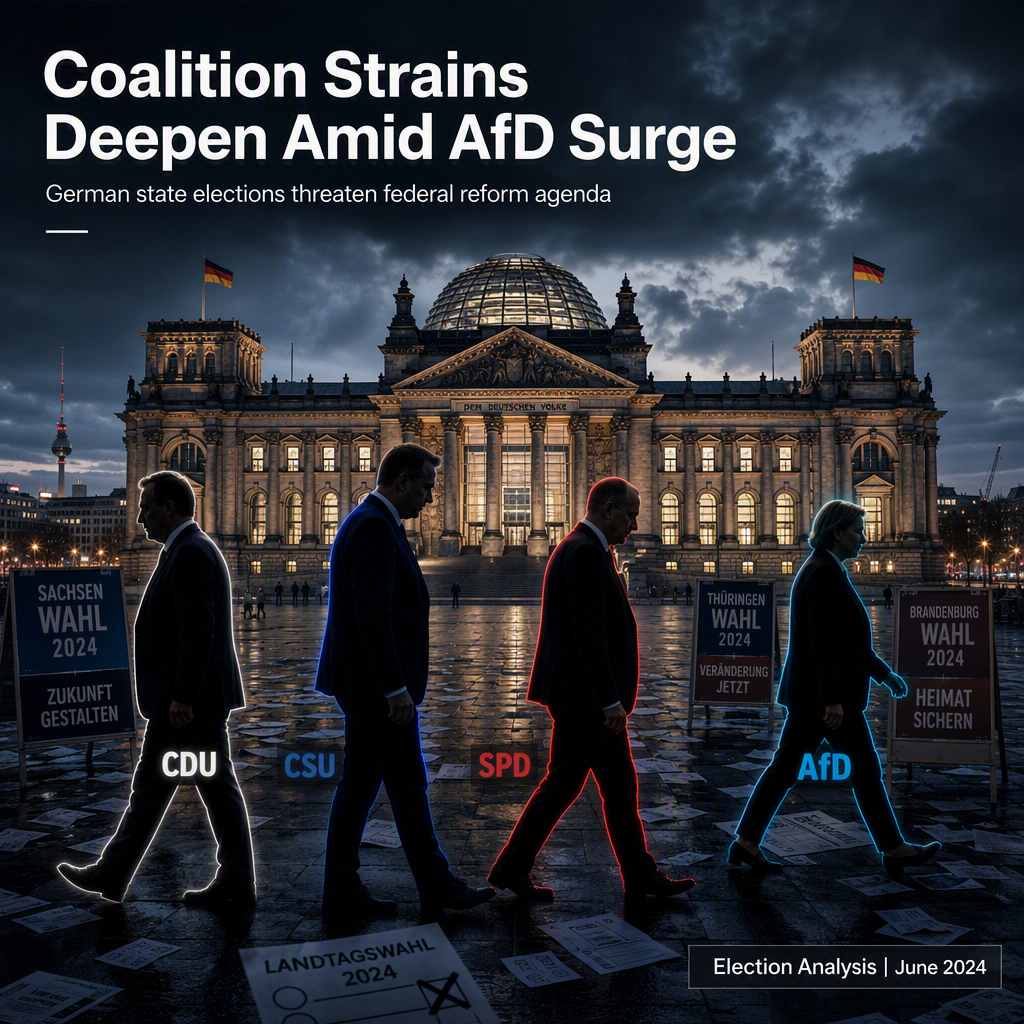
Commerzbank’s Dr. Ralph Solveen analyzes the potential impact of the Saxony-Anhalt election and two subsequent votes in Berlin and Mecklenburg-Western Pomerania on Germany’s governing coalition, comprised of the Christian Democrats (CDU), their Bavarian sister party CSU, and the Social Democrats (SPD) [1]. The analysis highlights that both the CDU and SPD are projected to perform poorly in these elections, which could put noticeable strain on the coalition at the federal level and complicate the passage of planned federal reforms [1].
The rise in support for the Alternative for Germany (AfD) party is cited as a key factor complicating policy responses and coalition cooperation. Dr. Solveen notes that diverging approaches to the AfD’s strength among coalition partners could further hinder reform efforts [1]. Additionally, the possibility of leadership changes within the SPD is mentioned as a potential outcome of the poor election results [1].
Despite these challenges, Commerzbank expects the federal coalition to survive the upcoming elections, though the results in the three Eastern German states are likely to make planned reforms more difficult to implement [1]. The report also warns that if the CDU were to consider forming a minority government reliant on AfD votes, the stability of the federal coalition would be at risk [1].
For financial markets, the short-term significance of these elections lies in their potential to impact the functioning and reform agenda of the current governing coalition [1].
CONCLUSION
The upcoming state elections in Germany are expected to strain the CDU/CSU–SPD coalition and complicate federal reforms, primarily due to projected poor results for traditional parties and the rise of the AfD. While the coalition is likely to survive, increased political uncertainty may challenge the government's ability to implement its planned agenda.