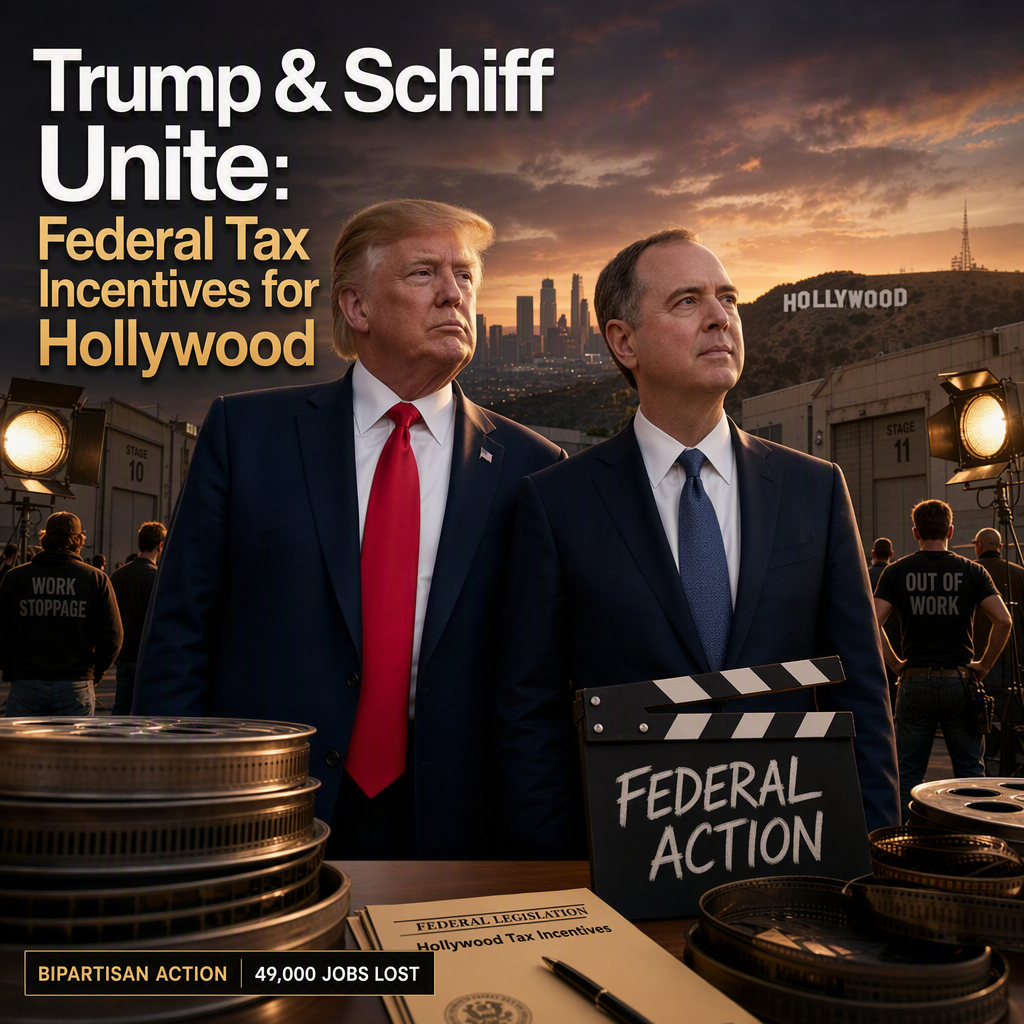
President Donald Trump has proposed new federal tax incentives aimed at revitalizing Hollywood and reversing the significant job losses in the entertainment industry, which has lost 49,000 jobs since 2022 according to the Bureau of Labor Statistics [1]. In a notable bipartisan development, Sen. Adam Schiff, D-Calif., who previously led the first impeachment against Trump, publicly expressed strong support for the initiative, urging Congress to "immediately take up and pass a federal film tax incentive to bring back these good-paying jobs that we've lost to other countries" [1].
Trump's proposal comes after a meeting with actor Jon Voight, the U.S. special ambassador to Hollywood, and calls on both Republican and Democratic leaders in Congress to swiftly craft legislation to "save the Movie, Television, and Entertainment Business in America" [1]. Trump emphasized that the incentive could be implemented "quickly, accurately, efficiently and, importantly, will benefit ALL of America" [1]. He criticized the current state of Hollywood, describing it as a "complete and total disaster" due to productions relocating to other states and countries with more attractive tax breaks [1].
California has attempted to address the issue by more than doubling its Film & Television Tax Credit Program to $750 million, but this effort was undermined by Governor Gavin Newsom's imposition of a $5 million state corporate tax credit cap over the next three years [1]. As a result, California remains behind Georgia and New York, which offer more than $1 billion and roughly $800 million in tax breaks, respectively, as well as international competitors like Canada and the United Kingdom [1].
The bipartisan push for federal incentives reflects growing concern over Hollywood's declining competitiveness and the broader economic impact on the U.S. entertainment sector. No specific market reactions or analyst opinions were cited in the article [1].
CONCLUSION
President Trump's proposal for federal tax incentives to support Hollywood has garnered rare bipartisan backing from Sen. Adam Schiff, highlighting the urgency of addressing job losses in the entertainment industry. While California has taken steps to boost its own incentives, it remains outpaced by other states and countries, underscoring the potential significance of federal action.